

Jennifer van Alstyne introduces a new series on The Social Academic Podcast, conversations with award winners of the Best Personal Academic Websites Contest. Alyssa Sinclair, PhD (Allie), directs the Learning & Behavior Change Lab at Rice University. Allie is a winner of the Best Research Lab or Group Website Award.
Hi there, I’m Jennifer van Alstyne, host of The Social Academic Podcast. This is Season 8, episode 2 featuring Dr. Allie Sinclair. We hope you get inspired with this conversation about her award winning research lab website.
Mentioned in this podcast episode:
- Owlstown, a free academic website builder
- Storyset, for illustrations
- Dr. Echo Rivera, for custom illustrations and data viz (she appeared on our last episode, check it out!)
View the Best Personal Academic Websites Contest award announcement. Get inspired for your own personal academic website.
Subscribe to The Social Academic blog.
The form above subscribes you to new posts published on The Social Academic blog.
Want emails from Jennifer on building your online presence? Subscribe to her email list.
Looking for the podcast? Subscribe on Spotify.
Prefer to watch videos? Subscribe on YouTube.

Interview
Jennifer van Alstyne: I am so excited to introduce a new series on The Social Academic Podcast. Hi everyone! I am Jennifer van Alstyne, and this podcast is all about online presence for faculty, researchers, scientists, graduate students. If you’re in higher ed and you’re hoping to have more intentional and meaningful online presence for yourself, this podcast is for you. I’m really excited to introduce my guest today because this series is all about the Best Personal Academic Websites Contest and ways that different folks in academia are representing what they care about and their research online.
Dr. Allie Sinclair, would you introduce yourself for folks?
Dr. Allie Sinclair: Sure. Hi, my name is Alyssa Sinclair, but please call me Allie. Everyone does. I’m currently the Joan Bossert Postdoctoral Research Fellow at the University of Pennsylvania, but I’ll be starting my own lab as an assistant professor at Rice University very soon this summer. And so the lab website that I created was in advance of that to help me sort of refine my vision and recruit students this past year.
Jennifer: I’m curious about when you first started dreaming about your website, is this something that you always knew would come? Did you wait until you knew you were going to have your own lab before you made it? What was the kind of process like to really envision this for yourself?
Allie: Yeah. I mean, I had dreamt of staying in academia and starting my own lab for years. And in some sense, I always kind of dreamt of creating the website, but I was a little less clear on sort of what the vision of it would be. It wasn’t until I had accepted the offer and started thinking about how I wanted to create a presence, not just for me, but for my research group that I started really thinking concretely about what aesthetically I wanted to show, what key ideas I wanted to convey and what kinds of features I wanted to be available for people when they came to the website.
Jennifer: That’s great because I feel like some people worry that their website is going to be all about them. But what you’re sharing is that it’s really about the team, it’s about the research you’re doing as a group and the things that you want to see in terms of change in the world. I like that your website is pretty open about your research. And I realize folks who are listening to this probably don’t know about your research. Would you tell them a little bit about what your hopes are for the lab?
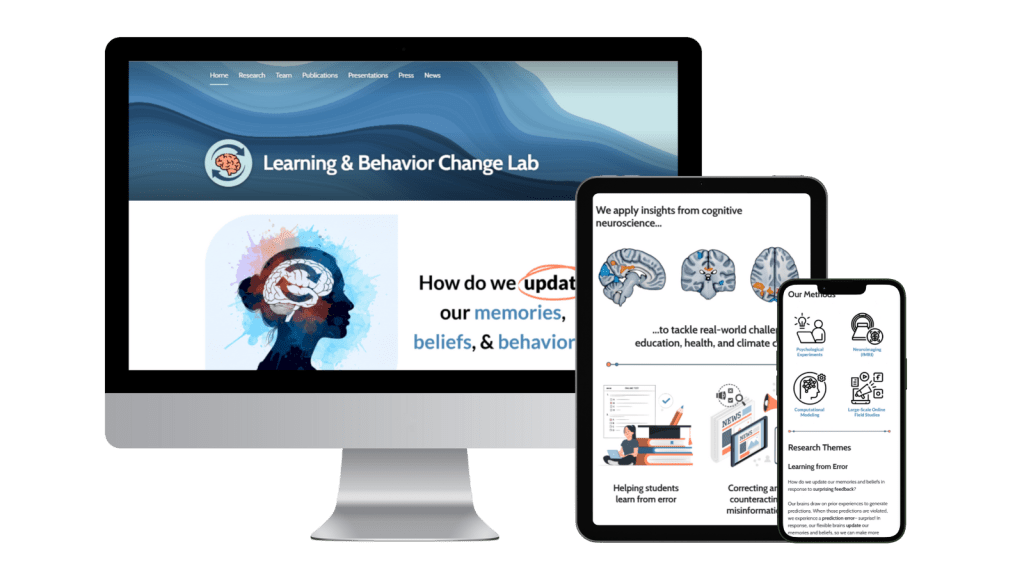
Allie: Sure. Yeah. My background is in cognitive neuroscience. I study learning and memory, but also how those adaptive learning processes can translate into updating beliefs and changing behaviors. How we make better choices in daily life. For that reason, my work really crucially bridges the basic mechanisms of how the mind and brain work with real world applications. We want to know, given what we know about the mind and brain, how can we design interventions that help people change their behavior or learn from feedback, update misconceptions and beliefs that they might hold? And some of the work that we do relies on methods like neuroimaging to see what’s happening in the brain while people learn or make choices. And then we apply those insights to real world interventions and ways to motivate behavior change, to help people make healthier choices in daily life or to help them take action in ways that would be good for the environment to help address climate change.
Those are some of the things that I do. Because of that, I was especially motivated with the website to make my work very accessible to a broader audience. Because the work that I do is societally relevant, I want to make sure that we can communicate that science effectively and not just to other people who are experts or within the ivory tower.
Jennifer: Some people kind of get stumped at that point. They’re like, “Well, I do want to be more accessible. I want to reach more people. I’m not sure who I want to reach.” Can I ask who are some of the people, in maybe the general public outside of experts in the ivory tower who you’re like, “Oh, I know people need this research. These are the people I’m hoping will come to my website in future years.”
Allie: Yeah, it’s tricky because the website is supposed to serve multiple audiences who might want to engage with it in different ways. I don’t know if I did that in a perfect way, but the strategy that I took to try to make it more inviting when you first arrive. To have colorful aesthetics and illustrations that help people understand the core concepts or the application domains that we explore, as well as plain language information that can help people quickly understand what it is, what we do and why it matters. But then I also want to provide more information for the people who do want to engage deeper, like prospective students who might want to join the lab or colleagues who want to engage with my research on a critical or scientific level. Starting with the high level concepts, I then kind of drill down where people can go and seek out information that’s relevant to them.
For example, on the publications page, I let people click to filter through to particular topics or particular application domains to just see the papers that are most relevant to what they posted in. I’ve also got some featured papers there. So if you don’t know where to start, there’s already a few things that you can see to kind of get a taste of what the lab is about and what we do.
It’s a choose your own adventure situation.
Jennifer: I love it. I feel like that kind of intention upfront is so helpful, not just for folks like future students who are going to be joining your lab, but for the people who might collaborate, the people who want to share your research, the people who really want to introduce you to new people. So beneficial.
Allie: Yeah. And the work that I do also tends to get some press coverage, in part because we talk about these real world challenges that are relatable and important for society. And so I want to make sure that the work that we do is accessible for people who might want to write a story about it as well.
Jennifer: Is it only people who want to write a story? Are you open to podcasts and maybe be on YouTube or TV or anything like that?
Allie: Well, this is a podcast right now, so I guess I’m open to podcasts. But yeah, in general, I have done other … I’ve done interviews for radio, I’ve done some podcasts before, even a couple of short TV segments, not as many for those. And then of course there’s also work where people have read a paper and either interviewed me about it and then written up a piece, or just gone ahead and directly written up a piece about some of the work that we’ve done without talking to me personally.
Jennifer: That’s exciting. I love that. And I feel like because your work is so societally relevant, it’s really nice to have that website where media can come visit, learn about you, and even write that story without you needing to necessarily be input at every moment. I think that’s quite nice and something that folks don’t often recognize is a benefit from having a website.
Allie: Yeah, I think it very much is. When I was a PhD student, I already had created a website that was for me personally, more of a simple digital CV, but I often did find that was useful. When people would reach out, they were interested in covering one of my recent articles in a news story. They could find me easily because of the website, find my contact information, discover what else I did. For example, I would have people reach out because they had seen one new article that come out and then they would mention like, “Oh, and then I looked on your website and saw that you’ve got some other related articles and this one was interesting to me too.” And now they want to talk to me about multiple things.
Jennifer: That’s perfect. And I feel like that’s such an invitation for people to explore more. It’s not as overwhelming as sometimes people expect and they’re like, “Oh, I put everything on there and it’s too much,” but actually that’s what people get to then choose what they explore and what they find really engaging. I would love to chat with you a little bit about the graphics, about the colors, because I feel like you were quite intentional with how you show up in terms of the visuals on your website. What did you love? Did you try anything that didn’t work?
Allie: Yeah, thank you. I definitely was intentional about it. I wanted to have an aesthetically pleasing and colorful website, something that’s got a little bit of whimsy to it I guess, in addition to providing the factual information about the science. I relied quite a bit on resources from a site called Storyset. They have free illustrations that you can check out. All you have to do is just credit them, but you can download these, reuse them and modify them to your liking. Essentially what I did was I went and browsed for illustrations they had that were related to particular concepts, like maybe students learning in a classroom or climate change. And I often found that none of them were really what I was looking for, but because you can download them as vector graphics, I could customize them however I wanted. Many of the illustrations that you see on the website were heavily modified by me by hand.
I would find multiple illustrations from Storyset that each had some element that I liked. Then I would download them, tweak them in Illustrator and copy and paste, merge from across illustrations. And I also wanted them to feel cohesive. I recolored all of them to the color palette that I created so that it would look like they all came from a set, although they don’t actually exist as a pre-made set out there in the wild. I kind of tailored them to illustrate exact ideas that I wanted to show.
Jennifer: I’m so glad I asked that because that is absolutely beautiful. I have not heard of that level of visual intention for a very first website for your lab. I think that is so nice that you knew this element is not, it’s not quite right. It doesn’t have all the things that I need and you found other ways, creative ways to bring it together. And for anyone who’s listening, I imagine that there’s some folks out there that are like, “I don’t know how to do that.” There are people who can support you with that process if you’re looking for customized illustrations for your site. I’m not one of them, but Dr. Echo Rivera, who was my guest on the podcast last week, she does custom illustrations for folks. If you ever need something and you’re not wanting to do it yourself, just know that there are people out there to support you too.
Allie: That’s great. And Storyset makes it very easy. You don’t have to go to the level of customization that I did, but if you go directly to their website, you can browse for illustrations and you can already customize the one primary color in them or toggle how much detail you want in the background or icons floating around and things like that. I’ll often use their content for talks as well. Typically then I don’t have quite as much time or perfectionism motivating me. And so I will be more likely to just grab a mostly relevant illustration that they have and that’s much easier, a lower barrier to entry I think than what I ended up doing for my own website, which was creating these more bespoke illustrations.
Jennifer: My next question is more about feelings and emotions. I feel like there’s a lot of people who at the start of their website project, they might be nervous or have some anxiety, maybe excitement, but we don’t often got to talk about what it feels like to actually have your website out in the world be representative and intentional for what you want people to know. I’m curious how it felt before and after for your website.
Allie: Yeah. Before, I definitely felt kind of daunted by it or uncertain. I knew that it was important for me to create one, but I felt like I wasn’t sure what I wanted the core message to be. What’s the first thing you see when you arrive? How exactly do I want to pitch my lab? I hadn’t even chosen a name for my lab yet. And there was a lot of uncertainty of thinking through this brand that I was creating that was more than just me as an individual, but for my research group. Afterwards, I was really pleased with how it all came together. It felt like a good expression of my research identity. I was excited because it was kind of a way of introducing this new group to the world and of encouraging applications from students or lab managers, people who might want to join my lab.
And so it was a way to kind of announce that and celebrate the work that I had done and the start of something new.
Jennifer: Thank you for sharing that. Celebrating something, the start of something new. When does it start? It sounds like this summer, is that correct?
Allie: Yeah. I accepted my offer last year, but I deferred a full year, which is why I had this time to make the website and recruit students and so on. I think I would’ve been a lot more panicked about it if it had been starting right away. Perhaps I wouldn’t have made all those custom illustrations, but because I had that time, I sort of had a longer runway and some space to breathe. But yeah, I’m officially starting July 1st, but we’ll be moving in about a month now. It’s coming fast. Yeah.
Jennifer: Oh, I’m wishing you all the best for the start of everything.
Allie: Thanks.
Jennifer: I’m curious, if you have a message for someone who is maybe at the start of that process, maybe their lab is coming in the fall and they’re thinking, “Do I need a website now? Should I wait until I am there on campus?” Do you have any messages or advice for them?
Allie: Yeah, good timing because now is the time of year when a lot of people are getting or negotiating faculty offers. Congrats to everyone who just found out that they’re starting a new lab. I would say if you can find the time to do it over the summer, I strongly recommend that. I think especially now as I look ahead to the next fall, I’m going to be teaching a new class for the first time. I have other things that are going to be on my plate and other things that I’m worrying about. Especially if you are in STEM in particular and you’re planning to recruit students for your lab, you would probably want to be advertising that right away and people start thinking about opportunities that they might want to apply to over the summer. And so having a good web presence to first, reaching out to your new department, making sure that the faculty profile page for you because I had to initiate that process.
They were a little slow to get that going. Making sure that you have a digital presence for the department and then also having something for your research group. I think it’s really valuable to show people that you are in this new role, that you are recruiting people to join your research group and that you will be available for opportunities at your new institution.
Jennifer: Ooo, I really appreciate that. Especially the tip about creating that faculty profile or even updating it. Sometimes the person who usually updates it has changed positions or schools or maybe they’re no longer there and it’s someone else’s duty. And even figuring out who to go to for updates can sometimes be a challenge. Good to start early.
Allie: Yeah. Especially tricky when you’re navigating a new institution where you don’t know who to contact, right? Yeah.
Jennifer: Exactly, exactly. Mmm. I feel like this podcast episode is a thousand percent reaching people who both don’t want to do their own website and people who do. There’s a lot of people who are unsure. I’m curious about what helped you know you wanted to create it yourself as opposed to getting support.
Allie: Yeah. I felt like I wanted to do it myself in part because I have a creative streak. I enjoy drawing and painting some things. I like choosing colors and whatnot. I have an eye for aesthetics. It felt like something that would be fun for me and rewarding in addition to being a lot of effort. And it was something that I was kind of excited to tackle on my own as opposed to just outsourcing it. There’s also the cost factor, right? If you were to hire a designer, that could be quite expensive. Although of course it depends on who you contract and what exact services you require. But that was something that was on my mind, especially because I’m a junior researcher. I hadn’t actually started my lab yet. I didn’t have access to my startup funds yet. All of those factors that led me to think about what I felt that I would be able to do on my own.
Jennifer: I think that’s such good advice for folks who are out there who are like, “I am starting a lab in the fall and I don’t have access to my startup funds. I want an online presence going in.” You can start a website now, maybe with Owlstown, which is really quick, free, easy to set up. You could use something like WordPress.com, which is my favorite, but there’s options for you to do this yourself and resources to help you on The Social Academic blog. Please check out all the free stuff that will help you create your website. If you want to start now, do it. You don’t have to wait until you’re actually there.
Allie: Yeah. I checked out multiple options for website builders and ended up going with Owlstown in part because I really liked how easy it was to go from zero to something, like a minimal viable website. You could do that in half an hour, which is incredible. And I also really liked that it was explicitly tailored for academics. For example, its got features where you can look yourself up on PubMed and it’ll find just auto-populate a publication section for you, which is amazing. Or for example, other things, like if you want people to be able to download a PDF of an article or search through to filter a list of publications by some keyword. It made it easy to do that. Those were features that I’d already been looking for and to implement. And when I tried with other builders like Squarespace, [I couldn’t] figure out how to make it work.
And so when I saw that, even though Owlstown can be a little more limited in terms of customizability in other ways, the fact that those sort of functional aspects were there and really tailored to academics was really appealing to me.
Jennifer: I really appreciate that you said that about the customization because one of the things that I love about Owlstown is I’ve gotten to see the progression of it since, almost since it started when I first met Ian and we started collaborating on the Best Personal Academic Websites Contest. It’s almost like all of the people who create websites and then their needs help inform the new features and iterations of what Owlstown offers. And I’ve recommended this as a website builder to so many people, even people who come to me and they’re like, “I want a done-for-you website.” When we talk, if it’s something that’s simple that they could get up today, I’m like, “Don’t hire me. You can go do this yourself and it’ll be quite a bit easier than you expect.” I’m curious, when you were customizing your Owlstown website, is there anything that you were like, “Oh, I would dream about if we could add this feature in the future,” or something else that you’re thinking about adding to your website maybe once your lab is up and going?
Allie: Yeah. I mean, there were already some features that I, Ian is very nice and very responsive. I had reached out to him about a couple of things. For example, just off the top of my head, I was having an issue at one point where some high res images were not loading properly. And so I reached out to him. He was immediately on it, super responsive, and he’s made a number of improvements, both to sort of buggy things like that as well as just new feature requests. That’s been great. It’s already improved and grown a lot, I think. I will say when I first started trying to design my website, I was mocking it up in Squarespace and they had really nice modern landing pages where it can take the full width of the screen. They’re animated elements that flow in. I really liked that.
And that was something I chose to give up when I decided to move to Owlstown instead. And that was for the more practical features like the publication related stuff and whatnot. But I would love to see the ability to do that kind of glossy, interactive, modern website feeling on Owlstown in the future. That would be really cool.
Jennifer: Very cool. I’m so glad that we had this conversation because celebrating websites like yours, I think is really important to help other people be able to see themselves in that space. It’s okay to take up space online. It’s helpful for other people, not just yourself. It can be really a lovely way to start your lab or to create community within a place that you are already belonging. I am wondering if there’s any closing thoughts that you’d like to add before we wrap up today.
Allie: I don’t think anything else comes to mind for me.
Jennifer: Great. How can people visit your lab? I realize I don’t have the name up on the screen.
Allie: Yes, it is SinclairLab-Rice.com
Jennifer: Yay! Thank you so much for coming on The Social Academic. Dr. Allie Sinclair, I’m wishing you all the best as you get your lab started this summer.
Allie: Thank you so much, Jennifer. It was a pleasure to meet you.
Subscribe to The Social Academic blog.
The form above subscribes you to new posts published on The Social Academic blog.
Want emails from Jennifer on building your online presence? Subscribe to her email list.
Looking for the podcast? Subscribe on Spotify.
Prefer to watch videos? Subscribe on YouTube.
Bio
Alyssa (Allie) Sinclair, PhD (she/her) is currently the Joan Bossert Postdoctoral Fellow at the University of Pennsylvania, affiliated with the Annenberg Public Policy Center. She is also an incoming Assistant Professor in the Department of Psychological Sciences at Rice University, where she will direct the Learning & Behavior Change Lab.
Sinclair is a cognitive neuroscientist who studies how people update their memories, beliefs, and behaviors in lab and real-world settings. Her expertise spans learning and memory, belief and behavior change, affect, and information consumption. Sinclair completed a Ph.D. in Psychology & Neuroscience at Duke University, postdoctoral training at the University of Pennsylvania, and an Honours B.Sc. in Psychology at the University of Toronto.

