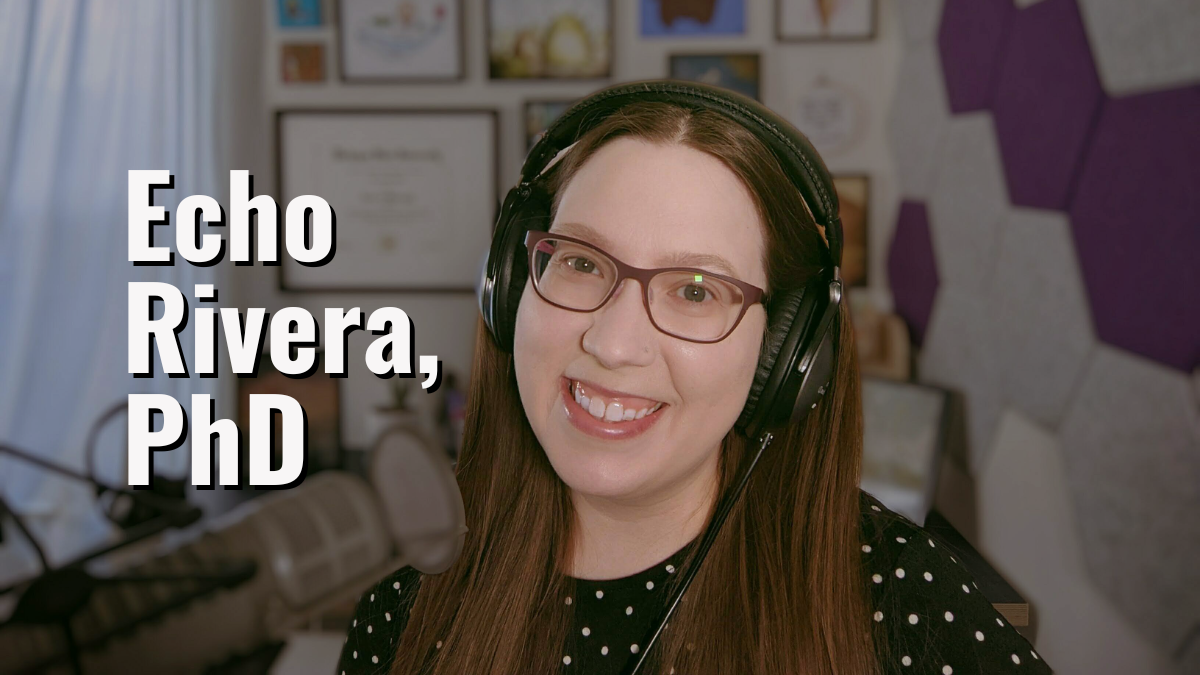
Communicate your research through data visualization and presentations. Learn how to create highly engaging slides for your research (or have them created for you) with Echo Rivera, PhD.
In this episode, Research Communications and Slide Design with Dr. Echo Rivera:
- What inspired her to build presentation design skills as a level 10 introvert
- How you can build your capacity for presentations and research communications
- Echo’s book in progress on job talks for academics and researchers (Want to be a beta reader? Reach out!)
- Ways you can work with Echo (done-for-you services + her professional development program)
- Considering space for sharing her hobbies online
This episode was broadcast live on March 2, 2026. Thank you! A full transcript will be added to this blog post when it’s ready. In the meantime, watch or listen on YouTube, Spotify, and Instagram.
Check out our past episodes of the podcast (2019, 2020).
Interview
Bio for Echo Rivera
Read our guest’s bio.
Ways you can work with Echo
Download Flyer
Download Presentation Support Flyer
Jennifer: Hi there. I’m Jennifer van Alstyne. Welcome to season eight of The Social Academic Podcast. I’m super excited because my guest today is a longtime friend. Let me just check the Instagram feed to make sure that we’re all set.
Echo: Hello, hello, hello!
Jennifer: Yay. I’m so excited.
Echo: I’ll do the little live dance.
Jennifer: Oh, here it is on Instagram. I’m going to hit go live. Perfect. Okay. Now we’re live on YouTube. We’re live on Instagram. And for anyone who is just tuning in for the first time, that is how this show gets shared. It’ll also go up on Spotify later. Stay tuned for more ways to engage with The Social Academic.
Echo, I feel like you were my very first live guest and this was five years ago.
Echo: No.
Jennifer: Yeah, 5+ years.
Echo: No, I refuse to believe that.
Jennifer: We’ve done collaborations since then, but our first time live on YouTube was five years ago. And actually we met online.
Echo: We did.
Jennifer: You reached out to me.
Echo: I did. I totally remember that, yes [laughs].
Jennifer: I am curious about how you felt about building relationships and friendships online. As someone who’s really introverted, I find that’s mostly the way that I connect with people. Is it similar for you?
Echo: Oh yeah. Just in case people don’t know this about me, I mean I’m out there talking about public speaking and putting yourself out there, but I’m coming from level 10 introvert. I could just be inside all day long, never leave the house. I’ve got my books, I’ve got my games. I work from home, all that good stuff. Yeah, I think a lot of my friendships have been formed online and maintained online. So that, my life is very online and remote and meeting people and connecting with people across the world as a result, which is super cool.
Jennifer: I love that. And you’ve been on social media a little bit less in the past year. I would love for you to do an introduction for yourself and share with the researchers and academics who check out this podcast, what your work is about and how you can help them.
Echo: Yay. Hello. I’m Dr. Echo Rivera and I help academics and researchers and evaluators and basically people in STEM create engaging presentations. That is the primary thing that I’m here to help with.
I am trying to end death by PowerPoint in every discipline across the world. Our class lectures, our conference talks, our keynotes, our book, whatever we’re doing, let’s do it in a way that captivates people, our students, our colleagues, and just really helps them understand what we’re saying and actually makes an impact. Let’s be memorable. Let’s just share our work in a way that makes that lasting impact. That’s the primary thing that I do. And then more like generally, I’m just in general interested in visual communication. It doesn’t just have to be presentation or slide design. It can be reports, infographics, social media graphics. I did a science comic once, which was amazing.
Just anything that is creative and is in that research, communication, evaluation, communication, that whole world that academics kind of find themselves in. We don’t have to just do this in a boring way. We can do this in a fun, creative way. And that’s kind of all I’m about. Let’s make this fun, interesting and exciting.
Jennifer: Okay. That was such a warm introduction. I feel like if I didn’t know you, I would be like, “Ooh, I really like Echo.” I feel like you’re so my type of person. But one of the things that I find really interesting about you is that, I mean, you’re good at a lot of things, but you really felt like presentations were something that you hated and you formed an entire business to help you and other people get really good at making decisions when it comes to presentations so that it’s a skill that you have capacity to build and not a headache or a big thing on your to- do list that you’re not looking forward to. Tell me a little bit about what it’s like to move from that place of really disliking presentations to the feelings of being like, “Wow, I could do this.”
Echo: Hmm, yeah. Even some extra backstory here, especially for people who are new. This actually came from a place of intense public speaking anxiety. This whole thing started because I was terrified of public speaking. I would throw up in the bathroom. I would lose sleep. I would shake and you’d hear my little note card. This is like index card stuff. My index cards would be shaking. I’d be terrified of public speaking. But towards the end of undergrad, it was like, “Well, this five minute class presentation is just destroying me, but I want to be an academic. How is that going to work? I’m going to need to do conference talks. I’m going to need to teach a class. I have to figure this out.” It actually kind of, it came from that and I didn’t do Toastmasters or anything. That was the big recommendation at the time.
I just did, that’s a whole other story, but I basically, I made it as creative as possible. That’s where this whole being creative came in: I told stories, I used visuals, I used lots of animations, which I’ve changed on what I recommend for that. But I started off using every animation possible, but that was just the beginning. And I was just using it as a creative outlet. And then people started complimenting me and saying things that I didn’t believe at first, like, “That was the best presentation I’ve ever seen.” And I’m like, “Oh, they’re just being nice. They know I’m nervous. They’re just being nice.” But over a time that kind of sank in and it became a source of not just a creative outlet for me, but also a source of seeing in real time that I am actually having an impact. Having people actually listen and nod and go, “Whoa.” And that kind of thing in real time and having people, even my chair and professors when I was a grad student coming to me and being like, “That was amazing.
What’s going on here?” And so it became a source of joy for me. And so I wanted to sort of spread that around. I wanted everybody to experience that because a lot of people dread and hate public speaking. A lot of people dread opening a PowerPoint or Canva or whatever. And I used to, too, but now it’s fun and that’s what I want. I want people to have so much fun working on their slides. I want people to be putting together something and then they giggle to themselves like, “Oh, I can’t wait for my audience to see this!” Moments like that. And then when you deliver it live and the audience reacts the way you want, I mean, there’s just like, that’s magic. And so that’s what I want.
Jennifer: I just want to say, this is the year of AI. And so I went to a presentation earlier this year and I saw an AI presentation, that they did the presentation in AI and I was like, “Oh, that was slightly better than I expected.” It’s not good, but it’s actually, it’s better than I expected. I worked really hard. She gave me all her advice on how she did this. I worked really hard with Gemini and Canva AI to make a really excellent detailed, thorough prompt that was supposed to create a presentation that was at least workable, like I could just change some things. And it gave me five examples of crap. It was just five really s****y presentations. And I did a lot of upfront work to see how this would test because I was curious. Is this something that has become a lot easier since I learned how to do presentation slide stuff from Echo?
And the answer was, no. It would have made my work 10 times harder to start from a shitty place and work my way back to fix all of the things that the AI messed up. And I thought, oh my God, this is literally the time when people need to recognize that these skills, it’s not something that AI can take over, but if we have the options on our brain, those decisions, they don’t feel hard. It feels like something that’s doable even in less time than people expect. It’s not Echo saying, “Oh, you have to spend more time on presentations.” She’s saying, “If we build our capacity, if we build our skills, that time we spend on presentations will be more focused, more productive and highly more effective than it would’ve been otherwise.” I freaking love that. Echo, you have a course, you have a whole program where people can learn how to do it themselves.
You have a huge library on YouTube where people can get tutorial videos and now you’re working on a book. I want to hear about the book because that is so exciting to me.
Echo: I’ve been wanting to write a book forever and this is like, I’m so excited to finally be here in this process. And I’m hoping to write more, but this first book is about job talks, academic job talks. I want this to be a short guide to help people, whether they’re early career, mid-career, late career, basically just everybody, I want to help them out with that very scary, intimidating, confusing, weird talk that they are going to have to give as part of the academic hiring process. Yeah, that’s been my big project so far over the last couple months.
Jennifer: That is so cool. One of the things that I feel like people have a hard time with when they’re writing books is actually talking about the book that they’re writing while it’s in progress. But you actually reached out, you have a couple beta readers for your book. Is that right?
Echo: Yeah. I want to go through a beta reader process. if you are watching and if you are somebody, I hope I could do this, I hope you don’t mind, but if you are somebody who gives advice to people who are going through their job talk. Like maybe you’re a chair and it’s your mentees or it’s part of your position at the university. I’ve had a couple of people in those different spots already reach out. But if you are mentoring and you are giving advice, I’d love you to be a beta reader. And of course, if you’re actually putting together a job talk, I would love for you to be a beta reader. Yeah, I really, I’m going to write the draft, get that first draft as good as it can be. And the reason I’m writing a book is it’s based on a lot of the one-to-one work that I’ve done with clients on their job talks.
I’ve based it on past work over, I don’t even know how, like seven years by now, eight years. I don’t even know how long. It’s been a long time. It’s been a long time of helping people with their job talks. And I could see the patterns of which ones are successful, which ones aren’t, and that kind of thing. And so all the best advice is going into this book, but I also want it tested, like pilot tested basically. Yeah, I’m seeking beta readers and just to make sure that it’s clear, people get the suggestions and that kind of thing. And I want it to speak to different fields. My PhD is in psychology, but I help people across STEM. And so I want it to speak to different industries. I want it to speak to early and mid and late career people.
I kind of want it to reach all these different situations. There will be links and stuff if you’re interested in being a beta reader.
Jennifer: Do you help people outside of STEM, like in social sciences, humanities, medicine?
Echo: Yes, definitely. Yeah, psychology, social sciences, like hello. That is my background. That is definitely my field. Yeah, humanities, historians, linguistics. I mean, I’ve worked with people from so many fields. I literally had to sit down and list out all of the fields on my website. Yeah, social sciences, you’re fully welcome in addition to basically across the fields. medicine. I’ve worked with people in law, law professors. Yeah, if you’re a professional in academia, we could work together. I got you.
Jennifer: I love this. Okay. I feel like there’s probably going to be some people who are listening that maybe have a job talk coming up. They can’t wait around to be a beta reader for your book, even though it’s going to be amazing. That is future support. I’m curious, is there a way they can get help from you now?
Echo: Yeah. Right now I do one-on-one services. I do sort of the full range of services. You can learn the skills from me. I teach you through an online course. Professional development is there. You can learn these skills. We can also work together. We get on Zoom, we workshop your job talk, I can look at drafts, I can edit the script, give feedback on the script, because it’s not just slide design that I help with. I do want to make that clear. I help with what you’re, I call it the storyboard: what you say, the level of detail, how you frame it, what order you go in, what you don’t say, what you choose to leave out, which is, that’s a hard one. That’s a hard one. One person called me a thought partner. It’s kind of like that.
We’ll think through your script together and what you say. We could do that together. And then of course I offer done for you services where if you just hand it to me and then I can design your slides for you and that kind of thing. I could help with sort of just anything. Wherever your energy level is, whatever time you have, whatever your capacity is, I work with a range of budgets. We could work it out, we could figure it out and I can help. But for job talks, most people do multiple one-on-one sessions that includes some time for me to review or edit drafts of the slides or the script. So that’s kind of a good starting point for most people, but just planning to see that other options are there as well.
Jennifer: That’s perfect. I feel like you’re someone who is a really well kept secret in the sense that your transformation from working with people is huge, but it’s often something that people, I wouldn’t say they brag about it. People don’t necessarily brag like, “Oh, I had this done for me,” when they get support all the time. There’s a lot of people, and I’m thinking early career researchers when I say this, there’s a lot of people in academia that are getting support on different areas of their research, their communications, how they’re engaging with people, and that support can look different ways for different people and be different investments for different people. But I want you to know that it’s something that you can do. Getting support with your presentations is not plagiarism. It is working with an expert professional to better communicate your ideas to an intended audience.
I just want to put that out there for people who are like, “Can I get help with my job talk?” And the answer is yes, and lots of people do it.
Echo: I’m glad that you said that because I do think that there’s some level of embarrassment, maybe even it goes so far as shame of like, “Oh, I couldn’t do this thing.” And there is this culture where we kind of view presentations as like, “Oh, we just put it on the back burner. It’s not really going to matter. It’s not that important. Don’t spend too much time on it.” So it gives sort of this impression that it’s just not worth certain things, but it is and people are getting help. I would love to be there for you and help out with that.
Jennifer: Yeah. I was one of those people. I feel like when I was in grad school, there were professors that I respected who said things like, “Oh yeah, I did my presentation on the plane while I was heading to the conference.” Okay, your one and a half hour flight, you managed to do your entire presentation in that time. And so I thought, “Oh, this is something that other people don’t value.” But then I saw really good presentations. Then I experienced it as an audience member and I was like, “Oh, I’m missing out. ” As the person who is actually like a really good writer, you can sit and listen to me talk and it’ll be good, but the presentations that I do at the same time just enhance it so much more. Almost like it’s what makes that time that I’m presenting really worth it for myself and for the audience.
But for the work that I put in, I feel so much better about it when I know that it lands, when I know that it’s effective. And I really thank Echo for prompting me that was something that I could build and that I could get better at. Man, there’s so many things that people put themselves down for because I can’t do this yet or I don’t know if I can do this. But yeah, especially online presence too. I get that a lot.
Echo: Awesome. Well said. Chef’s kiss.
Jennifer: Oh, actually one of the things that people are really unsure of is, and okay, maybe I probably should have asked permission in advance to say this, but you have two really cool hobbies that you started recently: woodworking and [learning] Japanese. And one of the things that you asked recently was like, “Where are people going online to talk about the things that they care about?”
Like you’re considering, do I want to start a newsletter or some kind of place of my own? I’m curious about when you started these new hobbies, they seemed mostly about you. What is prompting you to want to reach out and connect with more people about something you care about?
Echo: Oh, okay. That’s really funny that you ask that because just this weekend I was talking to my partner because yeah, I think I want to start a new blog about Japanese learning and I’m laughing because it’s like, I’ve got a YouTube channel, I’ve got a website, so I have to be very careful about, I’m very careful about when I have an idea, if I’m actually going to go forth and do it. Something like this, something public like this. And that was one of his questions, he kind of knows this. This is a thing we do. And so he was like, “Well, why? What’s your purpose?” And it was the exact same purpose. What I’m doing now with presentations, by the way, is my second, we’ll call it website blog. My first one, I actually started in graduate school because I got really into cycling, like bicycling and the intersection of active transportation and equity and things like that.
And so I actually started a blog about cycling and I did a comic about life as a cyclist and stuff like that.
Anyway, it was the exact same reason I had for both of those things, which is just like, “I just want to help people.” And I just entered the intermediate stage of Japanese and it’s hard. It is hard to learn a language, like a second language and get all the way to intermediate, especially because I am just doing this for fun. I’m just doing this as a hobby. I was like, “I just want to help people get to that intermediate stage.” And that was it. That’s it. I don’t have ideas of monetizing. I’m nowhere near making money from this. That’s sort of not part of it, but it’s just, and Japanese is a hard language. I think people get that. It’s like, yeah, I’ve learned a lot along the way. And so even, you don’t have to be an expert. You don’t have to be at this high-level expert to start sharing what you’ve learned with others.
And so that’s it. If there are people out there who want to learn Japanese and they don’t know where to start or they’re struggling to get it through intermediate stage, that’s what my blog would be about. Now, whether or not I actually do it, I’m still not sure. I’m going to wait until my book is at least at the beta reader stage.
Jennifer: Ooh, I really like that. I feel like if you’re still wanting to do that at that point, it’s a really good indication that it’s something that you’re going to want to stick with and continue putting energy into. That is so cool. I was thinking about you this weekend because we went to the movie theater and saw Kokuho, which is a Japanese language movie about Kabuki theater. And I was like, “I wonder if Echo’s seen this movie?”
Echo: I will. I will. It’s on my list. Yeah.
Jennifer: Oh my goodness. I feel like that journey is really interesting. I’m glad we talked about it now when you’re still in the planning stage because frankly, that’s mostly where people are at. Mostly people are considering, “Should I start this? Should I not? Where should I go? If I do, what will it look like and how can I avoid pitfalls or mistakes along the way?” I really appreciate you being open about that experience.
Echo: We’ll see if it turns into anything.
Jennifer: Yeah. Okay. Before we wrap up, I want to talk about your done for you services. And for clarity, for anyone who’s listening, I don’t get any gift or monies from recommending Echo. She’s been my top recommendation for presentation slides, research communications since I met her. This was 2017, 2018. It’s been a long time since I’ve recommended Echo and I want her to tell you about her done for you services because there’s so many people that I chat with that are like, “Yes, I need this thing. I do not have capacity to do it myself.” What can people work with you on aside from job talks?
Echo: If it’s presentations, it could be job talks, it could be keynotes, it could be conference talks. It could be if you’re doing a tour for your book, it could be for that. Some people do what’s called sort of a pre-tenure tour where they’re just sort of getting their name out there, their research out there, that kind of thing. Any presentation is something I’m interested in helping.
Jennifer: TED Talks?
Echo: Oh, well yeah.
Jennifer: [Laughs] I’m just thinking presentations is such a, it covers so many things. Okay, so I don’t even know this, but what about someone who’s like a faculty member; they want to have slides for their courses, but they’ve never done slides before. Can they work with you on getting support to learn those basics?
Echo: Yeah. I mean, I even forgot to mention course, because it’s just sort of like if you are a professor, whatever presentation you’re doing is something I’m familiar with and I can help you with. Yes, course lectures definitely.
Jennifer: Cool.
Echo: Yeah.
Jennifer: I have another question. What about academics who have a consulting business or they want to release a paid course that’s available to the public? Could they work with you on slides for their course?
Echo: Yes. And there is actually on my portfolio, you can see a sample where I did this for a client.
Jennifer: Oooh, love that.
Echo: That’s exactly it. She had already been running the course for a while and she had the script and she wanted to update the slides because her course was doing well. It’s like, “Let’s make these videos more engaging.” And so I basically redid the entire course. I redid all of the slides.
Jennifer: That’s amazing.
Echo: Yeah, I mean I could definitely help with slide design. What I typically need, I don’t know if it’s helpful or if this is too many details for that.
Jennifer: No, it’s good.
Echo: Having a script. I typically need you to sort of write what you say because slides should be the compliment to what you are saying. And so that’s usually always the first question people ask or they’ll send me a deck that has no notes and so I don’t know what they’re saying. And that would be kind of the first thing is, give me an idea of what you’re saying on each slide and then I’ll make it amazing.
Jennifer: That is perfect.
Echo: It’ll be lovely.
Jennifer: Okay. And then next question is kind of-
Echo: It’s data visualization as well. I want to put that, it’s also data viz.
Jennifer: Data viz, yes. Okay. That’s really important because there’s so many people who maybe don’t have that kind of skillset themselves and really want support with that. So data visualization, presentations, done for you or learn yourself through the professional development program. I wanted to ask about people who maybe have a team, like they’re a research lab director and they know that those presentation skills are going to make their research impact better. Can they sign up their whole team for your program?
Echo: Yeah, definitely. And for teams, we actually have a special option that isn’t on our website.
Basically my online professional development course is, it’s a set of four courses basically, but if you are part of a team, we can do something where it’s only the first course, which is a really good fail-proof slide design. It basically boosts the accessibility of your presentation. Your presentations will meet a lot of minimum universal design accessibility stuff. It’s a huge boost to presentations. I actually have more options for teams.
Jennifer: I love that.
Echo: Group discounts of course, group rates and all that kind of stuff. Just email me. No wrong way to get in touch. You don’t have to use a perfect form or anything. Just email me and we’ll go from there. I welcome all emails. Hello, welcome, welcome.
Jennifer: Yay. I’m so glad because I feel like people might know I need help, but all of the steps to get there can feel so overwhelming that maybe they’re not going to go explore your website. Maybe listening to this conversation can help them be like, “Oh, I do need this in the future and I know I can email Echo when it’s time for me to get support.”
Echo: I’ll also add one quick thing that I also help with more than, I think I mentioned this in the beginning, but again just a sort of reminder that I focus on presentations for the done for you services part, but I also help with infographics. I can help with just custom figures inside a report or inside a publication. That includes data visualizations for quantitative or qualitative data. Just, I have other things that we could work on like visual reports, slide docs and that kind of thing.
Jennifer: You done for your report design?
Echo: Reports, it depends. If you want the report turned into something like a slide doc or a visual report, which tends to be a little shorter, a shorter version. But typically if your report is a hundred pages or something like that, maybe that’s a one-on-one, a coworking situation kind of thing, right? But it depends. Please reach out.
Jennifer: Hi, Jen Polk! We have a visitor. It’s nice to see you here. Jen Polk has also been on my YouTube channel, so be sure to check out past interviews with Echo, past interviews with Jen. We have a busy season here at The Social Academic coming up. I’m trying to stick to a weekly schedule, so we’ll see how far we get, but last year I had far more episodes in one season than I had ever had in the past.
Echo: Congrats!
Jennifer: I’m surprised by my capacity to share cool conversations like this one.
Echo: Yeah, this is so fun. Thanks for having me.
Jennifer: Yeah. Anything else you want to chat about before we wrap up Echo?
Echo: I think that’s it.
Jennifer: Amazing! This was so much fun. Thank you so much for coming on The Social Academic.
Echo: My pleasure. Bye.
Subscribe to The Social Academic blog.
The form above subscribes you to new posts published on The Social Academic blog.
Want emails from Jennifer on building your online presence? Subscribe to her email list.
Looking for the podcast? Subscribe on Spotify.
Prefer to watch videos? Subscribe on YouTube.
Bio for Echo Rivera, PhD
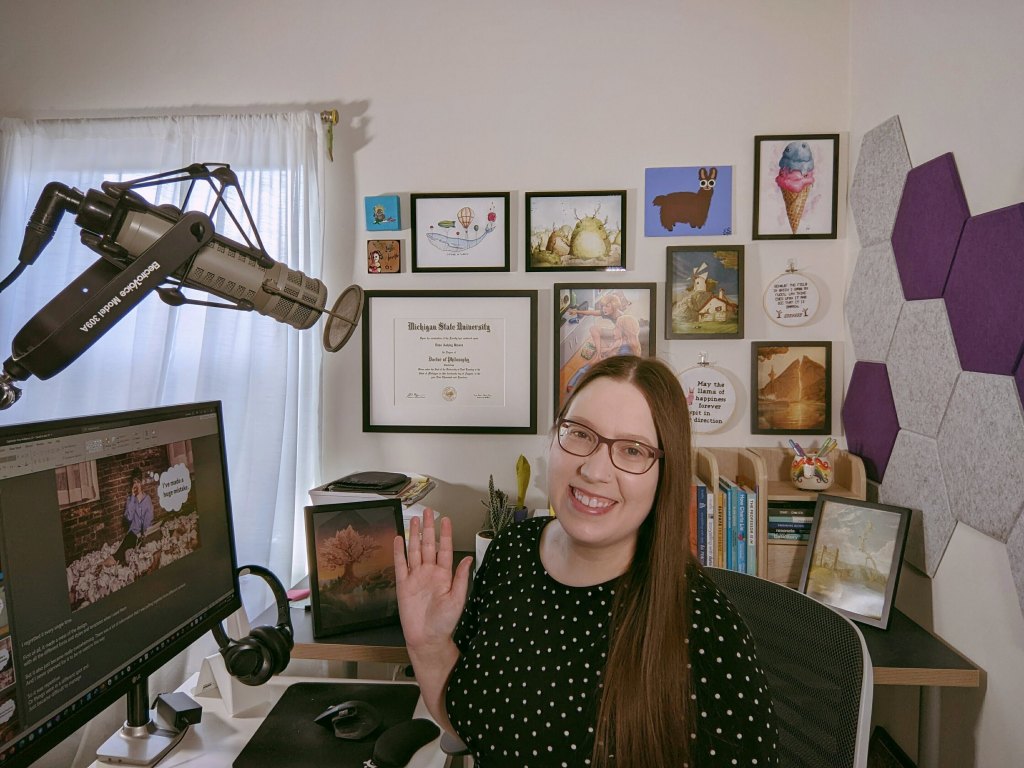
Dr. Echo Rivera is the owner and founder of Creative Research Communications LLC, a company that specializes in visual communication. She has a PhD in psychology from Michigan State University and specialized in community-based research. After earning her PhD, she was a Research Associate at a non-profit research and evaluation center. With 14 years of research, academic, and evaluation experience, she is well-versed in sharing complex data with a variety of stakeholders and audiences—from the public, to academics, and state/federal staff.
In 2016, she founded her company to improve the quality and impact of research communication. Clients include state departments, universities and research labs/teams, evaluation centers, and technical assistance centers. Dr. Rivera also helps thousands of professionals learn this skill every day through her YouTube channel, More than PowerPoint!, and through her professional development program, The Presentation Skills Masterclass Program.