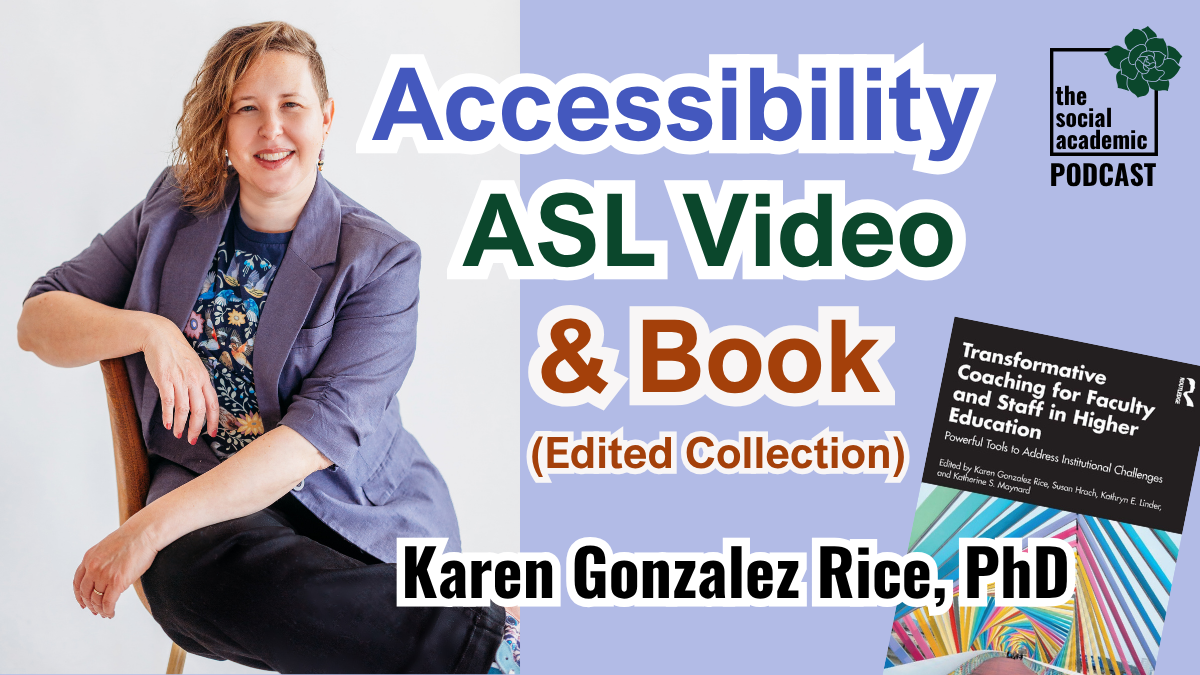
Karen Gonzalez Rice, PhD, Professor of Art History and Faculty Coach is interviewed about her journey with accessibility for her online presence leading to professional ASL videos for her academic website. She then created a virtual workshop series and book programming to celebrate her co-edited collection, Transformative Coaching for Faculty and Staff in Higher Education (Routledge).
In this episode:
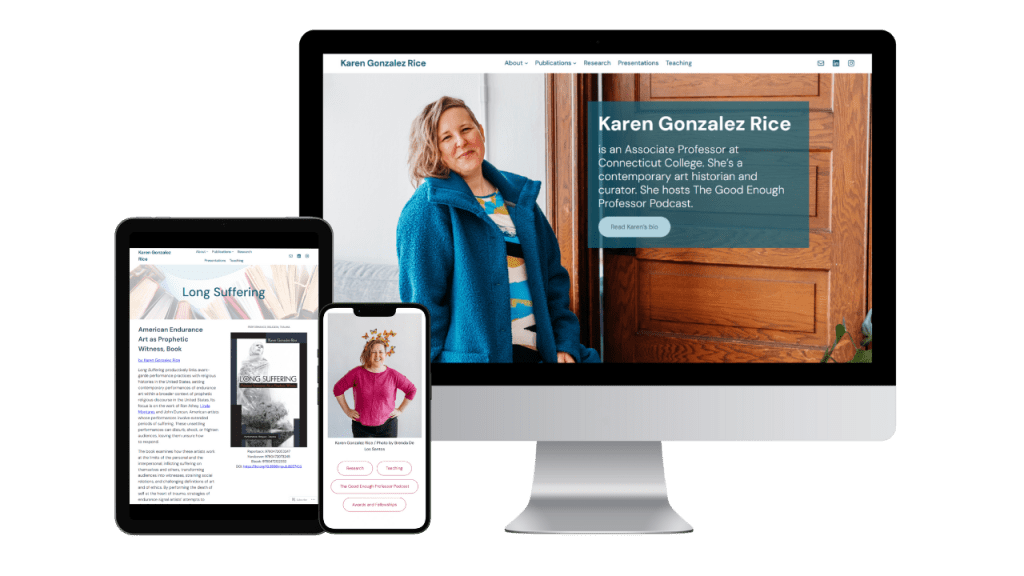
Making ASL Videos with Andy Tao of Blue20 to share on her personal academic website: https://KarenGonzalezRice.com
Have you ever thought about virtual programming for your academic book? We talk about celebrating her book, Transformative Coaching for Faculty and Staff in Higher Education: Powerful Tools to Address Institutional Challenges with a
- Kick off party to celebrate the authors
- Month of LinkedIn posts to introduce the coaches
- Virtual workshop series
How Karen’s online presence as a professor has changed and become more intentional and adaptable for her life.
Quotes
Let’s celebrate each other
“As academics, we are so reluctant to celebrate what we do, and we wanted to help folks kind of work through some of the big feelings that come up when we think about sharing our accomplishments. The idea that we were a community, not just in print, but in person or person and via Zoom was really countercultural and it was pretty exciting.”
Accessibility
“How do I create brave and accessible spaces for exploration and for sharing of different perspectives? This turned out to be a kind of… radical re-envisioning of what my courses looked like, how I showed up in my courses and what I was inviting my students to bring into the classroom.”
On recording professional ASL videos
“I would rather be myself and including all the mistakes, right? That was really helpful to have someone who was supporting me to be myself and not overly focused on perfection, although they do look beautiful and I’m really happy with how they turned out.”
Her online presence
“One of the major takeaways for me in the last year is that my online presence evolves, that it changes. It’s not static and I don’t have to be tied to one platform or one aesthetic or one thing. I think recognizing that there’s space for all of that has felt really liberating.”
This episode was broadcast live on Tuesday, April 21, 2026. Please find a full transcript below. Thank you!
Subscribe to The Social Academic blog.
The form above subscribes you to new posts published on The Social Academic blog.
Want emails from Jennifer on building your online presence? Subscribe to her email list.
Looking for the podcast? Subscribe on Spotify.
Prefer to watch videos? Subscribe on YouTube.
Interview
Jennifer van Alstyne: I am back on The Social Academic podcast with one of my favorite clients. This is Dr. Karen Gonzalez Rice. She created a personal academic website last year, but this topic is even more specific. We’re talking about two different things that are both about making your work more accessible to people. The first is going to be about professional videos. She made beautiful videos that we just updated on her website. And the second is about a workshop series that Karen created for her co-edited collection. I’m very excited to dive into this conversation, but before we get started, Karen, would you be open to introducing yourself for people?
Karen Gonzalez Rice, PhD:
Yes, of course, Jennifer. Thank you so much for having me. I’m really excited to get to talk about these topics.
I’m Karen Gonzalez Rice. I’m an art historian, a museum studies professor, I’m a curator, and I’m also a coach for academics. I host The Good Enough Professor podcast. My most recent book is a co-edited volume with three other higher ed coaches. It’s called Transformative Coaching for Faculty and Staff in Higher Education.
In my current research, I’m really working on connecting contemporary art and deaf visual cultures and more broadly putting the disciplines of art history and deaf studies in dialogue.
Jennifer: I remember that when we first met, accessibility was a value of yours. It was something that was coming into your research and you wanted it to come through to your online presence.
So I’m curious, what does accessibility mean to you? Is there a story for when you first recognized, oh, this is something that is important to the practices and how I show up in the world?
Karen: I love that question. Thanks so much for giving me a chance to kind of reflect on that.
I think for me, accessibility is about being able to have really good conversations, transformative conversations with all kinds of different people. That kind of attention to accessibility is really rooted in my experience as a teacher.
And when I started noticing that traditional ways of teaching were just not really yielding the kinds of conversations that I wanted to foster in my classes. That really led me to rethink my class environment. How do I create brave and accessible spaces for exploration and for sharing of different perspectives?
This turned out to be a kind of radical, fairly radical re-envisioning of what my courses looked like, how I showed up in my courses and what I was inviting my students to bring into the classroom and ways of being in the classroom. I really turned to culturally competent pedagogies, anti-racist pedagogies, trauma-informed pedagogies as a way of entering into a conversation about accessibility from a bunch of different perspectives.
Then I had a deaf child. Later in my research, I started working with deaf communities and accessibility really took on new meaning and importance for me at that point. And so I worked really hard to kind of better, and I’m still working hard to better understand ableism and the ways in which kind of ableist ways of thinking shut down conversation and how really without accessibility, we miss out on really rich and important conversations.
If folks want to start somewhere, Stephanie Cawthon’s book on Disability is Human is a really awesome place to start around questions of accessibility.
Jennifer: Stephanie is such a wonderful human being. I met her recently, actually, and got to present at the same summit. Oh, that’s wonderful.
Shoutout to our past guest, Carole Chabries, PhD for inviting me to speak at IMPACT 2026 where I met Stephanie and attended her wonderful talk: What Would You Do If You Knew You Couldn’t Fail? Such a good session.
Jennifer: You made some beautiful ASL videos with a professional company for your website, for your research.
What was that experience like? Were you always in the, I’m going to make these videos kind of space? I’m curious what the feelings were like before you actually recorded.
Karen: I was 100% terrified, first of all, to record videos and second in another language that is not my first language. So terrified.
A disability justice tenant is: nothing about us without us.
To me, this means not only did I need to be rooting my academic work in collaboration with deaf scholars and in working with deaf communities, so a kind of methodology, right? But also inviting folks in by making not just what I’m doing, but like who I am accessible in ASL at every stage of the process. Not just when it’s all beautiful and tied with the bow, but the messy middle, right?
Jennifer: That’s it. The messy middle.
And working with professionals, how did you get you through the messy middle to the other side of this beautiful professional video?
Karen: Oh, well, thank you so much for saying that they’re beautiful because of course when I see it, I focus on all the mistakes that I made. The points when I was feeling embarrassed.
But no, this is why it’s really good to have a partner, to have an outside kind of perspective. As you were helping me post these videos and kind of put them onto the website, you were very helpful in pointing out what others see, right? And not just what I see. Yeah.
But this process of working with a professional. I thought if I’m going to do this, I’m going to do this the right way. And I did have a grant related to funding my research. I was able to make the case that this is about accessibility and about making these connections. I reached out to friends who had done videos for their websites and started to kind of gather recommendations.
I was able to find Andy Tao through Blue 20. It’s the sign for blueprint, Blue 20, it’s sign language.
Working with Andy, who was so helpful about embracing not perfection, but who I am. So when I really was chatting with him about like, “Well, should I kind of get coaching in ASL to sort of have this be really perfect?”
And he was like, “Well, but when you actually sign with people, when you engage with people, just being yourself is probably going to be more helpful so that you’re representing who you are and not like this sort of beautiful picture of perfection.”
I really kind of took that to heart that I would rather be myself and including all the mistakes, right? That was really helpful to have someone who was supporting me to be myself and not overly focused on perfection, although they do look beautiful and I’m really happy with how they turned out.
Jennifer: Yeah, they look so good. I know. I remember as soon as I saw them, I was like, “Andy, is it okay if I recommend you to other academics because these are amazing?” And Andy said yes. So yes, I will definitely be linking to Blue 20.
I’m curious, for anyone who’s listening, there may be people who are like, “I kind of want a video for my website or to share my research.” Do you have any tips for a first timer, someone like you who’s pretty nervous beforehand?
Karen: Well, to me, it was really about connecting to my broader purpose and that for me was de- centering myself. In a lot of ways, you have these cameras, there were two people with…
It just felt like, “Oh my gosh, this is all about me. “
It’s not about me, really. It’s about my audiences. It’s about who I want to have these conversations with.
So if I could keep reminding myself it’s not about me and really kind of decenter myself, that helped me a lot.
Jennifer: That’s amazing. I feel like it’s hard to articulate the balance between something being about me, right? One of the things you loved about it was that it felt like leaning into who you are and leaning into the mistakes because that represents what people are going to engage with you in real life, in person, but also maybe on a Zoom call, people get to experience the real you, but also they get to know what those conversations and the potential collaboration might look like when they get to engage in this different kind of way.
And also, it’s not about you. It’s about the conversations. It’s about the other people. It can be both things at once. I’m so happy. Thank you for sharing that. People needed to hear that. I really think so.
Karen: You’ve pointed out such an interesting tension that is like this dance, right? It’s sort of being myself, but also also not about me. It’s both. It’s both of those things in a really wonderful way.
Jennifer: I want to talk about your book, Transformative Coaching for Faculty and Staff in Higher Education. Before we dive in, who are your co-editors? Let’s give them a shout out.
Karen: Yes. So this is a book I co-edited with Susan Hrach, Kathryn E. Linder (“Katie”), and Katherine S. Maynard (“Kitty”), who were so, so wonderful, just a really fabulous experience.
Jennifer: Yay. You created a lot of engagement with your book, and I hear that there were actually three distinct programs that supported this kind of community building, this invitation to engage.
Tell me about the three programs I want to hear about the different book marketing activities and the community.
Karen: Yes. I just want to back up for a minute and just describe the book because it’s really about coaching and we wanted to start a conversation about coaching in higher education, which we saw taking place. We just didn’t see a lot of big conversations.
I feel like I’m saying the word conversation a lot, but clearly that is a value for me dialogue. But we wanted to continue the conversation beyond the book and we wanted to do it in ways that were coach-like. We were really thinking intentionally about the content of the book, the kinds of conversations we wanted to have.
Another piece of this is that this is a little unique in that many, if not most of our authors are also coaches and have small businesses, right? They have coaching practices and we really wanted to be able to get the word out about their coaching.
So yes, we celebrated the book in three ways, which now at the end of this year, I look back and I’m like, wow, that was a lot. We did a kickoff party, we did a Meet the Coach LinkedIn series, and then we did a year of workshops.
I want to start just by sharing a little bit about the kickoff party, because I think even if we’d only done that, it would’ve been a really transformative kind of experience. What we did is we brought all the authors together. We did some sharing of information about logistics and stuff, and Katie Linder led a coaching session on self-promotion. So we very deliberately incorporated thinking about self-promotion into this kickoff party.
As you know, Jennifer, as academics, we are so reluctant to celebrate what we do, and we wanted to help folks kind of work through some of the big feelings that come up when we think about sharing our accomplishments.
Then also kind of get us into this like, “Well, what are reasons for doing it? ” Who wants to hear about this book? What would be fun and genuine, these kinds of questions.
Jennifer: So the kickoff party, that’s ‘highly recommended,’ it sounds like.
If you have a book coming out in the future, this is something that felt like a lot of people should consider this for themselves. Is that right?
Karen: Yes. Especially for co-edited volume. I’m sure you could adapt it for a monograph, but for us, we really wanted to address our authors and to support our authors in this way. And what we heard from them was that people were kind of shocked. We had never had this kind of communal experience, especially around something that would sort of help them help those skills.
The idea that we were a community, not just in print, but in person or person and via Zoom was really countercultural and it was pretty exciting. I think it’s something that I will certainly do again with edited volumes.
Jennifer: I was going to say, I want to dive into, you said a month of LinkedIn, is that right?
Karen: Yes, we did. So I think that by doing the kickoff party, we really set the stage for a more participatory kind of back and forth engagement from our authors. And that was really important because we wanted to center and highlight our authors. So the Meet the Coach programming was throughout the month of October.
The book came out at the end of September. So throughout the month of October, we did features, just really short little LinkedIn posts featuring most authors. We gave folks a choice, of course. There was a questionnaire that we created that really tried to get at who they are and also what it would be like to work with this person. So there were some questions about what’s the most delicious meal you’ve had recently? Or, what are you reading? All the way down to, what’s your approach to coaching?
What matters to you? So I think it was people were able to pick and choose what they shared. And obviously some people shared only the professional, others shared both, some were very personal. It was very interesting to see. But that felt like an event because we were posting and it was the four of us shared the posting, but we had something almost every day in October.
Jennifer: Every day. And there are four co-editors and daily posts, but you’re switching off days, it sounds like.
Karen: Exactly, exactly. So that it wasn’t just my voice or one person, it was that we wanted to show that this was a collaborative project.
Jennifer: Wow. Did you tag people? I’m curious about logistics. Did you tag people in the post? Did you each kind of re-share them? Were there any kind of suggestions or recommendations that you have for someone else who might be trying this?
Karen: Yeah. A couple things. First, templates. So I did the templates and I kind of designed everything so that it was the same. Everything looked the same and also just made it a lot easier. We were not reinventing the wheel. So templates rely on templates. The other thing, yes, 100%, tagging folks. We did that and then we reshared. Yeah. And so we were amplifying each other’s posts. It really did feel like an event. There was a kind of visual similarity. They kept showing up in my feed and you could sort of see that there was something going on.
Since then, I noticed on LinkedIn that one of the authors who contributed to the book, she recently published an edited volume in her academic field and she did something similar. She highlighted each of the contributors!
Jennifer: I love that. Oh my goodness. It’s going to reach everyone soon. I hope everyone starts doing something similar where they’re celebrating the people they’re collaborating with. That’s so beautiful.
Okay. So there was the kickoff party and then there was the month of LinkedIn where you’re highlighting the different coaches who have contributed to the book. What came next?
Karen: The workshop. So we started doing workshops in November all the way through April. So we have one more next week and then the workshop series is finished. But the book is really about starting a conversation. We just wanted to expand that conversation, continue it, invite more people into it, while also sharing the book and getting the word out about the book and highlighting the really awesome coaches and their coaching practices and giving folks an opportunity to experience what their coaching style is like. How does their coaching style kind of translate into a workshop setting?
Jennifer: I’m curious, who is this book for and how do you hope that those people will continue to be able to engage with the conversation now that the events are done?
Karen: I love this question because I’ve answered this question before months ago when the book came out, but I do think that the workshops, the experience of … And I was really leading the workshops or I was organizing the workshops, so I attended all of them. And being in all of the workshops and seeing these conversations, I think has really shifted how I think about the audience. And I think, well, there’s multiple audiences.
I think there’s folks who are like us coaches in the space of higher ed and some ways of thinking differently and maybe more collectively about what we’re doing, but also senior administrators and folks who might want to bring coaching and more of a coaching perspective into higher education, which seems really important right now in these difficult times. Folks who are curious about coaching either on either side, right? Whether they are curious about becoming a client and working with a coach or about folks for folks who are interested in becoming coaches.
What became really clear to me, and we kind of knew this, but the workshops really reinforced for me, the educational developers, the folks who are supporting faculty and doing the work offering workshop at their institutions, supporting folks in different ways, are really interested in how to incorporate coaching and coach-like conversations into their work. And they’re also recognizing, “I’m kind of already doing this. How might I pursue more intentional training or intentional focus?”
Jennifer: Authors don’t often see the direct outcome or the feelings of people who receive our book marketing or even the message of your book. But when you host workshops, you’re seeing people who are reacting, maybe they’re talking, making connections, meeting people, people who could help with their next step.
What is it like to actually get to experience some of those outcomes when you’re with people in those workshops? It sounds like you went to all of them.
Karen: I did. I went to all of them and I was just so impressed with all of the authors and the contributors who participated and who were offering such different ways of being and different models of what it looks like to coach, how to form communities and workshops. And yet they were all so different and they were all just wonderfully engaging and transformative.
I think that I’m really proud to have given all these coaches and authors the opportunity to do that, to kind of have that experience. And I also am really proud that we created a community. We had some hardcore followers, a couple folks who went to almost every workshop. So that kind of node of folks who came to every … Then there were plenty of people who went to multiple or … But to sort of see that we were building this space of community and connection and bringing clarity to folks during really hard times in higher education right now, it felt really meaningful.
And I was really pleased that we got to kind of address real existential challenges, as well as kind of joys and sorrows of the day-to-day.
Jennifer: I so appreciate you being open about your experience organizing and building community and really creating spaces for more conversations. It sounds like conversations is a huge value to every part of your academic life. When we caught up, you mentioned that you hadn’t updated your academic website in a year, but part of that was because you kind of felt like, oh, my online presence feels like me. It’s kind of like where I want to be at, and there’s not as many changes as maybe I might’ve felt in the past.
I’m curious about how you’re feeling about your online presence now post all of this book marketing and really building community, do you feel like there’s new ways your online presence might grow now? Do you feel like, “Oh, I’m really proud of this. I’m curious about your thoughts and feelings.”
Karen: Oh, I love this. I think that one of the major takeaways for me in the last year is that my online presence evolves, that it changes. It’s not static and I don’t have to be tied to one platform or one aesthetic or one thing. And Jennifer, you’ve really helped me in that conversation in particular. I remember you saying, “Well, what do you want more of in your social media presence and your online presence?”I had kind of stopped posting exhibitions because I wasn’t really using Instagram as much. You suggested, “Well, why don’t you just try that on LinkedIn?” It’s been so freeing. I think being able to just share images of something I saw and interesting artworks I saw without having to have some sort of perfect perspective or I did not … I don’t spend an hour drafting some sort of … I mean, I value that when other people do it, but I just like to share the pictures and that feels good to me.
So I have some of my posts are like that and others are more reflective or more book related. And I think that recognizing that there’s space for all of that has felt really liberating.
Jennifer: I love that. I feel like sometimes when people want a more intentional online presence, they lean into almost like prescriptiveness. Actually, I have to be careful what I say because people will do exactly what I say sometimes and I really want it to be opening, like world opening, conversation opening and not restrictive. So I love that you found ways to share the art that you’re visiting, the art that you care about that touches you in ways that feel like you do have space to be reflective and you do have space to just share the photos when that feels what’s right for you that day. My husband’s headed up to LACMA in a few minutes to go check out their new galleries during their member previews. I think about how much I visit museums and don’t share the things that I … I have just rolls of photos in my phone. I needed to hear your message today to encourage me to share more of that part of my life too.
So thank you so much for this conversation, Karen. I feel like we’ve covered so many things. This is going to be so valuable for people. Is there anything that we haven’t chatted about that you want to be sure to add before we wrap up?
Karen: I think my sort of coach brain is thinking about some of your questions around online presence. And for me, grappling with visibility was a key piece of being able to show up as myself and in ways that allow me to release perfectionism. And so I think that, and you helped me see this too, that this is not just about strategies or templates or whatever. There’s some inner work that I had to do to be able to foreground my values, right? Building conversations is more important that I love every photo that’s up there.
Jennifer: That’s it. That’s it. Oh, one last little question if you’re open to it. You mentioned templates for your month of LinkedIn. Were those Canva templates? I’m curious about what you meant by templates.
Karen: Yes. I just created templates in Canva and also just mental templates, I think, in a certain way. So for the workshops, I sort of created … I worked out, how many times do I need to post about this to get the right … Trial and error, of course, but I ended up doing two posts. One was focused on … It maybe was a description and the other was the person. But having in my mind an expectation really helped me release ruminating about it, if that makes sense. And worrying about what’s next. Well, oh no, it’s the one where this is going to be about the person, right? And that really streamlined things for me for sure.
Jennifer: I love this. Okay. This has been such a good conversation. I feel like if I ask any more questions, it’ll become overwhelming for people. So we’re going to edit today, but Karen, please come back on my podcast in the future because I know there’s so much more that we could totally talk about. Thank you so much. Stay on for a moment as we finish up the stream.
Karen: Thank you, Jennifer. This has been delightful.
Jennifer: Yay.
Subscribe to The Social Academic blog.
The form above subscribes you to new posts published on The Social Academic blog.
Want emails from Jennifer on building your online presence? Subscribe to her email list.
Looking for the podcast? Subscribe on Spotify.
Prefer to watch videos? Subscribe on YouTube.
Transformative Coaching for Faculty and Staff in Higher Education: Powerful Tools to Address Institutional Challenges
Edited by Karen Gonzalez Rice, Susan Hrach, Kathryn E. Linder, and Katherine S. Maynard
With chapters by Kathryn E. Linder, Jessica Miller, Christine Moskell and Katherine S. Maynard, Anne Marie Edwards, Elizabeth A. Norell, Susan Hrach, Laurel Iverson Hitchcock and Allison M. Curington, Jenn Wicks and Dana Wetherall, Jenny Hannah Moore, Kathryn E. Linder and Susan Robison, Sara Schley, Kate Henry, Kim Burns, Rebecca Pope-Ruark, Charles Klink, Gypsy Denzine, and Timothy L. Davey, Eric M. Stauffer, Katherine In-Young Lee, Kimberly J. Hale, Gypsy Denzine and Whitney Sherman Newcomb, Rebecca Campbell and Gypsy Denzine, Chinasa Elue, Brooke Anne Hofsess, Mary Carney, Harry L. Price, Leslie Ortquist-Ahrens, Jennifer W. Purcell and Misty Grayer, Diane E. Boyd and Benjamin K. Haywood, Karen Gonzalez Rice, Susan Hrach, Kathryn E. Linder, and Katherine S. Maynard
About the book: This wide-ranging collection explores how to integrate coaching into higher education in ways that tackle some of the most pressing challenges facing institutions today. By embracing coaching as a powerful tool for growth and change, faculty and staff can navigate complexities, foster innovation, and cultivate thriving academic communities.
Drawing on the expertise of seasoned academic coaches, the authors provide a rich, multifaceted exploration of coaching’s potential to drive individual transformation and institutional success. With insights grounded in diverse roles and perspectives, the chapters showcase how coaching can empower faculty and staff at every career stage. From creating authentic connections and building resilience to promoting inclusivity and inspiring structural change, this lively book is packed with the practical tools, real-life examples, and thought-provoking reflection questions necessary to develop a core, functional understanding of coaching in higher education. About the book.

Karen Gonzalez Rice
Karen Gonzalez Rice is Professor of Art History and Faculty Coach with the Center for Teaching and Learning at Connecticut College.
Gonzalez Rice holds an Associate Certified Coach (ACC) certification from the ICF. In her coaching practice, she works with individual faculty, staff, and senior administrators, and she partners with institutions to design programming for developing wellbeing, expanding leadership, and building caring communities within and across campus contexts.
Her podcast, The Good Enough Professor, explores how we can humanize higher ed by interrupting academic grind culture and re-imagining success on our own terms.

Note: I felt lucky to design Karen Gonzalez Rice’s website. My husband, Matthew Pincus, and my friend, Brittany Trinh, joined me for this website design project on her Team VIP Day. Karen is a past client, here’s what she shared about working together. No gift or monies were exchanged for this interview or for any content on The Social Academic. Thank you!