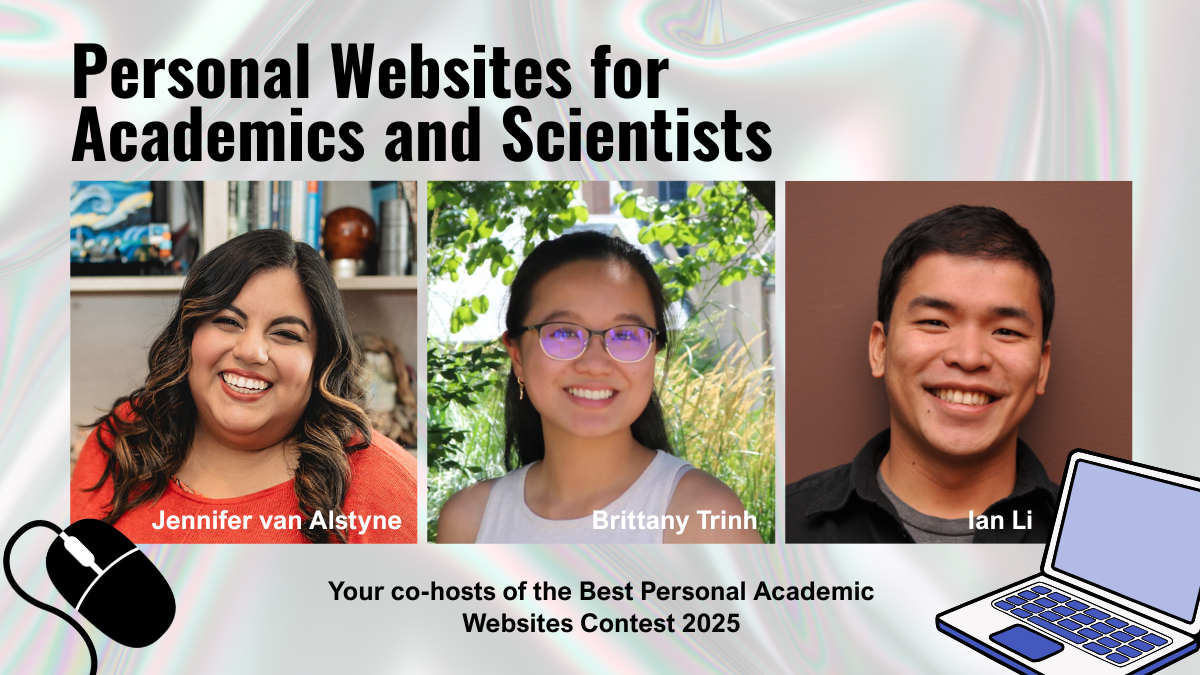
Tips and advice about websites for academics from 3 experts who want to help you make your own website. A livestream for faculty, researchers, and grad students.
This livestream is part of the Best Personal Academic Websites Contest 2025, the 3rd annual contest hosted by Jennifer van Alstyne of The Social Academic, Brittany Trinh of the Beyond Your Science Podcast, and Ian Li creator of Owlstown, a free academic website builder.
Join us for this informal chat about websites for academics in 2025. Some questions we cover:
- What are your options for making your website?
- What makes for the best website examples for academics?
- How can I have a website fast (like today even)?
- What should people prioritize when telling their story on their website?
- What makes for the best portfolio websites (and what can go on them)?
Your contest co-hosts are back with another live to support your academic website project. Whether you’re a professor, researcher, scientist, postdoc, graduate student, independent scholar, you deserve space online.
This year’s Best Personal Academic Website Contest also supports the websites of research labs and research groups.
Check out our past livestream, the Set Up Your Website event.
In this interview

Intros for your contest co-hosts
[Jennifer van Alstyne:] Welcome to The Social Academic. Today, I’m joined by co-hosts of the Best Personal Academic Websites Contest, Brittany Trinh of the Beyond Your Science Podcast, and Dr. Ian Li of Owlstown. I’m excited about this contest because we were actually on hiatus last year, and so having this kind of renewed energy to share more personal academic websites, research lab websites with people to inspire them to create that space online. I’m excited to team up with you both again for that. Brittany, would you share just a little introduction about who you are and your podcast?
[Brittany Trinh:] Yeah, thanks Jennifer, for having me on the podcast and for us to collaborate together on the best personal academic website contest again. So my name is Brittany Trinh and I am currently a PhD candidate in chemistry at the University of Wisconsin, Madison. And I’m also the host of the Beyond Your Science Podcast, which is a podcast about creativity and entrepreneurship in STEM. And so we just talk about all the different ways that we can use creativity in our graduate school and research and how we can take that and beyond into our career.
I love that. And Ian, you created Owlstown. Would you mind telling people a little bit about what Owlstown is and how it could help them?
[Ian Li:] Sure. Thanks Jennifer. Yeah, so Owlstown is a website builder, specifically designed for academics. It’s used by thousands of PhD students, professors, researchers, and it’s a way to make it easier for people to make an academic website, and also with Owlstown you don’t have to worry about coding and you can just focus on how you want to share your content.
[Jennifer:] I love that. Now I feel like some people maybe don’t know why we’re doing this contest. And so I just wanted to share my own motivations for bringing us all together. I just feel like there’s so many people that have created a space that maybe inspired me to create my own space online. And that work kind of really went unrecognized for so many years. There’s not really a way to celebrate this space that academics can create for themselves online, at least not in a formal way, like the way you might receive a teaching award or a research honor. And so I really love that we’re kind of creating this way to celebrate the hard work people have put into their websites. What about you guys? What do you like about the contest?
[Brittany:] For me, I love seeing the creativity across the different platforms that people use. Like some people are very scrappy and they use Google sites and then they make it super creative. And then some people it doesn’t really matter the builder, but you can really see their personality shine through the website, through the colors or the storytelling and their texts. And I think that’s a really fun way to showcase not just your academic work in the traditional sense, but also incorporating your personality in there, too.
[Ian:] Yeah, and for me, the thing that I like about the contest is that it’s, it ends up with giving examples for great academic websites for people to follow. ‘Cause I think one thing that, maybe one barrier that people, for people starting an academic website is like, “What should I put in it?” And the website, the contest shows great examples of what you can put into your website. And that also with the number of people that enter their, their websites, it’s a great example that it’s actually possible for people to do it.
What inspired you to make your website?
[Jennifer:] I was traveling over the summer to go back to the East Coast and visit family friends, and also one of my mentors from undergrad. And she was actually the first professor that I knew that had created that space for herself online. She had a personal academic website and a blog where she wrote frequently. And I really felt like that was something that inspired my own journey. So getting to connect with her in person and talk with her about how her website was meaningful to me as a student, as a student who maybe thought I didn’t deserve to have that space online, seeing someone else do it first made such a big difference for me.
What inspired each of you to make your own website?
[Brittany:] Well, I think for me, I think it’s, well a lot of people are online now, and I thought that it was a great way for me to share the work that I do with more people. I think when I was in grad school, anyone who would listen to my research, I was super excited. And so if I could also do that online, it was like a great way for me to share the work that I’ve done and with people I would Google – I would use search engines to find people and their work. And so I’m assuming that people will also look for my own work and that I needed to create, create a space for- I can share that my research so that when people do search for me online, they can find my website and see the work that I’ve done.
[Ian:] I think for me, my original intention, if we go all the way back to my college days, I started my website, which was like a word WordPress blog because I wanted to document my like final year of college, my senior year, about my research that I was doing and my feelings and thoughts about applying to grad school and things like that. And so it was just really for fun. But over the years I’ve of course have used it more for career development and things like that, but I’m kind of going back to the idea of really using your online space as a creative outlet. And that’s why I really like encourage more people to do it because then you can also showcase all the other stuff that you do in addition to the science as well. And that’s also part of the reason why I’m also trying to showcase that through my podcast now as well in this final year of my PhD. I think it’s just, kind of like a time capsule. So I think it’s really fun and I just want more people to do that.
[Jennifer:] Whew. I really like that. Now I’m curious because I feel like I didn’t have any reservations when I made that decision to create my personal academic website, but so many people do. They have that hesitation or feel like, “It’s too early,” or “I haven’t done enough,” or maybe, “I just don’t have the time or skills to make this happen.”
Was there anything that held you back when you were first starting your website project or maybe once you already had it?
[Brittany:] I think for me, when I made my website initially, I didn’t have this fear because it was all on the creative side of things. But then once I started grad school, I did feel very shy about sharing my academic work. And actually, it’s only like more recently that I’ve started to realize, “Okay, even though I don’t have a paper yet or whatever, I can still share the science, I can still share the service that I do in the scientific community or the awards I’ve won or just anything else that I’ve done honestly.
And it’s taken a while to get to this point, but I definitely understand and sympathize or empathize with all the grad students who feel like, “Oh, I don’t really have anything.” But I think that it’s still really important to kind of just start now rather than waiting until it’s when you have so many other things like looking for a job, trying to finish your dissertation and things like that, right? If you have, if you just want to do a little fun creative project, make your little website, and put your accomplishments and all your cool fun stuff on there that you want to share with the world.
[Ian:] Yeah. Yeah. And for me I think, when I started grad school…that’s a long time ago when I started grad school. I probably did have that hesitation of, “Well, I don’t have enough content to share.” So when I did make my website, it was probably just my face, my contact info and maybe something a little about me, like first year grad student or something.
But I think in retrospect, I think what I could have done at the beginning also was add, probably like document my, that first year or second year and so forth. Because I think there were a lot of things I experienced during those years, good and bad ones of doubt or excitement that I wish I had a record of so that I could look back at it. And also like, I think during those first few years I’m learning new things about being a researcher and also the field that I was studying. I wish I had a record of that.
And after the first year, second year, I had prepared slides already for presentations. I prepared posters, all that info could have been shared also on my website even though I didn’t have a paper yet at that point. I could have shared all that process that I’ve been doing that whole time because those processes were important to getting to that first paper, that second paper and so forth. So I wish I had documented that process better in retrospect.
[Jennifer:] Hmm, I appreciate you sharing that because I feel like there’s people who are listening to this who are waiting, they’re waiting until something else happens and you don’t have to wait. But not only do you not have to wait, but moving forward can bring new opportunity, maybe bring aligned opportunities that will forward your career and help you reach your goals…which kinda brings me to my next point which is that…
Ways to make your academic personal website
[Jennifer:] There’s many ways to create your website. To be honest, I’ve just written these down, so I’m going to go through the list. I’m just going to read my list so we can chat a little bit more about, what it’s like to create your own website because there’s people who are listening to this that are like, “I don’t have a website. I want to enter the contest or maybe enter next year, but I just don’t have a website now.”
So what are your options for making a personal academic website? A research lab website?
- Do it yourself. There are website hosts for you, like WordPress, Squarespace, Ian’s created Owlstown, an academic website builder for you.
- You can do it with your university. Some universities already have a solution for personal academic websites or for research lab websites. While I don’t always recommend that this is the best choice for everyone, doing it with your university through OpenScholar or through another platform that they use is definitely something that you should consider. If this space is something that’s an option for you, why not use it?
- You can do it with a student or with a friend. I’ve met a lot of people who have created their website working in collaboration with someone that you already know. So if you know someone who has these skills, who’s interested in a paid project like this, that is a good opportunity at least to have a conversation.
- You can do it with a professional website designer. I design websites at The Academic Designer LLC. Brittany has designed scientist websites. I feel like there’s many people out there. Even Dr. Lily Rosewater, who was on The Social Academic yesterday, there are people out here who help academics, researchers, PhD students, postdocs, independent scholars have space for yourself online.
- You can do it with a team. There are agencies who are here to help you with your website design and agencies like Stellate Communications have experience in helping academics like you. So there’s many ways to create your own website.
I don’t want you to feel like one way is the right way for everyone. It may be that, you actually try multiple ways in your career, and so I encourage you to create that space for yourself. Even if you don’t have it now, it’s something that is possible for you. What do you think, is there anything you want to add to that, Brittany and Ian?
[Ian:] Oh yeah, I think that’s a good overview of the different ways that you can build a website. I mean, yeah, there’s more details in each of those, but yes. Yeah, that’s a really good overview.
[Jennifer:] Ian, Owlstown is a great solution for people who want a website. I mean, you could make their website today while you’re listening to this. So would you tell people just a little bit about what it’s like to make a website with Owlstown and have that kind of supportive environment where you’re like, “Oh, here’s the answer to these questions,” and then you get a website. I love it.
[Ian:] Oh yeah. So with Owlstown part of the inspiration for me was to, when I created it was make it easier to create an academic website, and that sometimes setting up a website, setting up a server, creating webpages with HTML JavaScript CSS can be difficult and time consuming. As a grad student or someone in academia, you’re already busy with all this, your stuff, you don’t want to spend that much time. So the idea was, “Well, what if you, there’s a website builder where with templates specifically for, for research content, for academic content. And that’s, what came about was Owlstown.
So you go to Owlstown, you, there’s templates for what kind of content you want to put into your website. And so instead of focusing on how your website looks like or how to set up a server or how to code in HTML or CSS, you can focus on what content you want to share on your website. And so there’s templates for your publications, people that you collaborate with, courses that you’ve taught, blog posts, upload your cv, et cetera. And yeah, so you can start really quickly and it’s also a great way to just get started if, you kind of have reservations on starting, like how it might be difficult. Maybe just go to Owlstown and see, to just get something started and then if you at some point get the itch to actually code something, maybe go with another platform or try the, some other things. But if you want to just start quickly, you can do, you can create one just in minutes.
[Jennifer:] For those of you who are watching, we all met up back in 2023 during an earlier Best Personal Academic Websites Contest and we have us Set Up Your Website live event. The replay is here on The Social Academic blog and on YouTube. So if you are interested in checking out like a tutorial of Owlstown and hear more about our conversation where we answer some frequently asked questions about personal academic websites, be sure to check out that video. Find more resources.
Storytelling on your website
[Jennifer:] One thing that I wanted to chat with you both about because it came up during the awards last time, is that we had, we had an award for Best Storytelling on a website. And I feel like storytelling is something that maybe scientists are doing for their papers and people are considering in their teaching. Storytelling for yourself doesn’t always come naturally for academics.
What tips do you have have for ways that you can feature things on your website, or materials that you can share, or even writing that help you tell your story. What do you think?
[Ian:] I can start. So I think, I think for storytelling, maybe one difficult, maybe one difficult thing for me, when you’re trying to tell a story about yourself is, there’s a lot of details about the work that you do and it’s hard to kind of like narrow it down to the essence. So what I would say to that is I think it’s okay to just let it come about organically and not hesitate, not plan it out and don’t feel like you have to have it planned out right from the very beginning. I think the, it will come out naturally as you kind of share your content online. What is it? It’s kind of some people say the act of writing is a form of thinking. Then at some point you’re, editing and then you kind of get the final draft, the final thing from your writing. But at the beginning there’s all these drafts that happen.
I can imagine like as you’re building your website that all this content that you’re sharing, it’s kind of like getting to, I don’t know, at some point the voice will come out as you add more content to your website and then from there then you kind of continue the voice. But at the beginning maybe it’s very hard to plan that out. But I think I’d say focus on like just the share, sharing your content and then let it kind of organically grow and the, I think the story will come out as, as you grow your website.
[Jennifer:] Ooh, I really appreciate that. Actually writing as thinking was like the tagline of my MFA program in grad school. And so I really value that idea for websites because it is this kind of iteration. Like you are going to change in your life and so your website should be able to change with you and maybe your story isn’t going to be the same all the time. It’s okay if it changes, it’s okay if it grows with what you decide to share about yourself. Brittany, what about you?
[Brittany:] Yeah, I agree with what Ian just said. And to build on that, I think the voice aspect, literally the tone and like the word choice that you use can also be something that makes it more you, right?
We don’t have to always adopt this stereotypical, professional tone. For the website, you really can make it your own and you can also incorporate the visuals into your website to do that as well. And you can choose your medium to do that, right? It doesn’t always have to be words. It can be the photos, it can be like, the layout and things, but of course to what Ian was saying, you can’t know that from the beginning, right?
You have to start somewhere and then you kind of build on that as you see more examples or you do more things and then you just have more things to share. Even for me right now, I would say my own website, the storytelling aspect is something I probably want to work on a little bit more. And I, that’s what I’ve been thinking about as well. So yeah, it’s just, it is just iterating and eventually as you, as you grow more, like we were saying, you, you will get something that feels more like you.
Colors, visuals, and brand colors for your website
[Jennifer:] You brought up kind of like visuals and I’m curious about photos, visuals, and brand colors because I feel there’s a lot of academics who are like, “I want a nice looking website, but I don’t know anything about visual branding. Where do I start?” Do you have tips and tricks that you’re open to sharing? Brittany, why don’t you go first and then Ian, I have a more Owlstown specific question for you.
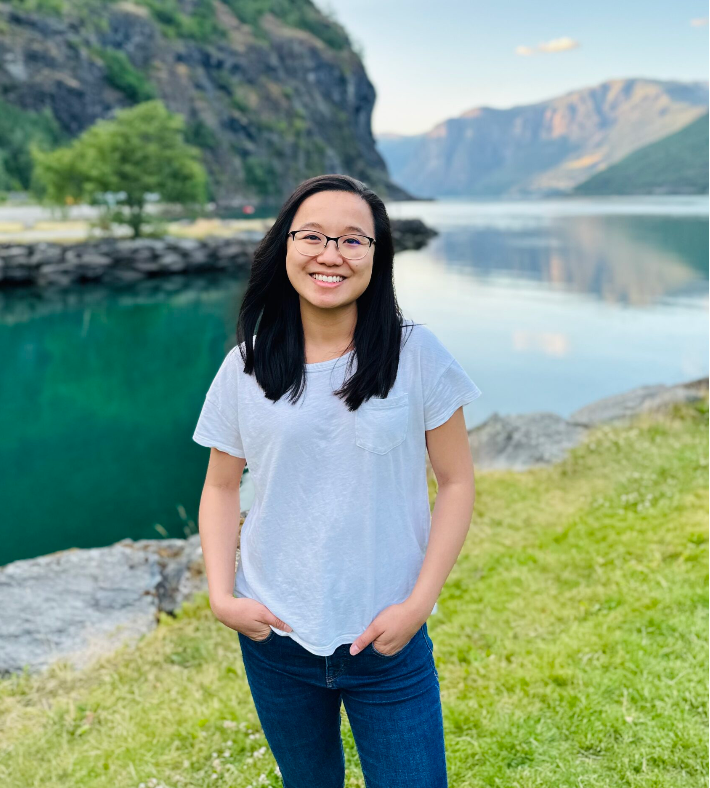
[Brittany:] Yeah, so for me, my favorite trick is honestly you just have to have like a few really good, clear headshots of yourself or photos in action, you at the bench or in the field or something like that you can share. And then sometimes if you’re really at a loss for color palettes, you could pull the color palette from that photo. So, if you look at my photos, I mean I already naturally like blues and teals and light greens and my photo of me, like in Norway just coincidentally was perfect for that. So I pretty much just use that for everything now.
Honestly, just choose one or two colors for simplicity, make sure they’re accessible for the web. That’s the only other thing. And then for fonts and things, honestly just choose a font that’s readable and I mean if you want to go more into the design aspect, that’s totally cool. There was a time where I was really obsessed with font pairings and stuff, but as time has gone on, I just need something that is easy to read across different devices and I like, don’t care anymore.
That brings me to my last point, which is, that’s probably the least of your worries. Don’t get too caught up in it. You just, again, need something to get started and you can always easily change it later with a click of a button or two. So it’s not the most important thing. The most important thing is to take that first step, build a website and put your content on there and share it.
[Jennifer:] Ian, I’m curious about how Owlstown helps people who maybe don’t want to make all of those decisions themselves, but still want a good looking website?
[Ian:] Yeah, so one of the design decisions I made with, with Owlslston was to basically limit the choices that you have. Basically you have, just for designs for Owlstown, the three choices you have are the template or, but Owlstown it’s called a theme and then the color. And you can pick one or two colors and the font. Well, there’s a bunch of choices for font, but you can only choose one. So yes, it’s a limitation, but the idea for that limitation is that you don’t get lost in kind of making decisions, ’cause that’s already a lot of decisions right there.
As Brittany pointed out, you don’t want too many fonts, you don’t want too many colors ’cause then it just becomes too busy and it’s not readable or not pleasant to look at. So the limitations are there to make it easy or easier to get to the beginning of your website. And then after that you can focus on the content that you’re sharing. I think that, for me, I think the most interesting academics websites for me are the ones that are constantly updated with their content and also the work itself is interesting. So it’s not necessarily how the website looks like. It’s like, “Okay, the, this person is doing really cool research and I want to hear more about it and I want to hear about it as it progresses year after year.”
[Jennifer:] Oh, I like that. One of the questions that I ask professors when we start working together on their website project and I design in WordPress.com because I like that it has fewer decisions than general WordPress for a lot of professors, but it’s honestly, it’s still too many decisions for a lot of people and that’s why I do the setup for them. But when I’m thinking about choices, how many choices do you want to make about how your website looks versus how many choices do you want to make about what you’re actually sharing about yourself, in your bio, in the photo that you choose, in the projects that you’re open to creating space for. So I love that Owlstown is a great template for people to be like, “Okay, here’s the things that I’m thinking of and actually it creates the website for you, and makes that process really easy.
Tips for academic portfolio websites
[Jennifer:] Hmm. I am curious because I love portfolio websites. I feel like that’s probably what I’m interested in the most and what I think that a lot of people maybe don’t recognize their website actually is. It’s kind of a portfolio for your research, your teaching for the things that you actually are creating that space for. And so I’m curious, what are your opinions on what makes the best portfolio websites? Ian, why don’t you start?
[Ian:] Yeah, it’s a good one. So for me, I think academic websites should go beyond, I think the common thing about academic websites is probably going to be a list of my publications. Okay, that’s great. But I think academic websites should go beyond that in the sense that when you’re creating a paper, there’s, yes, you publish a paper, but you also go to conferences. When you go to conferences, you do presentations, and if you have a video of your presentation, you should share that. I think that’s a great one to share on your website. If you have a poster for your paper, that’s another great thing to share in your paper.
But why do we do presentations and posters? Because it’s a good summary of the paper. A good way to kind of get a sense of the paper and maybe to entice people to read the paper, right? And if you can share those things along with your, with your papers on your academic website, it’s a great way to kind of funnel people into your work. I can, so if people are working on a portfolio website, definitely not just have a list of public publications, but also for each publication maybe share posters, slides or maybe even blog posts about each of those papers, if you have, they have them. I think those are great things to add to, to your portfolio website.
[Jennifer:] So materials that help tell the larger story about who you’re connecting with and who you’re sharing this with. And that can actually invite more people back to your website and Owlstown creates space for that for you.
Brittany, what about you? What makes for the best portfolio websites?
[Brittany:] Yeah, I think for me there might be a theme here, which is that I think it’s a great place to showcase your personal projects as well. And I, of course I agree with everything that Ian said regarding the publications and the posters. And part of, if you want to share more beyond the science, right?
Sharing your personal projects on your website, whether it’s just a page where you, highlight just all the different things you do or you have a separate page for each one. Like basically things you want to be recognized for, to be known for. So it also helps you be a little bit more memorable I think. It’s like, oh, someone can associate you with this research and you also do this thing.
For example, for me on my website of course it is the Beyond Your Science podcast, it’s the writing that I will show on my website. I have submitted things, but I haven’t put it on the website yet. And then also the musical performances that I have, am a part of or have done just to kind of share that more widely. Also it makes it easy for me to share it with family and stuff. I just send them a link to my website so they can kind of see all that. So yeah, I think it’s a place for you to share anything that you are proud of in, like one, one easy click.
[Jennifer:] I love that. When I think about that question, what makes the best portfolio websites for academics, for researchers? I think it’s one that’s intentional.
Sometimes your portfolio is like really specific towards your academic life and maybe you have a side hustle or a consulting business or a research lab and you end up having two websites thinking about like what is the scope of the portfolio of things you want to share with the people who are visiting this space?
One of my clients comes to mind because we started out creating her personal academic website. But then she had this research group, she wanted to highlight all the people in the group. And so really showcasing the group’s projects created a new scope. Having a separate website for that made sense.
And I think that that’s one of the many reasons why having the Best Personal Academic Websites Contest celebrate not just like multiple awards for different types of websites, but also this year you can enter up to two websites in the contest.
So if you have a personal website and maybe like a consulting website or a research group website. I mean, you don’t have to pick and choose between one or the other. You can actually enter them both into the 2025 contest in the same form. You don’t even have to fill it out twice.
[Jennifer:] One thing that I wanted to chat about before we wrap up is that there are so many people who feel like, my website maybe isn’t good enough. Like, should I enter the contest?
When I think back, would I have entered this contest when I was a grad student or when I first created my website? Honestly I think I would’ve had serious imposter syndrome and said no. What about you two?
[Brittany:] I think for me, my mentality when it comes to these things is just kind of, shoot your shot. I mean that has kind of worked out for me in some areas.
It’s also just a fun little thing. You never know what you can get. We’re giving feedback to people who want feedback, right?
[Jennifer:] Yeah. If you enter this year’s contest, after the awards are announced, you will be able to request feedback from any of us if you’d like it. We’re not going to just give it to give you advice unless it’s something that you’re open to. But we are offering advice for anyone who does enter the contest.
[Brittany:] Yeah. So I think for that alone, if you wanted to get a couple tips to improve your website, I think it would be worth it. Yeah.
[Ian:] Yeah. I think looking back, when I was in grad school, would I have shared my academic website? I probably would’ve been like, yes. Yeah. I mentioned earlier, anyone who would listen to my research, “I was like, yes, I’ll tell you about it.” And so if there was any way that I would, my website was, had all my research stuff in it and says, if they were, if people were going to look at it like, yes.
Let’s not forget that, research takes a long time. It takes so much time. And so I was, “If you want to, if people want to hear about it, yes.” My research is reaching other people and my website was an opportunity to do that. And so this is a way for me to be able to share with other people. Yes, I think I would’ve entered it when I was in grad school.
[Jennifer:] I love that. And if you’re listening, I hope that inspires you to take a chance and enter the Best Personal Academic Websites Contest.
This contest is for faculty, researchers, scientists, postdocs, independent scholars.
If you consider yourself an academic, even if you’ve recently left this space, if you would like to celebrate the energy you put into creating your website, we would love to celebrate you.
Entering the contest also helps other people because you have that opportunity to become part of the Academic Web Gallery on Owlstown, inspiring people around the world to create their own personal academic website.
I hope you’ll enter this year’s contest.
Brittany and Ian, thank you so much for joining me for this conversation. Is there anything you’d like to add before we wrap up?
[Ian:] I look forward to all the entries.
[Brittany:] Yeah, I was going to say the same thing.
[Jennifer:] Yeah. Yay! Thank you so much for watching this video. Please give it a thumbs up and share it with a friend. This contest is something that people probably haven’t heard about, so if you know someone who has a website that you admire or you have a website yourself, we would love to see your entry. Thank you so much for joining us.
The 2025 Best Personal Academic Websites Contest has closed for entries.
Subscribe to The Social Academic blog.
The form above subscribes you to new posts published on The Social Academic blog.
Want emails from Jennifer on building your online presence? Subscribe to her email list.
Looking for the podcast? Subscribe on Spotify.
Prefer to watch videos? Subscribe on YouTube.
Resources to help you create your academic website
Articles, guides, and videos for your faculty website project. This resource list is from Jennifer van Alstyne, Brittany Trinh, and Ian Li to help you make your website. Our goal is to help as many people as possible. Please share with your friends 💌
Check out Brittany’s recent appearance on The Social Academic where we chat about research lab websites.



RESOURCES ON THE SOCIAL ACADEMIC BY CATEGORY