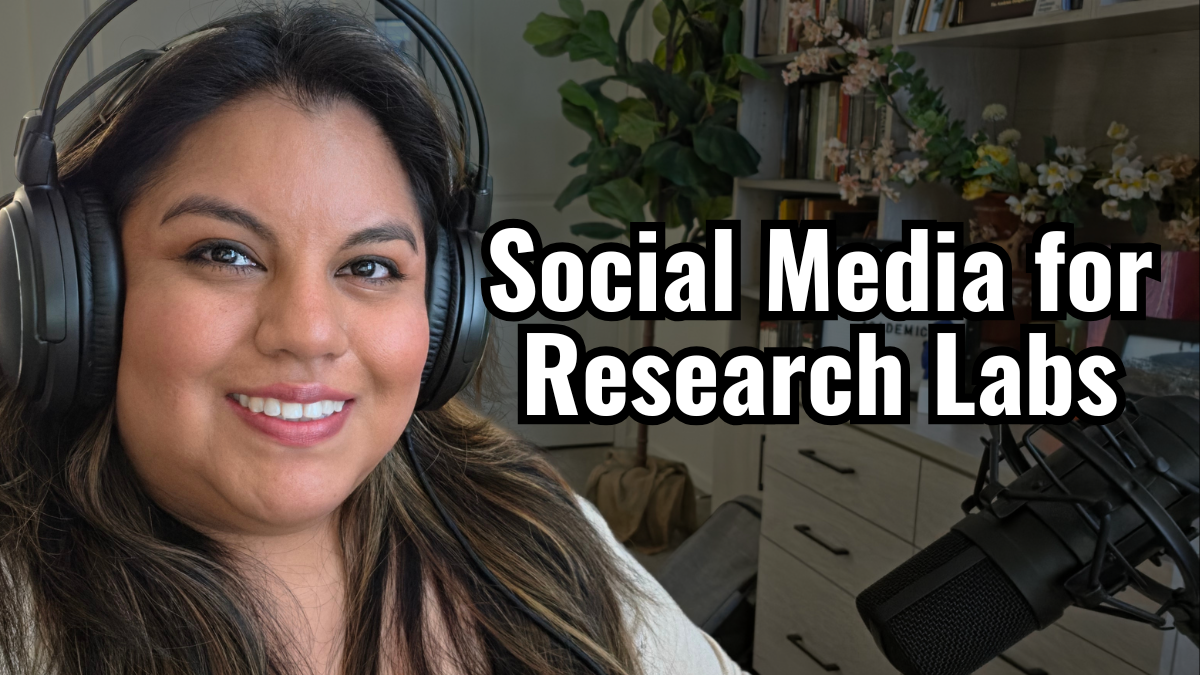
Let’s talk about social media for research labs and research groups. Hi, I’m Jennifer van Alstyne. Since 2018 I’ve been helping professors and researchers be intentional with their online presence. I’m about to go into a day of strategy and social media support for a research lab.
I shared with the PI, “I have a bunch of advice / recommendations I’d love to share with you that aren’t specific to your lab. Would it be okay if I make a public video to answer some FAQs? I think it could help more people.” The lab director said yes! So here it is. An episode to share with you with social media advice for research labs like yours. I hope you find it useful!
Bookmark this page or save the video for later. Even if social media isn’t a priority for you right now, this episode is here to help you in the future too.
Subscribe to The Social Academic blog.
The form above subscribes you to new posts published on The Social Academic blog.
Want emails from Jennifer on building your online presence? Subscribe to her email list.
Looking for the podcast? Subscribe on Spotify.
Prefer to watch videos? Subscribe on YouTube.
Questions I answer in this video
- Solo episode FAQ on social media for research labs
- Professional vs. personal vs. research lab social media accounts
- What platform should I be on?
- How much time should I spend on social media?
- What type of content should I create?
- Should I wait for the publication to create content?
- How do I connect with people?
- What do I do if there’s crickets on my posts?
- What metrics should I actually care about?
- Who should be involved?
- Can a lab member/student manage social media?
- What happens when my social media wiz graduates, or leaves?
- How can I hype my lab’s social media
- Why are students always worried about doing the wrong thing?
- Should there be training for using social media?
- What will my university think?
- What does my university not want me to do?
- How do we handle the icky stuff on socials?
- Things to avoid
Hi there, I’m Jennifer van Alstyne. This is The Social Academic, a podcast and blog about online presence for faculty, researchers, and graduate students. I help academics like you feel confident when you show up online through my company, The Academic Designer LLC. You have agency in creating a stronger online presence for yourself.
This episode of The Social Academic Podcast was streamed live on June 5, 2026 to YouTube and Instagram via Restream. Sharing since this has been an easy way for me to create videos the past year or so. If you think this episode may be a helpful resource for a friend, I’d love if you’d share it with them. I appreciate you!
Subscribe to The Social Academic blog.
The form above subscribes you to new posts published on The Social Academic blog.
Want emails from Jennifer on building your online presence? Subscribe to her email list.
Looking for the podcast? Subscribe on Spotify.
Prefer to watch videos? Subscribe on YouTube.
In this episode
FAQ on social media for research labs
Jennifer van Alstyne: Hi everyone. I am Jennifer van Alstyne. This is the Social Academic Podcast. This is a special episode. Honestly, I haven’t been live myself in quite a while. I haven’t done a solo episode on the podcast in a while and that’s because I’ve been having so much fun when I am recording with guests.
Today’s special episode is about social media for research labs and research groups. I have a bunch of frequently asked questions. I have 19 of them. I don’t think I’m going to get through all of these, but I am excited to share as much as I can in the time that I have. Let me hit go live on Instagram.
I am broadcasting live from Restream directly to YouTube and Instagram. This is one way that I have been able to make more video for the Social Academic Podcast with ease, especially since I’ve been doing some much higher production video for my family’s YouTube channel, Art with Bob Pincus. We make videos about art exhibitions, museums, all sorts of things. I’ve been diving into video this year. That is not what this episode is about though. Let’s start with the most frequently asked question, which is, it’s really about thinking about your lab identity online.
Professional vs. personal vs. research lab social media
Question #1: What is the difference between my own professional account, my research lab pages on social media and my personal accounts? What is the difference? Do I need to have separate accounts?
To be honest, for some people there isn’t much of a difference. Their online identity is very closely tied to their research lab and the research that they do.
They don’t necessarily separate where they share information, where they celebrate students, where they’re celebrating publications and research outputs or community collaborations. I think that there are people who really like having separate accounts and I think that works for a lot of people, especially if that’s kind of how you’ve approached other areas of your social media in your personal life, but it is not necessary to have separate accounts. Sometimes there isn’t really a separate identity between the research lab on social media and your own. It might be the same account. It may just be focused on where you direct people to. For instance, your research lab website on your university’s page or if you have your own website. If you have a LinkedIn profile or page for the research lab, that is another way that you might have separate identities, but maybe that’s only in one place.
It may be that your Bluesky, it’s just you, but you’re sharing some things about the research lab as well.
What platform should I be on?
Question #2: What social media platform should I even be on as a research lab?
What social media platform should I be on is a question that most researchers have. If you are a faculty member and you’re thinking about being on social media post-Twitter, you may be unsure where to be spending your time. And honestly, a lot of people have spent significantly less time on social media. If you are a research lab director or a member and you’re someone who’s like, “I really don’t have capacity for social media,” I understand. It doesn’t have to be your priority at this moment. If social media, if having a more intentional online presence is a goal for you, I want you to know that you can be on several social media platforms.
You don’t need to be active on any of them to have an intentional online presence. What do I mean by that? You can have ResearchGate. Some people have an ORCiD profile. Some people have a LinkedIn profile that maybe it’s a little more static, something that you update once or maybe on an annual basis and then you don’t necessarily need to go post. You’re just adding new publications. You can always be active on social media. I think that is a wonderful way to do research communications, to connect with your research lab members and the larger community online, but you can have intentional online presence profiles without having to be active on social media. And that kind of has potential to open up your world. If you have an old Twitter account like the research lab director I’ll be working with tomorrow on kind of social media strategy things.
This is something that is okay. I said, “Hey, if you haven’t been bothered by your Twitter account in a while, but you have 3000 followers, they’re still, by all means, let’s keep your account. Let’s just pin a post to the top to make it clear that you’re not really checking this account. It’s not super active and for people to connect with you and the research lab on LinkedIn where we’ll be launching a newsletter soon.” There’s lots of ways to connect with people online, but it doesn’t have to be the way other people might have done it in the past or the way that you think you need to be doing it now. There’s lots of options that might fit into your lifestyle and might fit into your lab’s culture quite well. Any platform of social media, there’s other researchers on. There may or may not be conversations about research happening, but that doesn’t mean that the researchers and other people in your field aren’t spending time there.
How much time should I spend on social media?
Question #3: How much time should I be spending on my lab social media or on social media in general?
I love this question because honestly, I have talked with so many academics about their social media habits and what it’s like to think about and write things on social media if they even do that at all. And honestly, a lot of people come to me and they’re like, “I am on social media a lot. I spend a lot of time scrolling on social media. This is my happy place. I love looking at reels about cooking or about science or about anything that is related to their interests.” And they’re not really active about their research or their research lab or the academic side of their life in terms of posting. That’s okay. Sometimes they’re not even posting personal things either. They just don’t post.
There’s many ways to use social media, but if you’re someone who’s already spending two hours a day, three hours a day, if you’re someone who’s already spending actually a lot of time on social media and you don’t want to be spending that much time, being more intentional about what you’re doing on social media can help you really kind of be thoughtful about where you’re at in your own relationship with it. I think there’s so many people who want to have maybe a little bit more control or … I don’t mean control. They don’t want their social media used to be thoughtless even if it is enjoyable. And if you’re someone who feels like the way that you’re using social media now is an indicator of how you might use social media, sometimes having a structure and having intention and having a meaningful reason to be posting or using social media differently, whether that’s creating content or connecting with people, maybe even having conversations with researchers around the world.
There’s options for you that don’t involve scrolling or kind of endless uses of social media that are going to feel like a suck of your time. I hope that by listening to this, you will feel a little bit more understanding of the options that you have and the intention that you can bring to your social media presence as a research lab or as a team who cares deeply about a specific area of research. If you’re collaborating to help share it, there’s ways that you can do that with more ease.
What type of content should I create?
Question #4: What types of content should my lab do on social media?
I like this question because I think that I can answer it two ways. One is about the actual types of ways that we can share content on social media and the other one is about the content or the topics of what is shared.
There’s so many different ways to be someone who shares on social media. You can be a writer, you can be someone who takes photographs or who even ltakes screenshots or shares images that are related to your research. You can be someone who creates videos or creates community.
Yeah. There’s just many ways to be on social media that I think that the question itself can sometimes feel like a trap when you’re first starting to be intentional. Oftentimes I ask people who are academics wanting to be more active about actually sharing on social media when they need to. We talk about how are you using social media now? Do you ever post? And some people are like, “Yeah, well, I post a photo when I’m out with my family and that’s only on Facebook and only a few people see it. It’s not the same as posting about my research.” And then I ask something like, “Do you take photos when you’re traveling to say research conferences, even if it’s of your coffee?” That gets people into a little bit more of a conversation of the habits that they might already have or what they don’t do at all.
If you’re like, “I don’t take any photographs ever. I don’t take selfies. I’m not a photograph or a video person.” That gives you information about maybe the type of content that’s not quite right for you on social media. One of my friends is an amazing graphic designer. She doesn’t take on work or I’d have her work with my clients, but she is someone who is really talented at it and she uses it to highlight her hobbies. And I know scientists that are amazing illustrators and they use it to create things that are related to their science. There’s options for you if you are creative to lean into that creativity. But if you’re someone who’s like, “Listen, I want to be more active on social media, but I’m not really a person who’s going to go onto Canva and design a bunch of graphics.
I’m not going to go take a photo when I’m traveling to my conference. I’m really focused on networking in the way that was comfortable for me.” I understand that. You can do text-only posts that have a big impact and a lasting impact. Your social media can reach people for not just the day that it happens, but if you’re posting on LinkedIn, you can reach people for months and years after the initial post is made and it can still be served to an audience of people who may care about your research too. There’s lots of options for types of content and really listening to what is interesting to you, what you might be viewing and enjoying, what you’re curious about creating, what you definitely don’t want to try. These can help clue you in to the type of content that you can lean into for your research lab or group.
Now the other side of that is about what kinds of content about my lab or about my research should I be sharing on social media? And I love that question because I think that there are so many endless things that could be shared that sometimes people are surprised that there’s just a ton of options. Basically, what researchers and scientists do every day is cool. It’s freaking awesome and what you care about in your research is something that I think, that energy, if you’re talking about it and you’re sharing it in an authentic way, that really comes across. I really think that even if you’re sharing it in a way that feels a little bit uncomfortable, like you don’t really post on social media ever, but you’re open to posting the title and abstract of your new publication and tagging your coworkers.
Even if you never post on social media, I’ll be super proud of you. I wouldn’t say you need to change your personality in order to be on social media. You don’t need to learn a new style of writing, although there are ways to make your writing a little bit more friendly for a general audience like defining jargon or keywords that people may be unfamiliar with. There’s things you can do to get better at it. But just doing it in the first place is far more than what most people are able to do. If you can post once a month, amazing. If you can post once a week, oh my goodness, that can make a huge difference for not just yourself, but for the people around you. For the people who are in your lab, for the funders who are celebrating the research because they cared enough to participate in this proces.
I think that there’s lots of opportunities for connection that can come out of it. The types of content you can share about your lab are endless from the research that you’re doing to the outputs that you have to the connections and community that may be created or inspired because of your research. You can share research partners, collaborators, you can celebrate not just people in your lab, but friends of the lab and people who are in your larger network You can connect with groups that are already actively on platforms to collaborate on something like a live event, a live LinkedIn event that is related to the research. There’s a lot of ways to take doing nothing, to creating one thing that makes a difference. Don’t think that if you start being on social media that it needs to be consistent or that it needs to be forever.
If you’re open to sharing something that helps your research now, that can make a difference.
Should I wait for the publication to create content?
Question #5: Is it okay to share about our research in preliminary stages or should we wait for the publication to be out?
This is a great question and one I think that I’ve maybe covered more extensively on the podcast in the past, but not specifically for research labs and groups. More for academic writers in general. I would love if academic writers could share more about the process behind what they’re doing. They don’t need to. You don’t need to do any of this, but I think that there’s so many ways to talk about your research without giving away proprietary details or private information or embargoed information before it’s possible. Some of those things might be letting people know that you’re starting to investigate a research problem, encouraging people to explore a research resource that you found particularly valuable or a protocol.
I think that there are maybe photographs or videos of research in-progress that can be really engaging that don’t necessarily give away proprietary information. Considering that thoughtfully, there’s easy ways to say, take quote B roll, which is kind of just setting up … let’s see. I can show you. I have a little light on a stand here and honestly, I just have it propped up on a box right now because I’m in my office where I have too many plugs. I needed something that was portable that runs on a charge. My husband who does a lot more video than I do found this amazing one that I don’t have to plug in. It’s not a plugged-in ring light. It’s something that could travel with me and that I could set up anywhere, but you can just set up your phone, prop up your phone on books and take a video or take a selfie on a timer that could be useful for you in the future.
There’s lots of easy ways to go about it. In terms of sharing research in preliminary stages, I don’t want you to share anything that you feel uncomfortable with. But I want you to rethink the notion that everything about your research is private. While you don’t have to share research struggles or even research triumphs when it happens, I think that when people are a little bit more open to sharing the process or the connections or the collaboration or even introducing the people who are on their team who are working on this, that can help many, many … It can help connections. It can help connections not just for you, but it can help people feel like they’re part of your lab’s culture, that they have something that they can talk about and share and even share with their families. Or help create another resource for your team to share the good research that is happening.
I think that there’s a lot of people who are waiting. They’re waiting for someone to do it first and when you start seeing a little bit more of the lab culture or the lab team because that’s intentional space that we’re creating online, it can really help people who are on the team feel seen even in preliminary stages of research before an article is out. I would love it if you shared when an article comes out, but honestly, when you have an article accepted, that can be a really fun post. Even if you can’t share some information, just saying like, “I have an article that’s in this field that’s just accepted and I’m very excited to celebrate the team members who have been working hard on this. We’ll let you know the details when the publication comes out.”
This is a very general, non-descriptive response that still shares your emotions, it still celebrates the team. I want you to think about the process of sharing research with a little bit more ease than announcement. There are things that we can do to celebrate while things are still in progress.
How do I connect with people?
Question #6: How do I connect with people on social media in terms of my research lab?
This is a good question because there’s a lot of people who don’t post on social media, but still want to be more connected. If you’re a research lab who’s just getting started, you might not have an audience. You may need to connect with more people. If you’re a research lab director who has an extensive audience, you may want to help your content, if you’re making an effort to post on social media, really find those people.
How can we reach those people where they’re at? These are both questions that kind of make it a little bit easier to know where to focus your time. How do I connect with people on social media oftentimes by being the person who’s open to connecting. There’s so many people who are on social media every day but they’re not really thinking about connecting intentionally and I think that’s really normal. I think that, I’m someone who was adopted and then both my parents passed away when I was young. When I was in grad school and I started kind of connecting with the visiting writers that I was working with because I was in charge of events when I was in grad school. There were so many people that I met along the way that I was like, “Ooh, I want to stay connected with you.”
I reached out to them. I didn’t send a message or anything, to be honest. I just after meeting someone and feeling good about that connection, I sent a Facebook follow request, I sent a LinkedIn invitation, whatever I could think of that might help me stay connected. I’m not someone who is intentionally networking. Honestly, I’m not in the DMs, I’m not someone who reaches out all the time because I’m so focused on my projects, just like you’re focused on your research. It may be that you can’t divide your attention, but when you do have that connection, when you are meeting someone in the future or you’ve just met someone or you’ve heard about their research and admired it. If you’re open to being the connector, to being the first person to reach out, that’s amazing. And honestly, I found so many cool people and friendships and collaborations because I’ve been open to reaching out first.
I literally don’t even send a message. My profile, my LinkedIn profile account speaks for itself. My online presence speaks for itself. When I send that message, not a message, but when I send that follow request, people are able to choose. Like, “Do I want to check out this profile or not?” And letting it be their choice has been a wonderful way to, I don’t know, grow really intentionally. I don’t really think about growth in a way, but I do want to stay connected with the people that I care about. And that’s true for your research as well. Okay. “How do I connect with people on social media?” Please consider reaching out first. While you can send a personalized message to them, you don’t have to, but I do encourage you to be the person to take the first step if you are a research lab or director of a research group.
What do I do if there’s no response to my posts?
Question #7: It feels like no one is seeing my post. What do I do?
If you are new to social media or maybe you’re not very active on social media or maybe the algorithm just changed and all of a sudden you’re like, no one is seeing my posts. I feel like I am, “screaming into the void.” That’s something I used to read on Academic Twitter that I feel really resonates with people even more now on Bluesky and places where it might feel even lonelier than you expect because connection can be hard. Reaching people where they’re at can be hard and feeling like you have to reach people is even something that I don’t even want to think about. That goes into kind of my next feeling about this, which is that oftentimes we do not see the metrics and the connection that people have visibly with our posts on social media.
You may know people who are active on social media who are prolific. They share a lot of posts. They share they’re amazing writers at social media. It seems to come really naturally to them and they get a lot of comments. You may be someone who posts and you found that’s been the case for you as well, even if you’re not as prolific as the person who’s posting every day. That being said, I want you to know that at any time there may be reasons why your post is resonating with people in a way that is not visible, in a way that is not something that we can see in the analytics or in the metrics but is still happening. And oftentimes when research labs are asking me, “What should I look for in the analytics? How do I know that this is a good use of my time?” I encourage them to talk to people.
I encourage them to actually talk to their lab members. Ask, “How has social media been for you?” Even like, “Are you seeing our content? Are you enjoying it? Is this something that you find helpful? Is this something you’d like to participate in or collaborate on?” I think that there’s conversations that can happen and there’s things that you’ll start noticing at conferences when you’re connecting with other researchers in person that they know a little bit more about your research. They know a little bit more about what you’ve cared to share. Sometimes that is not visible on the likes. It may be that no one comments on the post, but that post really resonated with the exact audience that you were hoping for. You may not see that. And so trying to let go of the anxiety or worry or maybe even frustration that comes up, I really think that is difficult for people, especially if maybe you’re even used to getting social media engagement in another area of your life.
I have a friend who had a massive science communication channel and when she started posting about her personal research, she didn’t get as much engagement as when it was about more general science. And she was a little bit frustrated by that, but it really made a difference for her when she started having conversations with people who were reading and engaging with what she was sharing, even though she didn’t really see that in the analytics the same way that it had been for another channel that she had. Lots of people go through these feelings, whether you’re super popular on social media or you have zero followers and you’re just starting out. I think that letting go of some of that need to look at the numbers is really healthy, especially when you are starting out sharing your own content if that’s even a goal for you on social media.
If it feels like no one is seeing your post, don’t trust that. I think that there are more people than you expect who may have already seen it, but there’s also ways to reshare and repurpose what you’ve shared once. If it matters to you, it may be worth sharing again.
What metrics should I actually care about?
Question #8: How do we know if our social media efforts are actually working? What metrics should a lab actually care about?
And again, I think the metrics that you should most care about are what people are thinking, what they’re feeling, how they are different in person or in conversation than they might have been otherwise. If you’re like, “I want to get into the analytics, this is something that I love or that I care about,” I understand that. I think that the things that you want to be looking for are that your post is getting impressions.
Is it even reaching people in the first place? Because frankly, if it hasn’t reached many people, that might not be your fault. That could be an algorithm change, but it is helpful to be like, “Okay, well, only 30 people have seen this post. It’s okay if no one has liked or retweeted it. Let me re-share this maybe in another way or wait a couple of days,” because it may be that audience will pick up and more people will have opportunity to engage. I have shared essentially the same message about social media accessibility and how I use CamelCase by capitalizing the first letter of each word in hashtags and also on websites in order to make things more accessible for people on social media. This is something that I’ve shared as a message, I don’t know, 30 times since I started The Academic Designer LLC back in 2018. And it’s the seventh time that I shared it or the eighth time, but that one went viral and it reached a ton of people who now knew a little tip about accessibility.
I’m not saying that you should share something 30 times. That might not be the best use of your time, but that message was one that I cared about and was an easy change for people to incorporate. I wanted to share that. I’ve seen people share a science or research resource or protocol or something like a story about how they got into science just over and over again in ways that reach new people each time. And I think that there is so much opportunity for you to learn from the metrics in terms of when things work well, but I don’t want you to get bogged down by … I don’t want you to limit yourself when the analytics don’t look as good as you would hope. When things are looking like they’re not reaching people, try that same message again because you cared enough to want to write it.
You cared enough to want to share it with people in the first place. Consider sharing it again in a different way, maybe at a different time and see if that changes. There’s lots of ways to reach people, but you always have control of how often you’re open to sharing your own message. Just know that you can always share things again and don’t trust the analytics for the first time. Consider more data to help you make informed decisions.
Who should be involved?
Question #9: Who should be involved in the social media for my lab?
This is a really good question. A lot of people end up having the answer be like, “Okay, right now it’s just me.” Or, “My lab team is amazing and they are super focused on their projects. They cannot divide their time.” And, “It may be that I can bring on support for social media in the future, but it’s just me right now and I have 15 minutes and basically am overextended as it is.”
If you are in that position, know that it’s okay if you are the only person on your social media team. It can be just you and it’s okay if that means that your capacity is not as high as what you would wish it were if you had more support. You can create positions in your team that more specifically support social media. Some people have that as their research lab manager or program director or other kinds of support, but I’ve also had research labs and research centers who have actually created positions for science communication or research communications within their team. And it’s really made a difference not just for their own research but for the entire team and the portfolio of the PhD student or master’s student who is participating in that experience. That is something that is often a learning on the job kind of role.
It’s not always that you have someone who is an expert in social media who happens to join your team, but you would be surprised who may be curious about diving into this. If it’s something that you’re considering getting support for internally on your team, that’s amazing. There are some research labs, some research centers who hire outside support. They hire an agency or a dedicated social media manager or maybe a videographer or photographer, some other kind of professional content creator who can support the projects that they care most about sharing. One example of this is my friend Dr. Tulio Rossi in Australia, has a company that creates animated videos, video animations for research, does some really beautiful and award-winning work. Tullio is someone who supports researchers to get the message out there and video can really be useful. Not just for social media, but it can end up on your website.
It can be shared with the news. News media needs more videos and so they like sharing research that has videos. There’s opportunities for you to hire support to create the thing that you need. If you don’t have the skills, you don’t have the capacity, you don’t have the time, there are other people out there who can help you with that. Now you might want to consider the exact type of support that you need because there are people who want social media strategy. That’s kind of what I do. I go in, I work with a team and we talk about what’s going to be supportive for them, supportive for their unique needs and we create processes or plans that are unique to them. But there’s also people who need a social media manager. That’s not something that I do. But social media managers, they’re kind of with you for the long run.
They’re there to help post content, to check in on comments, to ideate and be a project manager with the other lab team members to share the research. It can be really helpful to have someone dedicated or freelance who can support your team as well. That’s something that’s pretty rare, but when you have the funds to support it, I think that can be a really good use of your time. Honestly, I find that folks who are more intentional about their online presence do get to see really great benefits when it comes to research funding of various kinds.
Can a lab member/student manage social media?
Question #10: Can my lab member or student manage my social media? Yes. Definitely your research lab member or your research lab student may, I would say may be on the team to manage your social media as a lab or maybe even your personal social media if that’s a kind of a combined online presence, but they shouldn’t be the only person. You should definitely be part of that process. Honestly, even the most intuitive people who practice science communication, they care deeply about getting your voice right and getting the lab tone right and making sure that the things that they create are part of … they’re things that make you feel proud and that make the lab feel like a community. Because that is a pretty deep approach to research communications that is honestly quite close to the research itself, I encourage you to carve out time together to make sure that you are able to support them. Whether it’s just kind of an interview style meeting so that they can get the information they need to better share on social media or to support them by implementing processes that will help them get the information they need from other team members in order to be able to share on social media.
An amazing research lab manager who’s going to be taking on some more online presence responsibilities shared that he’s totally open to supporting folks on creating social media content, but would much prefer to be editing and posting and getting it out there than doing a lot of the writing himself. We’re actually just creating templates for the team that are going to help other people do some writing for social media and help them be able to share faster and more thoughtfully with their specific goals in mind. You can create your own template and just something in Google Docs or Word, something that’s shareable that can help you get information too. And I’ve also encouraged, honestly universities and graduate schools to create a form, like a Google Form that invites people to share good news. I found there’s, there’s people who are unlikely to share good news even if they’re already asked. To invite it.
There are researchers at every career stage who honestly have imposter syndrome or feel like they might be taking up too much space when it comes to sharing what they care about with their research or what they care about in terms of, maybe an award or an honor or a grant received. Now I know as a lab you probably have a team culture of sharing that internally, but there’s a lot of people hesitant to share that say with their own social media audiences. They may be waiting for you to share it first. When I think about the people who are less likely to be open, but still want to participate, we can create a form or even that the Google Doc template that is really going to support them to have this process. Like, “Oh, this is something that we’re inviting. We’re happy for you to help us create content for social media and we’d really appreciate it if you filled out this form, but also we want to celebrate you.”
That can be part of your process. Maybe even make it easier, more streamlined, honestly more trackable so that you are celebrating everyone. There’s lots of options for you.
What happens when my social media wiz graduates, or leaves?
Question #11: What happens to our lab social media accounts when the person managing them, like a student maybe graduates or a person leaves the university, they move on.
This happens all the time. I would say that the number one thing I would recommend is having a process to both onboard people onto your social media accounts and to offboard them. That should include handing over any information or notes maybe that they have for the next team member. That would be amazing. But also changing passwords, making sure that any kind of authentication, or maybe if they’ve set up in the back end of a social media … If you have a LinkedIn page for your research lab, you can add a team member to help manage that page, to help post things to social media, which is amazing. But if that team member then moves on to another position or maybe they have different responsibilities in your lab now, that person may need to change.
You will be making sure to check in, maybe on a regular basis about who has access to what accounts. Making sure that you have a process to keep that secure whenever people do move on. That’s just for digital safety. It’s really a good practice to change your passwords on a regular basis.
How can I hype my lab’s social media
Question #12: How can I get my lab excited about our social media and their own social media?
Okay, this is a good question. How can I get my lab excited about our social media? The best way to do that is to be open about it. I think that when people know that you’re being intentional because you care about something or prioritizing something, it really makes a difference. But honestly, most lab members, most people, they just don’t know how their help can be useful to you. And there’s lots of ways that engaging with the social media posts that the lab or that you might share may be helpful and it may be helpful for yourself, but it also is helpful for the team as a whole. Encouraging people to participate with ease. I would love it if they, “Hey, if you see a post about our research lab, we’d love it if you gave it a like.” It can be that quick, it can be that simple.
If you’re open to reposting it or sharing it or leaving a comment, that would be honestly even better. We’d love to see our team, but also help you reach more people. And then there are a lot of people on social media who are scared to post themselves, but if you encourage them to say post about their research talk or their new research publication and say, “Hey, tag me or send me the post. I would love to share it on the labs page.” I think that can make a really big difference. Feeling invited to participate not just with the things that you share but with their own things and maybe you can reshare them and you can repost them and you can help their words reach more people too.
Another way to help people feel excited about social media is to understand how it might impact the research engagement and research impact that your lab is hoping for. There are a lot of people in the community and when I say this, I mean there’s so many different people that research labs end up supporting or that their research really should reach. When we think about other scholars in your field, maybe policymakers, people who are practitioners, graduate students, maybe members of the general public. There may be many people who can benefit from having a better understanding of what you do, who … the ways that they can maybe take your research to the next step or better engage with your research deeply, say reading the article or sharing it as part of their policy framework, having it make real impact in communities or become a community resource.
I think that there’s lots of opportunities for that can be more meaningful to people in your research lab than having it be about self. I’ve met many academics who are not open to self-promotion. They do not want to be bragging. They don’t want to come across as someone who is narcissistic or only talking about themselves on social media and sometimes it can feel like that, especially if you’re a research lab director, a lot of the things you’re talking about are related to what you do. Even celebrating the people in your lab might feel a little bit self-promotional, but really everything that you share is about other people. It’s about reaching other people, connecting with them, inviting them to engage with what you care about. People don’t have to read, they can keep scrolling, but if you don’t post in the first place, you’re not really inviting them to engage deeper. And that’s okay.
That’s okay. Again, you don’t have to post, but when we do, it does help take that next step. And I think that is a much more thoughtful way to inspire your team to reach people than thinking just about that sense of self because people do feel anxious about that. People do worry about that and it can stop them from posting ever.
Why are students always worried about doing the wrong thing?
Question #13: My students are anxious about social media and they’re worried about doing something wrong. What can I tell them?
I guess I have a couple reactions to this. My first is that there are graduate students who have experienced really negative things on social media. I mean, I’ve seen it happen in real time. I’ve seen everything from being doxed to ending up on the front page of The Washington Post to being removed from their position. I’ve seen people who have been celebrated and hated on for their research. I’ve seen people who have gone viral for things that are unrelated to their research but end up then affecting their research. I’m not someone who’s going to sugarcoat it and say that there are no opportunities for negative reactions. There are things that we might do that invite an audience that doesn’t react in a way that feels comfortable for us.
That is a very real possibility on social media, but that doesn’t mean that you can’t be intentional about what you do share or what you are comfortable with. I think that if you feel unsafe, if your students feel worried about their personal safety, their mental or emotional safety, their time, these are all reasons why they might think twice about what they post on social media or how it might appear. I have an entire article on The Social Academic Blog about dealing with negative reactions. I will share the link in the description of this video and some other resources that will be really helpful. But I want you to know that this does happen, it can happen. If you have a sensitive research subject, if you have a research subject that is triggering for some people or maybe considered controversial or political, it can invite reactions that don’t feel safe or don’t feel comfortable and that is reality.
There are also graduate students who really like saying and sharing their research no matter what. And so I find that there’s people who even knowing that are making really intentional choices about how they show up online. Leaving that choice to the student within reason. If your university has a social media policy that’s really strict and they’re going to get fired for saying something on social media and you won’t be able to protect them? That is something that you should chat about as a team. just chat about, “Hey, there is a university policy. Let’s take a look at it together. Here’s what I think it means.” You can ask questions to that office to see, clarify anything that you are unsure about. I really think more universities should have social media policies instead of just reacting in ways that can result frankly in lawsuits for a long time. But, this is something that is happening.
I can’t hide it from you. I can’t sweep it under the rug. There is potential for negative reactions, not just from outside of academia but within as well. That being said, there’s also so many opportunities for collaboration, networking, finding amazing people who are open to informational interviews for potential jobs. Networking with people inside of academia and quote in “industry.” There’s so many people who are open to connecting online that I would be lying if I said that I didn’t think that your graduate students should be on social media. I think if they’re open to being on LinkedIn at the very least, that would be amazing and super beneficial for their career in the long run. Even if they never post, having a filled out LinkedIn profile is number one recommendation for academics right now. I really know that it makes a difference.
Should there be training for using social media?
Question #14: What training should my lab have on social media?
That’s a good question. There are so many resources online for how to use social media, how to post on platforms. A lot of social media platforms have step-by-step guides that it may be that the people in your lab feel like they don’t need training or their, quote ‘social media natives,’ and they know everything there is to know about the social media platforms. There’s also people in your lab who have never been on social media. They’ve never used a platform. They have no idea what it looks like. Just creating time maybe as a team to chat about it to see what people are curious about, what they’re interested in, what they never want to try. If you’re lab’s being more intentional about social media now than you have been in the past. I think it’s really great to get your students involved in the conversation, even if they’re not going to be involved in the actual day-to-day of managing the channels or creating content.
And honestly, it can inspire people to reach out and be like, “Hey, this is something I’m interested in. Can I help support this project?” There’s lots of training that is out there on social media and honestly, The Social Academic Blog and Podcast in our interview series can be a really great resource for how other academics are using social media and we have lots of website resources too. There’s opportunities to learn. But it can feel super overwhelming to have it happen all at once. Encouraging people to explore what is right for the lab may not be exactly right for your personal social media profile. You can choose what is best for you. Not forcing people to post, not forcing people to participate in the social media. Letting people choose even to be someone who, if they don’t want to be posted on social media. I’m someone who is a survivor of domestic violence.
There was a time when I didn’t want to be on social media at all. I really felt like I was hiding and that hiding was best for my safety, for my personal and physical safety. Stepping out and being more public was such an intentional thing that I’m especially thoughtful when it comes to people who are like, “Hey, I don’t want to be tagged on social media, or I don’t want to be in photos that are going out on social media.” I understand that. I think that there is room to have those conversations in a thoughtful and engaging way with your lab.
What training should my lab have on social media? If you want your lab to have more formal training on social media, there are some really cool people out there who can help. I don’t do many workshops right now. I’m more working with teams in the kind of strategy way. I do professional development, but honestly I’ll probably refer you out to a friend who does social media work depending on your needs. Or, I’m someone who really encourages universities and colleges to bring in speakers who are in your field who are already doing and thinking about and caring about social media. I find that people’s stories can really inspire and motivate people to take action more so than a formal training on “This is what you do, this is how you do it.” Oftentimes those are too prescriptive and it’s really not going to work for most of the people in the room.
I have been training people on social media for years. There has to be room for adaptation. There has to be room for nuance. But there can always be room for inspiration when it comes to hearing from the people who are already out there sharing their science, sharing their research, connecting with people in these ways. You can get so much from that. I’d encourage you to bring in a speaker almost before thinking about ‘How to’ training. And the kind of custom workshops that I do are more like, “Let’s have a transformation of the team’s individual online presences together.” We can reserve a day where we’re all doing this together. It’s a Group VIP day. It’s really tailored and small group. Don’t invite me to speak about this to a large group. I will love recommending you to someone else, but I’m unable to do that myself. It’s just not the best use of our time. Actually taking action. That’s what I love.
What will my university think?
Question #15: What will my university think about my social media?
This is the hardest time that I’ve ever had answering this question. If you asked me two years ago, I’d say your university would love for you to be on social media. And honestly, universities were investing money with friends that I have over in the UK in order to get a group of faculty who were amazing at their research to be more active on social media. They were like, “Okay, these people are super busy. They don’t have the training.” You may feel like them.
You’re like, “I want to be more active on social media like I want my tooth pulled. This is not something that is a goal for me. It’s not a priority for me.” And I get that. It’s totally okay if that’s you. It’s totally okay, in my opinion, if you are not going to be active on social media at all.
There was a time when universities were very excited for you to be on social media. I’m not saying that they’re not excited for you still, but there’s a whole new lens at least here in America when it comes to what you say on social media, who you’re connected with and how it might affect your research funding. I think that there are a lot of people out there who are worried about these things. And that can sometimes affect how universities handle conflicts that may arise because of social media. That has resulted in people being fired, let go from contracts. That has resulted in lawsuits and freedom of speech suits being brought and sometimes won. I want you to know that universities are thinking about this with more liability and more concern than they probably have in the past. That being said, I still hear from researchers who are active on social media that their universities are loving it.
It makes it easier for them to share the amazing research that’s happening in that lab or that research group with a wider audience. Especially now that research offices at institutions, colleges and universities are putting more effort into explaining the research on social media. By that I mean … Okay, 10 years ago there were not that many social media channels that were dedicated to sharing the research at universities. There were some, they were amazing. That has become of increasing importance to universities, of increasing importance to research funding is getting the word out there so that the people who can fund, and engage, and collaborate with this research hear about it in the first place. Another thing that’s changed in the past couple of years that is affecting this is that the things that you post on social media become answers in AI, in Google Search.
They become something that can show up as a search result. If you’re posting about your research, actually it can reach a lot of people far beyond the platform that you originally posted on. And that can be good and bad. When you think about universities who are reconsidering their relationship with social media for sharing research, they want to do more of that, but they also are concerned and noticing that their researchers may be running into issues when it comes to sharing on social media. Some of the universities are really creating policies and procedures to help support and protect researchers who run into say doxing, hate mail, death threats. There’s really some negative reactions that are possible from having a more controversial research subject on social media. But that doesn’t stop many of those people from taking space for that themselves. If you’re someone who feels that it’s important to do this, that maybe you’re just starting out talking about social media for your research lab or research group, it may be good to check out the social media policy. But you can also go a step further.
You can reach out to the research office, see if they have any guidelines about social media or support or resources that can help you. You can reach out to the MarCom [Marketing and Communication] office, let them know that you’re wanting to collaborate on more social media things. If they want to, hey, do a video or collaborate on telling a story about the student research that’s happening in your lab, you would love to be someone who collaborates with them. You can reach out to the PR [Media and Public Relations] office and let them know, “Hey, I have this big event coming up and we’re going to be sharing it on social media. Is this something that we should be getting out there in a different way? We’d love to make sure that we’re doing this early enough so that we can work together on this if it’s something that aligns with your priorities.” Universities have supports to help you.
They also may have barriers to saying all that you want on social media or all that you’re thinking about. I think that there’s a lot of things that take your priorities away because you need to focus on the things that are happening in your lab and social media may be kind of last on your priority list. I’m not saying that it has to be higher, but I am saying that knowing how social media may fall into your university’s priorities can help you have a better understanding of the supports or barriers or limitations that I’d say might come up unintentionally or unexpectedly. There are things that you can do to know the answer to that question, the answer to, “What will my university think about my social media?” And honestly, it can be by being better connected with the other folks at your university who are thinking and being thoughtful about this.
Can we use our lab social media to actively recruit new graduate students, postdocs, or research participants? This is a really good question because this is something that affects many research labs and research groups. If you are at a university that allows you to use social media to recruit, then I think that is amazing and you can post to your heart’s delight about the open positions that you have, and honestly encourage other people to post about them too because it may be that one of your lab members has someone who is in their network who may be a really great fit who wouldn’t see it otherwise. They can honestly just repost what you share, but they can also share a little bit about their experience with the lab and let people know that there’s a position open. There’s lots of opportunities to get your team involved in the research lab member recruitment process.
When it comes to research lab participants, there’s a lot of research labs that are investing money into reaching research participants and study participants with social media. They’re investing in paid advertising. They may be investing in proprietary or private spaces to connect research participants such as a private website that is meant for the research participants to engage more deeply. There’s a lot of people who share their research studies just organically as a post on social media and there’s people who reach out to say local community groups or other potential collaborators to see, “Hey, are you open to sharing this research study? It is aligned with your audience and we’d really love if we can reach more people who are in your community. Would you be open to sharing this with them?” I’ve seen that just a couple of weeks ago from an amazing researcher who I met last year and there were people in the group who were like, “Yes, this is a research study that sounds just like me.”
Honestly, I posted a comment on it and I was like, “Hey, I really trust this person. I want you to know that this interview is safe and I encourage you to sign up.” And people appreciated that. There’s something personal and welcoming about being able to post your research studies on social media or to recruit participants to help more people have awareness that the study is in progress, or even to use money to reach the right audience for your research participants directly. There’s lots of opportunities for that, but what’s going to be right for you will depend on the study. It will depend on university or IRB regulations. So, really considering that early is the best thing that I would recommend.
What does my university not want me to do?
Question #16: What does my university not want me to do on social media?
There may be university or institutional level policies, but I had this question separately because there may be department specific policies. For example, one of my PI clients, we worked together a couple years ago. He’s super amazing. He works in a high security research lab and his department actually has strict regulations about, say taking photos of equipment. They don’t want anyone to go in and steal the equipment. Actually there’s a department level policy that you don’t post photos of equipment on the website or on social media. Actually quite easy to follow. There’s also regulations for that particular lab about not sharing photos of any human or animal subjects. Like, no tissue, nothing that is something that might be marked as ‘sensitive’ on social media for the visual content. They just have a policy in place already. Aside from a university policy, you might check if there are department policies for what you can or maybe can’t post on social media. What else? Ooh, this is a good one.
How do we handle negative reactions on social media?
Question #17: How do we handle public criticism, trolls or controversial comments on our lab’s posts?
And I’m going to answer this for individual people as well. How do we handle criticism, trolls, and controversial comments? One way to handle this I think that will support the lab long term is to have your own policy in place. If you have a lab policy that is like, “We are going to delete any comment that is misinformation, that is hateful, or that has something that is using profanity.” Say, you can have a policy in place that says, “Okay, these are the things that we’re going to delete or hide. We’re not going to engage with these people.” I think that is really fair and something that you can do to protect yourself, to protect your time, to protect your lab members, to anyone who’s on the team. But also people who are seeing it.
You can have your own policy in place and it can be helpful to share that with the other lab members. But another thing that I want to bring up with this is that when someone, anyone who you know, maybe you personally or someone in your lab who you care about, if they are experiencing public criticism, trolls or controversial comments, they may be going through a really hard time. I think that it can feel really scary in your body when this kind of thing happens and it can feel unexpected. It may be something that, hey, you think you can handle, you think is going to brush off your shoulder, but instead actually it feels really hurtful and it may feel harmful as well in the sense that you might be doxed. It may be that your lab member’s address or maybe the lab’s address has been shared on social media or someone has started emailing the president of your university about something that they don’t like what you said.
Honestly, these reports happen often. It’s not like they don’t happen. It’s something that hasn’t happened to a lot of people that I know about, but also has happened to more people than I’ve expected. I’ve had people on the podcast share, ‘I had a ton of people emailing my dean and emailing my colleagues and even my co-authors and someone emailed my family and they were saying hateful things about me and my research.’ Sometimes those kind of reports are brought to you, a heads up to let you know that this is happening. Sometimes they’re just filed away and you may never hear about the reports happening in the first place. I want you to know that just because this is something that happens, doesn’t mean your university is going to take action and it may be that the action that they take is to reach out to you and offer you maybe mental health support or a conversation with a research office or media training or some other way that they can support you.
And if this is happening to you, I would encourage you to consider reaching out for support, maybe have that private conversation with your dean, let them know what you’re experiencing and how it’s affecting you or affecting your lab members. And this may be a conversation that inspires the university to really consider what kinds of support that they can offer if they haven’t considered it in the first place. When we’re open about what we’re going through, it can really make a difference for people to be open when they experience something too. If you’re bringing up this conversation with your research lab and you’ve gone through something, maybe that has resulted in negative reactions in the past, even if it feels small, even if it didn’t go viral, but you had one mean comment, sharing that story can really help people know that this is space where you can talk about this kind of thing. But it can also help people feel more comfortable being prepared should something like that happen in the future. Telling each other, being open as a group can feel much better and create belonging instead of having people lean into the feeling of shame and isolation.
“How do we handle public criticism, trolls or controversial comments on our labs post?” The other thing I want to share about this is that you can choose not to respond, you can mute things, you can respond. Some people find that actually spending time to correct misinformation or to engage with more negative comments than other people might consider doing so has been a really good use of their time or has even invited people unexpectedly to champion the research or to engage with the resources that are shared. There’s opportunities to be thoughtful about how you respond and consider really stepping back for some time to give yourself space to think about how you might respond before doing it. Don’t respond from a place of heightened anxiety or anger. If you’re experiencing a lot of hate or a lot of criticism, consider asking a friend or a family member to actually check in on your account for you, document things that are really negative or harmful like rape or death threats. And really make sure that you are protecting yourself when it comes to your social media presence and the social media presence of your lab.
And that can sometimes mean muting things, stepping away. It may mean removing your account even if that’s something that you feel is the best way to respond to a situation, but don’t make that decision just kind of a gut reaction. Do take time, maybe even talk about it as a group to see what would feel safest for you.
Things to avoid
Question #18: What are some things to avoid for my social media as a lab?
Disparaging students. Don’t make fun of your students. Don’t threaten your students. And I say this because I’ve seen this on social media and I’ve been really just shocked by what some people will say about people that they’re mentoring or supporting on social media. Anyways, you are not that kind of person. You’re someone who wants to be thoughtful and help people avoid the things that maybe they shouldn’t say on the lab social media channels. And so when I think about that, don’t say something that you’re uncomfortable with. Don’t say something that you’re not okay with showing up for quite some time. Don’t say something that you are unsure of in a way that you would not be open to a conversation with. Don’t share things when you feel like it might violate someone’s privacy, or really something proprietary that maybe needs to be kept private. What else should you not do?
I don’t know. There’s so many things that you can do on social media that feel personal than kind a hard and fast rule. Yeah. Don’t threaten people. Don’t share things that don’t feel like you. I want you to have a social media presence that brings more than the effort that you put into it. And by that I mean that invites connection that helps people engage with your research or to take your research to the next step and create impact in communities. I want people who are finding you on social media to be able to take the next step, whether it’s checking out your publications or visiting your website or actually reaching out to you to have a conversation. But I also want you to be protective of yourself and thoughtful about your time. There’s so many things that you could do with social media.
I want you to start by really considering what would make you happy, what would make the lab excited? What do you want to avoid when it comes to social media and what’s going to be right for you and the team? It’s okay if you experiment with something and it doesn’t really work out. It’s something that you try and you don’t want to continue doing in the future. But if you are waiting for permission to take that leap and be someone who posts, maybe you’ve been someone who posts rarely in the past, but you actually want to be more active at posting this year. I’m excited for you and I hope that you found this video helpful. There are more resources for you on The Social Academic Blog and Podcast, and if you’d like really personalized support, don’t hesitate to reach out. I’m Jennifer van Alstyne of The Academic Designer LLC. This has been an episode of The Social Academic Podcast.
Thank you so much for joining me. I think this is my longest episode ever, but I promise I’m going to break this down into shorter videos. I’ll do question-by-question so that people can really get to the specific thing that they’re looking for. I answered all 19 questions and it took an hour and 15 minutes. I’m still talking because I want you to know that this video actually was pretty low effort for me. I sat down and I brainstormed about what questions would people really need to know. What can help more people? What are the burning questions research lab directors might have about social media? This is what I came up with: the list. And, I printed out my piece of paper and I hit record, actually hit ‘broadcast’ because we’re live on both YouTube and Instagram. Only a couple of people have tuned in to see this live, but this video is actually going to reach people for weeks, months and years. Hopefully it helps become a resource for research labs around the world.
I care so much that you have the agency and voice to share the research you care about on social media if you want to. If it’s not a priority for you right now please don’t feel guilty. It’s okay. This video will be here as a resource for you in the future if it ever becomes a goal for you. Thank you so much for watching!
Subscribe to The Social Academic blog.
The form above subscribes you to new posts published on The Social Academic blog.
Want emails from Jennifer on building your online presence? Subscribe to her email list.
Looking for the podcast? Subscribe on Spotify.
Prefer to watch videos? Subscribe on YouTube.