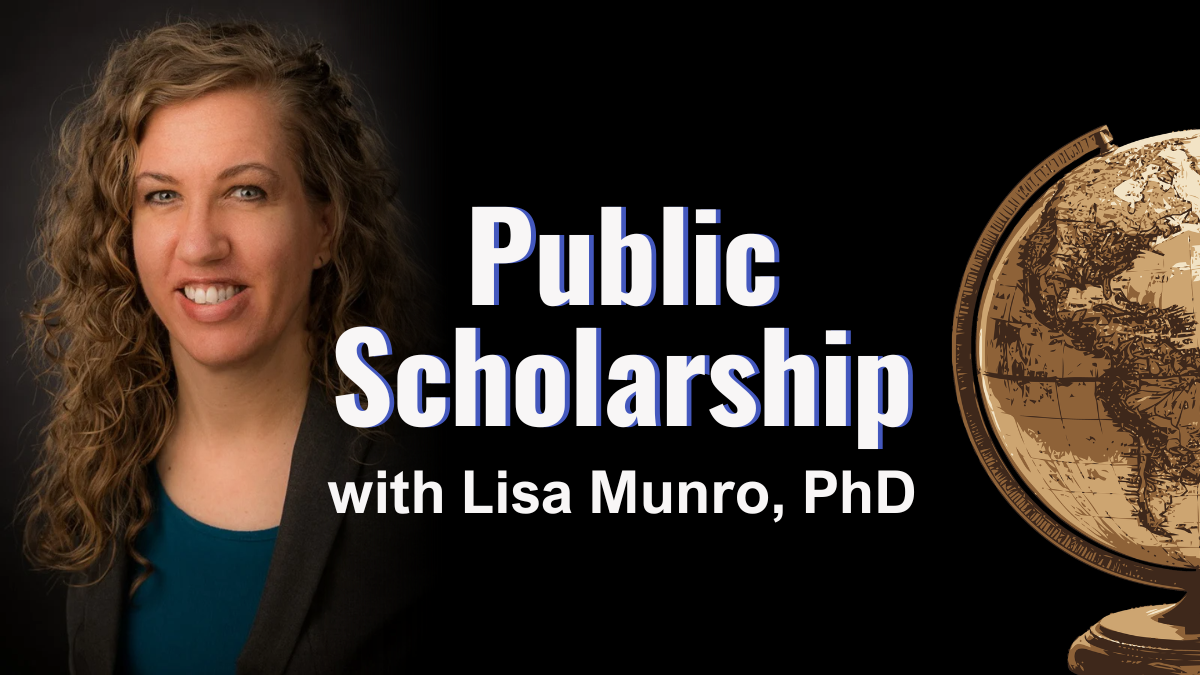
Lisa Munro, PhD talks public scholarship and her new consulting website, Bridging the Americas on The Social Academic Podcast.
What do you do when you’re really excited about an opportunity, but life prevents you from being there? When she couldn’t make her flight from Mexico to the United States for her TEDx audition, Lisa Munro, PhD didn’t let falling ill keep her down.
We’re back with Dr. Lisa Munro! This is our 3rd episode together for The Social Academic Podcast.
In this episode
- Her public scholarship and public writing journey
- Recording her 3 minute talk and sharing it on social media
- Making her new consulting and portfolio website, Bridging the Americas
We have agency is sharing what we care about. Lisa says, “I never give up on my writing. That’s just one of my rules—I just don’t give up on it. Either it finds a home or it ends up on my Substack, so it’s public scholarship in one way or another.” I hope this episode inspires you.
Subscribe to The Social Academic blog.
The form above subscribes you to new posts published on The Social Academic blog.
Want emails from Jennifer on building your online presence? Subscribe to her email list.
Looking for the podcast? Subscribe on Spotify.
Prefer to watch videos? Subscribe on YouTube.
Quotes from Lisa
Writing Is Community
“The myth of the lone genius is a myth. Nobody is getting writing done that way—people get writing done by talking to people, sharing ideas, and asking, ‘Can I bounce this off of you?’ Writing is community, and I think that feels really hopeful.”
On AI Writing
To ChatGPT: “I’m funnier than you…I’m a better writer than you, and I have better ideas.”
“There are a million ways to get writing done that don’t involve you actually writing, but human writing is really worth pursuing. If all of our writing is done by robots, what does that look like? That sounds profoundly dark to me.”
Sound Like You Talk
“William Zinsser says writing is talking to people on paper, and so it should sound like you talking to people. You’ll know when you read my writing because it will sound like me talking to you—it will have premium jokes, snarky parentheticals, and real human emotion.”
In this interview
Introducing Lisa Munro
Jennifer van Alstyne: Hi everyone! I am back on The Social Academic Podcast. I am Jennifer van Alstyne, and this podcast is all about online presence for professors, researchers, independent scholars, people who have something to say and want to be intentional about where you’re sharing it online. Dr. Lisa Munro has been a guest on the podcast multiple times, but this is a special episode for me because this video, this video that kind of sparked the idea for us meeting today, it’s kind of about public scholarship. It’s about how can we still have agency in getting reports out there when something goes wrong. Lisa, before we get into the story, would you introduce yourself for people?
Lisa Munro, PhD: Yes, I sure would. Let’s see. I’m Lisa Munro, PhD. I was trained as an academic historian and I had an academic writing business, still do. I’m taking clients less frequently these days, but I’m still doing that. And then also worked a long time in international education. I have a lot of background doing that. I live in Mexico, so a lot of my work tends to be both intellectually and personally transnational in scope. I just launched a brand new website that we can talk about called Bridging the Americas to help do that work.
Jennifer: Fascinating. Academia to academic editing and now to consulting based on your expertise, your real ability to help people. I’m really excited for you in this new journey. Last time we were live together on The Social Academic, we were talking about public writing. We were talking about ways that you were taking more action getting the essays, the thoughts that you wanted to share, and actually publishing them. How has that been? I’m curious for your update.
Public writing and aparta lugares
Lisa: Well, I wouldn’t say I’ve been spectacularly successful, but it has been learning, which is the whole point. When I started doing some public writing, one of the first big pieces I put together was what turned out to be a book chapter. I thought it was an essay. I though it was a really long essay. And I sent it to a journal that was not a good fit for it and it immediately was rejected and I was devastated. I was like, “Okay, but I still think this thing has things to say.” I never give up on my writing. That’s just one of my rules. I just don’t give up on it. Either it finds a home or I have started a Substack. It ends up on my Substack. It’s public scholarship in one way or another. I’m still pitching. I’m still writing. I still have a list of things I want to write. I still have books in process. It’s a lot. I mean, I’m writing all the time. I just finished an essay and sent it off last week and I was like, “Yes, amazing.” And we’ll see, does it land or does it not land? I think I’m getting better at pitching. The book is kind of a natural scope for me. Everything in my brain is a book. And so what I’m learning is that I can’t send essays out into the world that are, “Here’s my grand theory of everything,” because I do have grand theories of everything, but nobody wants that. Nobody really wants that. The stuff that I have been more successful with have been shorter pieces and with what I would call mildly interesting observations. Not super exciting, but mildly interesting. Now when I’m writing I’m like, “Okay, this has to be bounded in some way. You don’t get 7,000 words to just hear yourself talk. Maybe you get 3,000 or maybe you get less, maybe you get 800. Making it more bounded, more targeted, more focused, and without a grand theory of everything. I just finished writing an essay about informal governance and I was like, “Oh!” I was like, “I could talk about everyday forms of state formation,” which is this huge theory in my field. And I was like, “No, just no.” You can’t actually talk about that here. That would be an amazing and wonderful, that would be such a great essay or book, but you can’t talk about that here because you’re just talking about this mildly interesting thing that you saw.
Jennifer: What was the mildly interesting thing?
Lisa: The mildly interesting thing. Where I live in Mexico, there is a tradition that people call, aparta lugares. Aparta lugares means to leave an object, usually it’s a bucket in the street and you’re kind of reserving your parking. And so everyone’s like, “Oh, it’s just kind of this quaint custom.” But I was like, “What?” It’s just so interesting that suddenly this bucket, which is just a bucket, suddenly it performs work of governance. When people see it in the street, they’re like, “Don’t park there. Didn’t you see the bucket?” And you’re like, “Why are we all obeying the bucket?” I’m not sure. And so when I started thinking about it, this whole story came out about informal governance and public space. And so how when there’s not adequate formal governance, kind of informal governance kind of comes into play, but it’s not often visible and the buckets made it visible. I was like, “Oh, so I’ve now uncovered this whole layer of informal governance that’s happening right outside my house.” I think I have some thoughts about that.
Jennifer: I love it.
Lisa: Finished writing about that and sent that off and I’m just waiting to hear.
Jennifer: Wait, Lisa, I’m trying to picture this in my head. Are these, I don’t know, buckets filled with sand or water or something? Are they heavy?
Lisa: Sometimes they’re filled with trash. Sometimes they’re filled with sand. The serious buckets, people will have filled them with cement that would support a rod. It’s more visible, it’s more serious. Sometimes people will put in a pinch, people will use cardboard boxes and then sometimes broken crates. I found a row of broken cinder blocks one night on the street. I’ve been taking pictures of these objects. It’s become kind of a hobby of mine to take pictures of them and think about what does it mean when people start privatizing public space, informally privatizing public space? What does that mean for governance? What does that mean for parking? It makes parking worse for everyone. But this is the system and there are significant political constraints that mean this system is hard to change now. That’s what I wrote about.
Jennifer: Fascinating. Ooh, that sounds like such a good essay.
Lisa: Thank you.
What went wrong with Lisa’s TEDx pitch
Jennifer: I’m curious because I know TEDx speaking about the things that you care about, this was a goal for you this year and you actually had a TEDx audition scheduled. Tell me a little bit about what happened.
Lisa: Yeah. Actually, I had an essay. Well, my giant book chapter that everyone was like, “No, we’re not going to publish that because you were so over the word limit and this is so all over the place,” was a book chapter called The Cultural Romance with Death. The Cultural Romance with Death was about Route 66. It was about this romantic idea that people have about Route 66 and heritage roads and how the emotional attachment that people have to that road makes it hard then to implement safety changes. People are like, “Oh, you can’t change it.” It was, “Sorry, it’s a heritage road.” And it’s like, “But we need a crosswalk.” “No, no, no, you can’t!” There’s always this kind of struggle over this road and what it means and can you change it? Can you not change it? To what degree can you change it? There’s a lot of debate over that. I was in Albuquerque and doing field work on what was Route 66. I was standing on the road with a notebook and I was like, “Okay, people driving too fast and here are people not stopping on red and here is this and people can’t cross.” I did a bunch of field work, wrote it up and I thought maybe this is my pitch for Albuquerque TEDx. I sent it off and I did get invited to do a three minute pitch. Keep in mind that the cultural romance with death as a very long essay or a book chapter, it was 8,000 words. I mean, it was a monster and it’s like, how do you fit that in three minutes? You can’t. I had to be very economical about it. I really had to think about, “Okay, what is the important point here?” The important point for that purpose was that roads are stories and they tell us who really matters in the story and who doesn’t really matter in the story. And so that was really the point. I put together this pitch and I was like, “Okay.” And it was the night before I was supposed to fly. I was flying from Mexico to Albuquerque and I ended up, I was sicker than a dog. I couldn’t get out of bed. I was like, “Oh, I guess I’m going to have to cancel.” I canceled and I was like, “I’m so devastated about this,” but the talk still existed. I’m not going to waste it. I sat down at my desk at one point and I was like, “I’m just going to record this.” This is going to be my home recording of this because it just should be out in the world. I sat down and I just recorded it. I think there were a couple points in which it was not professional. The production values were dangerously low. There were several moments where it’s like I did that thing that everybody does when they’re speaking. It’s like you look up when you’re trying to remember what you’re saying next and you’re like, “Oh god, I’m doing that thing.” And then trying to read the script, I was literally reading off paper and I was like, “Okay, try not to read off the paper and I’m totally reading off the paper.” Very low production values. But the final thing was actually pretty good. I watched it and I hate watching myself on video, but I did. And I was like, “This is actually kind of good.” This is actually a good talk and this would have been a really good talk. What am I going to do with it now? And I was like, “Well, I’m going to put it on my website,” my new website for Bridging the Americas. I’m going to put it on my website as an example of kind of how I think about things. It’s now on my website. I’m probably going to rerecord it at some point. I think I have a better idea how to make a recording that has better production values. I’m going to do that. And I put it out on LinkedIn and I think maybe on Instagram. I put it somewhere else. Now it’s out in the world. I’m like, “Okay, it’s an example of how I think about things.” And yes, you can put me in a room or you can put me in front of a camera and I can talk to you about something very complicated and huge in three minutes. That was the value.
Recording video at home and public scholarship
Jennifer: I am really curious about the tools you used for the really low production value version. Was that just Zoom?
Lisa: It was not Zoom. I was like, “I wonder if Windows has a built in thing for this.” Surely they have. It’s like everybody’s recording video these days in some form. It’s Instagram or Zoom or it’s this or it’s that or it’s YouTube. And I was like, “Oh, surely Windows has something.” Windows has something called Clipchamp. And I was like, “Okay, we’ll see how this works. If it’s too complicated, I’m not going to do it.” But it was not very complicated. And I was like, “Okay.” And it can blur the back. It can give me a nice virtual background and I’m just going to do it. I’m just going to sit here at my desk with my webcam and my headphones and just do this. I played it back and I was like, “Okay.” And I could, I could upload it to different platforms and now it’s on my website. It did what it said on the tin.
Jennifer: That’s what matters. That’s what you used the first time. Are you going to change your tool for the second recording?
Lisa: That’s a good question. I mean, I don’t have a YouTube channel because I feel kind of…
Jennifer: Yet…
Lisa: Yet, yet. I feel kind of self-conscious on video, but I think maybe as my new initiative, Bridging the Americas is growing, maybe there’s a video, maybe there’s a YouTube channel involved in there. Right now it just has Instagram and LinkedIn and my website. Oh, and a Substack. Substack. Yes, it went to Substack too. Yeah, out in the world. But I’m going to try maybe a couple different tools. I think I’ll try Zoom. I used to record video. I feel like I used to record unlinked or unlisted video on YouTube. I feel like there’s a way to do that maybe. Maybe even just with my phone.
Jennifer: I feel like phone cameras are better than webcams.
Lisa: Yes. I feel like there’s so much better and I’m like, “Why could I just not speak into my phone?” I could just totally speak into my phone.
Jennifer: Yea.
Lisa: It would be fine. Yep.
Jennifer: It probably would be just as good, if not even better. Try it out!
Lisa: Yes. I’m going to try it. I’m going to try and rerecord the Route 66 thing. And then also I have a talk I do on adoption politics and I’ve done it several times and I’m like, “Oh, what’s the three minute version of that?”
Jennifer: I love that idea.
Lisa: Here’s another thing that I work on. I made a part of my website that’s called the research office and the research office is literally just anything I’m interested in. It gets space there. It’s like, “I’m interested in this and this and this and this other thing and this other thing and this other thing.” And it’s definitely part of the research office.
Lisa’s new website and business – Bridging the Americas
Jennifer: I would love to hear a little bit about your new website. Tell me not only what prompted it, but how it feels to actually be doing this work. It’s not your first website-
Lisa: Not my first website.
Jennifer: Does this one feel any different from the previous ones?
Lisa: Yeah. I had this academic writing website and I love that website so much. And I still have it. I’ve hidden it from search engines, so it’s a little harder to find right now because I’m trying to boost the new one. But I really love that website because I wrote great copy for that website. I invented phrases that became very closely associated with me. “I am permanently outraged for you about this!” I mean, everybody I see who has a website is like, “Oh, I do this and I do this and I can offer you this and I can do this.” My website recognized people. People would read my copy and they were like, “I saw myself there. You understood my problem.” I’m like, “Yep, I sure did.”
Jennifer: That’s such nice feedback. I love that.
Lisa: It was really good feedback because it’s like everybody starts with themselves and I started with them. That was kind of the shift there. It was a great website. It was like, “I am permanently outraged for you that no one has just sat you down and taught you these skills that you need to succeed in your job.” I mean, I really hit, and I didn’t have to do a lot of market research because I had worked in higher education and with writers and I kind of knew their pain and what they wanted and there wasn’t a whole ton of market research involved. Now my new website is hopefully going to launch me into more corporate consulting and binational consulting. That’s a new space for me. I’m a little intimidated, but I’m continuing anyways. That’s taking a lot and it feels a little mushy in places. Who is this really for? I don’t quite know yet. I have guesses. I have hypotheses. I don’t have actual facts yet. I’m like, “I think this kind of person would be interested in what I can do for them, but I don’t know yet. I think these are their pain points, but I’m not totally 100% sure yet,” because I just haven’t done the market research. This is going to take a lot more learning, a lot more researching than I have done previously. But it’s an interesting problem to deal with. Can I understand well enough what people are struggling with to be able to articulate it?
Jennifer: That’s fascinating. I feel like that transition point is such a good time to build a website. Honestly, the hangup that most people get in once they’re there is that because I’m still in hypothesis mode, I don’t know what goes on the website, but I think you’ve really embraced that mindset that things will adapt and change over time to meet your needs, to meet the needs of the people that you’ll be consulting with and the organizations. And it might be that you need things for different people in different countries. It’s really exciting that a website can adapt to that and exciting that you didn’t wait for all of that information to start sharing what you care about and what people should know about you now.
Lisa: Yeah, absolutely. It’s far from perfect. There are definitely going to be moments in which I’m like, “Ooh, I was totally wrong about that. People don’t care about this, they care about this other thing.” Or “They’re not struggling in these ways that I thought, they’re struggling with this thing instead.” It’s going to have to change and it’s going to have to adapt as I meet people, talk to people, do more market research, ask people, “What are you struggling with? Where are you struggling? How does this show up in your work? What would you want to know about this or where would you like help and support?” Until I do that work, I can guess, but I’m not totally sure and I’m willing to be wrong. And then I think the other thing is to not let … academics are always like, “Ooh, I need to read 50 books first and then I’ll proceed. And then maybe I can give myself permission to have an idea.” I think we should just take that and throw it out the nearest window and you have to move forward even though it’s not perfect and you don’t know enough. Of course you don’t know enough, but you have to move forward anyways without complete information.
A business conference and website evolution
Jennifer: Yeah, have to. I’m curious about the timing. I know that this idea of testing the hypotheses, actually talking to people is important to you. And I know that you’re doing some travel with that goal in mind coming up. Are you excited that the website is at a point where you can show it to people?
Lisa: Yes! I mean, that was one of my things because I’m going to a tri-national business conference, first business conference. I’ve been to conferences, not business conferences. I’m like, “Ooh, what do they talk about? What is this culture? How do they do it? I’m going to become a temporary anthropologist.” But thinking about if I give someone a business card, I mean the first thing I would do … this is what I’m guessing. You give them a business card, they’re back in their hotel room, “Oh, I wonder what this is,” and they’re Googling. And I want the website to be the first thing or my LinkedIn. Either one is fine, but I want them to be able to land on something and go, “Yep, I know what you do.”
Jennifer: I love that. And you feel like your LinkedIn is doing that for you? I know that for a lot of people at a transition time, sometimes they feel like their profile no longer reflects what they want people to know. Were you updating the LinkedIn as well as the website?
Lisa: Yes. Yes. And I mean, the text on my website changes because I’m pathologically incapable of leaving well enough alone. I am changing it a lot. It’s really an active development right now. But I think it’s to a point where I’ve come up with some good phrases. I have kind of a vocabulary that I would like to use. I would like to use certain words, and I think I can take that, I literally, I have a file on my computer that’s like Style Guide. What is my style guide? What does that say? No unnecessary [words]. And I don’t use AI to do this either, I should say that, because I think AI is useful if you’re like, “I need to build this giant data set.” I think it’s useful for that, but write a paragraph for me. I’m such a better writer. I’m a way better writer than ChatGPT. I’m like, “I’m funnier than you. I’m still funnier than you, and I’m a better writer than you, and I have better ideas.” I think AI, it has some uses, but is it going to write my website for me? No. Is it going to write my essays for me? No, because I want to do that work. But I do think it’s useful, I think to create. I mean, creating web copy is, I’ve kind of made this copy bank. Here’s a metaphor that really resonates with me. Here’s an idea. Here’s kind of a metaphor I want to use or here’s some really clever language. I was playing this morning with this idea of “I do not dish up meaningless corporate oatmeal.” And I was like, “Anybody who’s been on the receiving end of meaningless corporate oatmeal is going to totally understand what I mean.” I’m sorry. I can’t talk to you about synergy because I don’t even know what that means. I literally can’t do that. I don’t want to give you strategic and actionable insights because I can’t really be that person either. But what I can do, I can tell you what the straight s**t is. Oh, I can absolutely do that.” That’s kind of one of my phrases, that goes in the copy bank. Yes, absolutely or, “Here’s what no one else will say.” That’s one of the things I go back to a lot. “Here’s what no one else will say,” very unpopular opinion. I just have phrases that I kind of just have this bank of them that I work with.
Jennifer: What I especially like about that is that your phrase bank is not things that you think other people should hear. It’s things that feel inherently like you, what you would say to someone in person if you were having this conversation. If it wasn’t asynchronous, it’s fascinating that you are actually taking these phrases and making sure that they appear in the copy by tracking what’s important to you and what feels most like you. I have not heard of instances like that before. I’ve heard of people who are thoughtful and considerate about their style or their tone, how they come across, but honestly, it’s usually more generalized than the efforts that you’ve done.
Why write without using AI
Jennifer: I really appreciated what you said about having ChatGPT write for you. I have friends who really, they love the writing process with an AI. I think it really works for some people. As an editor, I’m wondering if you relate. I really struggle with the time that I have to spend editing, writing and outputs from AI. Editor brain for me is a mean brain. I’m not a very nice editor. Honestly, this is why I don’t do poetry editing or creative writing editing. I don’t do this for work because I find myself being placed in a negative space that I don’t want to be. I try to avoid that at all costs in writing for my business, writing for faculty, writing for academics. I want to have good feelings about it. I do all the writing myself. I think some of my friends who are especially marketers or people who’ve really embraced AI or even train people on AI, they’re kind of like, “Jennifer, what are you doing?” I use AI for other things, but not for writing because it drives me nuts.
Lisa: Yeah.
Jennifer: I’m curious about the feelings that you have when you’re thinking about AI or other people are thinking about AI in relation to their writing as well.
Lisa: Yeah. I mean, not everybody is a great writer and I get that. I had a whole business about that. Some people really struggle with writing. I think it’s a learnable skill. I think it’s something we can all get better at, but if it is not something that comes naturally to you, you need help with. Yeah, I’m not opposed to people getting help. That’s never been my shtick. If you need help, you need help. I do think that people’s writing is starting to sound, at least from what I kind of read on the internet, kind of homogenous. It doesn’t sound quite human to me. You’ll know when you read my writing because it will sound like me talking to you. It will have premium jokes. It will have these snarky parentheticals. It will have outrage at certain moments. I will yell in all caps. You’ll feel like it’s really, truly human because it is, because it’s me. It’s not like I invented this marketing persona. I’m not some snarky marketer. That’s not a shtick. That’s me talking to you. And I think it was William Zinsser who’s just so amazing, on Writing Well, he says writing is talking to people on paper and so it should sound like you talking to people. I really carry that with me because I want to talk to you and sometimes yell in my copy. That’s important to me.
Jennifer: Oh my goodness. This has been such a fun conversation and I love all the little updates for some things that we’ve talked about as themes for our past episodes on The Social Academic. If you’re tuning in to this one, be sure to check out our last episode about public writing. I think that was also full of tips and advice that academics could use if public writing is a goal for them. Please check out that interview on The Social Academic from last year. Lisa, is there anything you want to add before we wrap up? This has been so fun.
Lisa: Yeah. I think anybody who’s doing writing these days, I mean, it is hard. There’s a million ways to get writing done that don’t involve you actually writing, but I think human writing is really worth pursuing.
Jennifer: Can you elaborate a little on that?
Lisa: Yeah. I mean, I sort of think about the future side, the dystopic future maybe. I think about the future sometimes and I’m like, “Oh my God, if all of our writing is done by robots, what does that look like? What does that mean? What is that going to sound like?” And it sounds kind of profoundly dark to me.
Jennifer: Okay. I want to end on a little bit of a lighter note. That sounds like the bleak future we all want to avoid.
Lisa: Yep.
Jennifer: What is your hope for academics when it comes to the agency that they have, maybe they don’t realize it for their own public scholarship?
Lisa: What gives me hope is the idea that, and I think it’s starting to really spread, that no one is doing this alone. People are not alone in their writing. The myth of the lone genius is a myth. I mean, it just is. Nobody is getting writing done that way. People are getting writing done by talking to people, by sharing ideas with people, kind of, “Hey, can I bounce this off of you” kind of stuff. Writing is community, and I think that feels really hopeful.
Jennifer: Lisa Munro, thank you so much for coming back on The Social Academic. This has been a joy.
Lisa: This is always so fun. Thanks so much.
Subscribe to The Social Academic blog.
The form above subscribes you to new posts published on The Social Academic blog.
Want emails from Jennifer on building your online presence? Subscribe to her email list.
Looking for the podcast? Subscribe on Spotify.
Prefer to watch videos? Subscribe on YouTube.
Bio
Lisa L. Munro, PhD, is founder of Bridging the Americas. She’s the historian, strategist, pragmatist, and institutional problem-solver organizations turn to when they’re tired of worn-out international strategies and partnership efforts that still don’t work. Her work focuses on complex institutional and cross-border problems, particularly across the U.S.–Mexico relationship.
She works with organizations that are fed up with good ideas getting stuck, promising partnerships going nowhere, and institutional knowledge disappearing every time somebody changes jobs. Because the organizational chart, strategic plan, policy, or signed agreement will only tell you so much. The rest is people, power, relationships, history, knowledge, and unwritten rules.