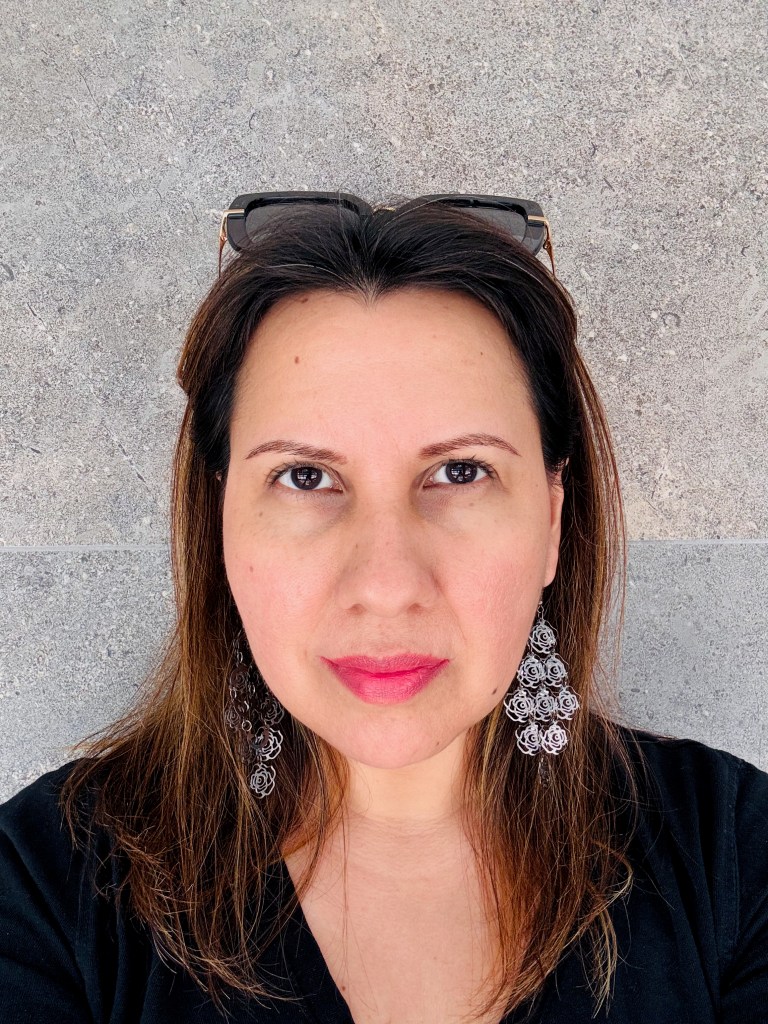
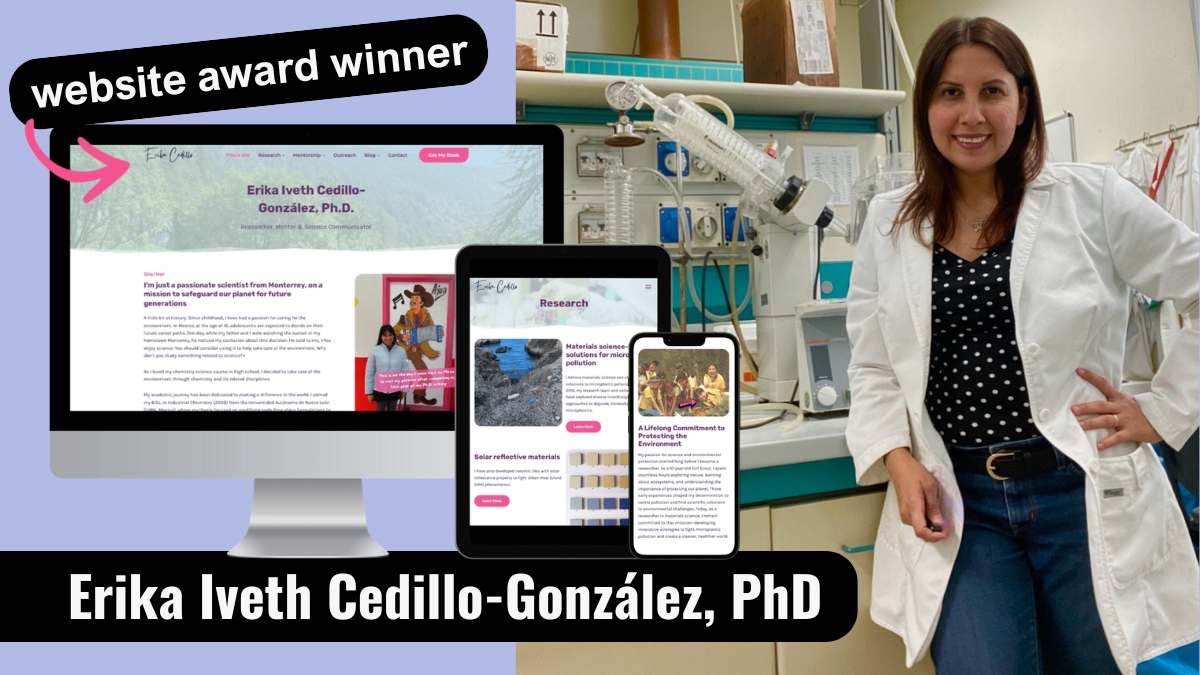
A scientist website that’s approachable, research-forward, and engaging from Erika Iveth Cedillo-González, PhD.
Let’s talk about science communication and your academic website. This episode of The Social Academic Podcast features Dr. Erika Iveth Cedillo-González, a Mexican materials scientist, mentor, and science communicator. It’s part of our series featuring winners of the Best Personal Academic Websites Contest.
Quotes from Erika
On her original website
“When I work in those universities, I had my personal website, but it was so institutional. And I always feel that it was cold, that it was very away from students, from possible collaborators.”
Sharing our stories
“My mission with that website was that people can see that are different kinds of scientists with different stories, but that all we can be successful in research.”
Beyond the lab
“I think that it’s very important to take our science outside the laboratory and make available to people, but not only to adults or youngers or young people, but also to kids.”

Interview
Jennifer van Alstyne: Hi there. I’m Jennifer van Alstyne. Welcome to The Social Academic Podcast. This episode is part of a special series featuring winners of the Best Personal Academic Websites Contest. And today is all about a personal scientist website that really made an impact on me. I think it will inspire you too. Erika, would you mind introducing yourself for people who are unfamiliar with you?
Erika Iveth Cedillo-González, PhD: Yeah, thank you. Thank you, Jennifer for this invitation to this podcast. My name is Erika Iveth Cedillo-González. I’m Mexican. I’m a researcher in the area of material science. I’m working currently in microplastic pollution, finding solutions to microplastic pollution. I have worked in two different universities, one here in Mexico, where I am currently, named Universidad Autónoma de Nuevo León for four years as Associate Professor. And then I work as Associate Researcher in the University of Modena and Reggio Emilia in Italy because my family, I have two countries, Mexico and Italy. And yes, I don’t know what to say.
Jennifer: That’s perfect.
Erika: Sorry, I’m a little nervous.
Jennifer: Thank you so much. Microplastics is what really, I feel like, drew me into your website. One of the things that I wanted to start off with today is that your website feels so personable and welcoming. I get a sense of your personality there. It shines through. I feel like this is something that as women of color, sometimes we’re told to tamper down our personalities or to be a little bit less than. I love that your website is so unapologetically you. How was that process? What did it feel like to create that space for yourself online?
Erika: Okay. Yeah. When I work in those universities, I had my personal website, but it was so institutional. And I always feel that it was cold, that it was very away from students, from possible collaborators. And I always feel that those websites doesn’t talk about me, about the person that is behind all that research, all that ideas, all that articles. So yes, I made a first attempt of a website that was terrible, was awful. I didn’t like that because my idea was to first find some examples of academic websites, and I just copied the sections. And it felt again, cold and not personal.
Then I decided to restart from zero again. And I reached a challenge, an online challenge for building websites with no knowledge in 10 days. I studied how to build my own website, and it gave me the opportunity of being me in that website. I choose my favorite colors, pink as you can see, and something that can be a good combination with that color. And I decide to tell people my story because I consider that I don’t have a traditional academic path. I have been in two different universities because of life, and I have been in many situations that are not the traditional path that one imagines for academics. My mission with that website was that people can see that there are different kind of scientists with different stories, but that we can all be successful in research.
Jennifer: Thank you so much for that. It sounds like you created a website. It didn’t meet your needs. It still felt cold. And so you went and you got training, a 10 day challenge for how to build your website. I love that story so much because there’s so many people who feel like the copying what they see is going to be enough for their needs. And you showed exactly why it wasn’t in your case and created something that was uniquely you. I love that.
Erika: Thank you.
Jennifer: One of the parts of your website that felt different from what other people do is the mentorship section. It felt invitational. It felt resourceful. It felt usable for the people that you might mentor or work with in the future, or even to help them share who you are if they’ve moved on to other areas of their life.
Tell me a little bit about what inspired the mentorship page on your website.
Erika: Okay. I have a podcast with a few episodes about helping the Spanish speaking community of researchers, new researchers with the everyday problems of being a scientist. Through that podcast, I learned that I’m not a mentor only in the academy, but also outside because I received some beautiful comments of listeners and then I decided to put all that information in my website because I wanted people to visit my website, that I imagine that many of those persons can be students. They don’t feel alone because my own story is that I had great professors as tutors of my master thesis and my PhD thesis, but they were not really mentors. I was so alone through that journey. And I think that if I knew that information before, the information that I tried to share in my podcast, my life will be easier in those moments. I want that, I think that many talents that are in academia at the end of the journey, they left academia because no one is saying, “You can be here and it can be easy.”
“That’s why I created the podcast and then I created the page of my website that talks about the podcast because I think that we cannot allow the loss of all those talents that can change and that can change our society, make a better world, but they feel alone. I don’t want that they feel like this. Yeah, that’s why I put also my podcast in my website.
Jennifer: Your podcast is such an interesting format in that it is something that can be part of the mentorship, but also shared as a resource for mentorship. I love that you’ve made it so publicly accessible for people. It’s something that can help people for years to come, even if they’ve never met you personally. And I think that’s really exciting.
Erika: Thank you.
Jennifer: When it comes to outreach, I know that you have a book about microplastics. Will you tell us a little bit about that and how you created space for it on your website?
Erika: Okay. Yeah. The book is called Pelucco because Pelucco means linked in Italian. It is the link that releases from synthetic textiles. And yeah, I started Pelucco because in 2020, I was following a course about outreach, but in documentary format. I have a final project to show to my professors and I made a very cringe video about using two lean balls. One was Pelucco, the other was the mother, and I presented that project. The teachers loved the idea, but they told me that it was not good for the commentary format. They recommended, advised me to make an animation, but I hadn’t the economic resources for making animation. I started with my husband that is a writer to write a column in a small journal for kids in Italy. It was in Italian. And then I had just one page to explain all the problem about microplastic pollution.
For me, it was a very limited space. Then when we finished that column, I asked my husband to write a book. He doesn’t want it because he thought that it was a very difficult process to write- And then we decided to, I’m sorry, I think I lost you.
Jennifer: I froze for a second. Would you mind repeating that?
Erika: I’m sorry. I’m sorry. Then with my husband, I decided to write the book. Yeah, he was in a little doubt, but then we started to write the book and I wanted to explain to kids and their parents the problem of microplastic pollution from a science point of view with real information that many scientists have collected in many years, in 20 years. And yes, I think that it’s very important to take our science outside the laboratory and make available to people, but not only to adults or young people, but also to kids. Because in my outreach experiences they are all in person, not online, I have seen that kids understand better the problem and they propose many solutions, many very funny and ingenious solutions to the problem, and they want to act in that moment. At that moment, right after the presentation, they want to act.
That’s why I decide to put also a page in my website about the book because I want that book to reach more people, and yes, that is more or less my answer.
Jennifer: That is beautiful. I really, I love this story. It sounds like it grew over time. You didn’t know it was going to be a book at the start. It was just a column that was a reaction to some advice you got about the animation. And I really think that having something grow over time is beautiful and it doesn’t just have the page on your website, it has its own website. Is that right?
Erika: Yeah, it’s right because even if Pelucco started like a column, now it’s a whole project with outreach and education. We are writing a second book about the story of Pellucco and we are incorporating research because now I’m outside the university, but I’m starting my own laboratory. A private scientific laboratory, I have a big investor, it’s a woman and I have four partners, three partners, I’m sorry. And yeah, now Pelucco will have the research component. It’s not more a book, it’s now a whole project. And I want to impact people, not only making science and making products that can contribute to solve microplastic pollution, but also I want to receive some students and some other researchers in that laboratory too. Yeah, because that problem, it’s so complicated to solve, it’s so big that we need many minds working together. That’s why Pelucco has its own website.
Jennifer: Now that you have a book website, you have a project website rather, you have your personal website and they both feel like so personalized. They feel like you. And of course they can grow over time, but I’m curious, what feelings about your online presence have shifted from say back when you were unhappy with the more institutional website that you had to now? What feelings have changed for you?
Erika: Okay. The main feeling is that I’m allowed to have an online presence because my familiar story, my grandmothers, they were silenced. They had great ideas, but nobody listened to those ideas. And my mom, not so much, but she lived something similar, less than my grandmothers, but something similar. I think that my website allowed me to share my voice with the world. And at the beginning, I was very, I was not sure about sharing my voice. I was considering to make the same institutional website that many scientists build, because I want to stay with the rules of academia, but then I remember something that I read in the book of Tara Mohr, Playing Big, and she says that women have also the right to be brilliant. I think that there are many persons like me that feel in some field, we can be brilliant, but we have the fear of showing up.
I decide to use my website to show that I can be brilliant too, and I’m allowed to show that brilliance because in that way, I think that others can be outside and show their gifts to the world.
Jennifer: Oh, thank you for that. That was really powerful. I’m curious if you’re open to it. Do you have a message or something you’d like to share with people who are at the start of that project? They’re still in the institutional space, but they do want to be more like themselves. Do you have something to share with them or a suggestion?
Erika: Yes. I think that the first thing you have to do is to identify what is stopping you from building your own website because it can be many factors. It can be fear of being judged by the senior academics of your department. That is valid. It can be that you feel that you don’t have the tools, so you can do the same thing that I did. Reaching a challenge and learn some very easy tools, or maybe pay someone, asking for help, or it can be many other factors. I think that the first thing is identify the factor that is stopping you, then try to solve that factor. And I think that after you pass through that barrier, everything becomes easier.
Jennifer: Thank you so much. This has been such a good conversation and for everyone who’s listening, if you are looking for some motivation for your personal academic website, the Best Personal Academic Websites Contest is opening again. We’re planning on the end of May or early June at the latest. So I want you to know that there is a place for you to share your website. If you are open to making it, we would love to see you enter the contest. Erika, this has been so good. Is there anything you’d like to add before we wrap up today?
Erika: Yes. I want to thank you for building this community and building this great idea of doing your own website because you are giving visibility to something that I think that any academic feels, but sometimes you don’t know how to put it outside of you, how to understand that feeling. You are giving visibility to that issue, and you are not just giving visibility, but solving that issue. I really want to thank you for that.
Jennifer: Thank you. Thank you. I believe everyone deserves that online space. If it’s something that you want for yourself, you can do it yourself and you can also get support if you don’t want to do it alone. There’s many options, and I’m just excited for everyone who is curious about taking that next step. Yay! Thank you so much for coming on the Social Academic Podcast.
Erika: Thank you.
Subscribe to The Social Academic blog.
The form above subscribes you to new posts published on The Social Academic blog.
Want emails from Jennifer on building your online presence? Subscribe to her email list.
Looking for the podcast? Subscribe on Spotify.
Prefer to watch videos? Subscribe on YouTube.
Bio for Erika Iveth Cedillo-González, PhD
Erika Iveth Cedillo-González, Ph.D., is a Mexican materials scientist, mentor, and science communicator working at the intersection of advanced materials and environmental sustainability. Her research focuses on developing semiconductor-based materials and systems to address micro- and nanoplastic pollution, one of the most urgent environmental challenges of our time.
Erika earned her Ph.D. from the University of Modena and Reggio Emilia in Italy and has built international research collaborations across Mexico, Europe, Costa Rica, and India. Her scientific work explores innovative strategies to remediate plastic pollution using advanced materials and light-activated processes.
She is also the co-founder and Scientific Director of Pelucco, a project that combines science storytelling, environmental education, and research to raise awareness about plastic pollution and develop real solutions. What began as an award-winning educational initiative is now evolving into a research laboratory dedicated to advancing scientific approaches to combat plastic contamination.
Through research, mentorship, and creative science communication, Erika aims to make science more human, accessible, and impactful while inspiring the next generation of scientists.