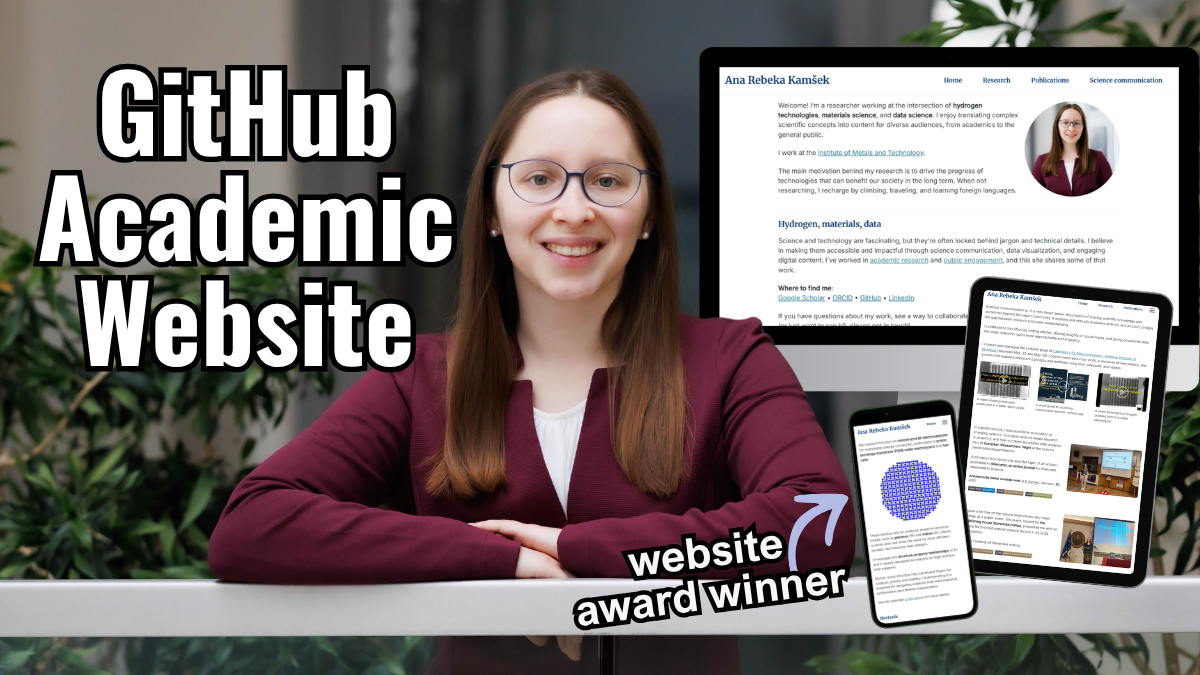
This interview features dr. Ana Rebeka Kamšek’s Github website for her research and science communication. This is part of the series featuring winners of the Best Personal Academic Websites Contest 2025 to share their website journey.
Dr. Ana Rebeka Kamšek is a Materials Science researcher in Slovenia. She hadn’t always dreamed of making a website. She worried before she started creating it that she didn’t have enough content to put there. Rebeka chose Github because she was already using it as a repository for coding for her research. While she knew there were other options for where to host her website out there, coding was a skill she knew and was open to learning more about for the design of your academic website.
Ooh at the end of our chat we get into talking about how Rebeka has approached getting photos of herself during talks and outreach events. She has super valuable advice to share about what works well for her. I hope you’ll have a listen.
This episode is available on YouTube, Spotify, and Instagram. The full transcript is below for you. Thank you!
Subscribe to The Social Academic blog.
The form above subscribes you to new posts published on The Social Academic blog.
Want emails from Jennifer on building your online presence? Subscribe to her email list.
Looking for the podcast? Subscribe on Spotify.
Prefer to watch videos? Subscribe on YouTube.
In this episode
Why use GitHub for a website
Jennifer van Alstyne: Hi everyone, this is Jennifer van Alstyne. Welcome back to The Social Academic Podcast. I’m here with another winner of the Best Personal Academic Websites Contest and this is all about building an academic GitHub website and what it was like for Dr. Ana Rebeka Kamšek to really create this space for herself, for her science communication online. Before we dive into you, could you tell me a little bit about GitHub? Is it something that you were using before for your research, before you created your academic website?
Dr. Ana Rebeka Kamšek: First of all, thank you so much for hosting me. I’m happy to be here. Yeah, as you mentioned, I used GitHub to make my academic website. So, the reason I chose GitHub was because hosting my website on GitHub meant I would have complete control over how it turned out. It required me to have some coding experience. I had to write some code, which required some work, but we have so many tools and resources for us today that it wasn’t extremely difficult. As you mentioned, I did use it in my academic life, which was one of the most important reasons why I chose this tool for my personal website too. Really short, GitHub is a platform that allows users to store and manage their code. It’s a very useful tool for tracking different versions of your code, for highlighting changes, for sharing it with collaborators and so on. For me, writing code was a very important part of both my master’s thesis and my PhD. I regularly wrote code to analyze microscopy images, to plot data. I always used GitHub for version control and for keeping a backup of my code. I couldn’t afford to lose any of the code because it was the most important part of my work.
Jennifer: Right?
Rebeka: And I liked the option to revert to a previous version that might have worked better. I also used GitHub to publish code that resulted in papers. Every time I had a paper where the code led to specific results, I would clean up my code and write some simple comments, upload the files and include a short description with the link to the paper. I thought that having public repositories was nice because whenever people would Google me or my group, they would find something that might be useful for them.
Jennifer: I love that.
Rebeka: This was the story why I chose GitHub. We can talk more about GitHub later, of course.
Jennifer: Yeah! Okay, that’s fascinating. Tell me a little bit about your research and your academic life, because I feel like I’m from a field that has no coding. I’m from English literature. I mean, there are people who do coding in literature, but I was not one of them. And so I’m one of the people who really didn’t explore GitHub as an option, even though I know a lot of people who really love it. It sounds like GitHub was the right place for you. You were already using it for other areas of your research. Tell us a little bit about your research.
Meet Dr. Ana Rebeka Kamšek
Rebeka: Sure. I’m a material science researcher. Currently, I work at the Institutes of Metals and Technology in Slovenia and I study materials for hydrogen technologies. In my work, I use microscopy and other experimental methods to learn more about nanomaterials. And I also spend a lot of time on data analysis to really take advantage of all of the experimental data we have. Real quick about my background at university, I first studied physics and then I got a PhD in chemistry. I became interested in material science because it felt like a field where it’s good to know a little bit of everything. And all of the data we collected when we investigated our materials meant I could also develop my coding skills to visualize the data to analyze it, gather more information about our materials while also making our lives easier. And aside from research, I’m enthusiastic about science communication. Whenever I get the chance, I write articles, I create social media content, participate in outreach events. I find that since I communicate science outside of my scientific community, this also makes me a better communicator for scientists and I enjoy exploring these two worlds and how they connect.
Jennifer: I really like what you said there, that being a better science communicator for the public also helps you better communicate science to other researchers. Why is that? Is there one aspect of that, for instance, that really clicked for you?
Rebeka: I strongly believe this is the case. I believe one aspect of science communication that is especially useful in academia is public speaking. Whenever I’m forced to speak in public about a complex concept to other people, it’s an excellent exercise for scientific conferences. Even though we’re all scientists from the same field at a conference, there’s still so many nuances and differences between our fields. It’s really helpful to know how to distill a complex topic down to something more manageable.
Jennifer: I love that. Science communication is something that shows as a value of yours, but also in what you choose to share on your personal academic website. I’m curious about what it was like to actually create the website. What was your journey like? Did you always know you wanted a website?
Did you always want a website?
Rebeka: No, not at all. Actually, it wasn’t until I saw your content on academic websites that I thought about making one for myself. I didn’t think I had enough to show, but then when I started doing it, it was a fun project and now I’m very happy to do it. Yeah. I also wanted to try something new. I wanted to write my own code for it, but I didn’t know any of the languages that are used to do that. This was something that I learned from scratch. I can also tell you that I did my website in different stages. There were so many iterations of it. When I started, I focused on the content first and how it looked second. I really appreciated the versional control function that GitHub offers because I made a lot of small changes to get the site to write this today.
Jennifer: Oh, I’m curious about how often those changes happened. Did you have a regular time in your schedule where you’re like, “I want to go update my website, it’s been three months,” or is this more like, “I had a bunch of changes that I wanted to see and then I made time for it.”
Rebeka: The second one, definitely. I tend to wait a little bit until I have three, four changes prepared and then I usually do them in one go. I find that this approach works well for me. I don’t have to think as often. It’s not an obligation, it’s just something I do for myself.
Jennifer: And you learned coding languages for this. Are there any tools or resources that helped you learn those things?
Rebeka: Sure. For the website, I used a variety of languages. I used HTML and parts of the website I wrote in Markdown. Those two I knew from my university years. And then for the design aspect, I had to learn a little bit of CSS. Now, I didn’t know the first thing about web design with CSS. I actually used a large language model [LLM] to turn some of my plain language suggestions into code snippets. I was using it as an assistant and this approach worked well for me and I’m proud of the result.
Jennifer: That’s great. I actually use Gemini to do schema for my website to help people find specific blog posts and things. There are so many things that we don’t know how to do that there are resources or tools that could help you. I appreciate you sharing that you used an LLM to support some of the coding for CSS on your website. Tell me about GitHub in terms of why you like it for your academic website. Did you even explore other options or were you always like, “Oh, GitHub is a good solution for me.”
Rebeka: I was aware that there are other options for making websites, including the ones that don’t require any coding knowledge. But by the time I was planning my own website, I already saw several pages by other researchers that chose GitHub. I saw that some of them made very nice minimalistic sites that were practical and resourceful and I thought that this would be a nice goal for my site. And to tell you the truth, I didn’t spend that much time exploring other options. At the time, I also didn’t think my website was that important. I saw it more as a public diary of my activities and I didn’t feel the need to choose something fancy. One thing-
Jennifer: I think you chose something that can be so fancy, like coding can get you anywhere.
Rebeka: Can be.
Jennifer: Yeah, yeah, yeah. There’s so much potential.
University hosted page vs. personal website design, what’s the difference
Rebeka: Sure. It can be fancy. One thing I did consider was asking my institution if I could host some content on their website, but then I decided against it because I figured I would not be entirely independent in choosing how the site looked and if I ever changed institutions, I would probably have to give up that space.
Jennifer: I appreciate you sharing that. Sometimes people come to me and they’re like, “Should I … I was offered space on my university’s website. Should I use it?” And I never tell them, “No, don’t use it at all.” But oftentimes I recommend, if you want to use that space, maybe use it as a landing page to help bring people back to a site that you have more control over. Because I’ve had so many people also come to me that have that university space that doesn’t quite meet their needs. It’s restrictive or stylistically you’re stuck with the brand colors and the feel of what was set up for you. It can definitely be nice to have your own space and get to control that. Is there something that you did in the design process to make sure that your voice, your visual preferences kind of stood out?
Rebeka: My design wasn’t very intentional, if I can be completely honest. I knew that-
Jennifer: Yeah!
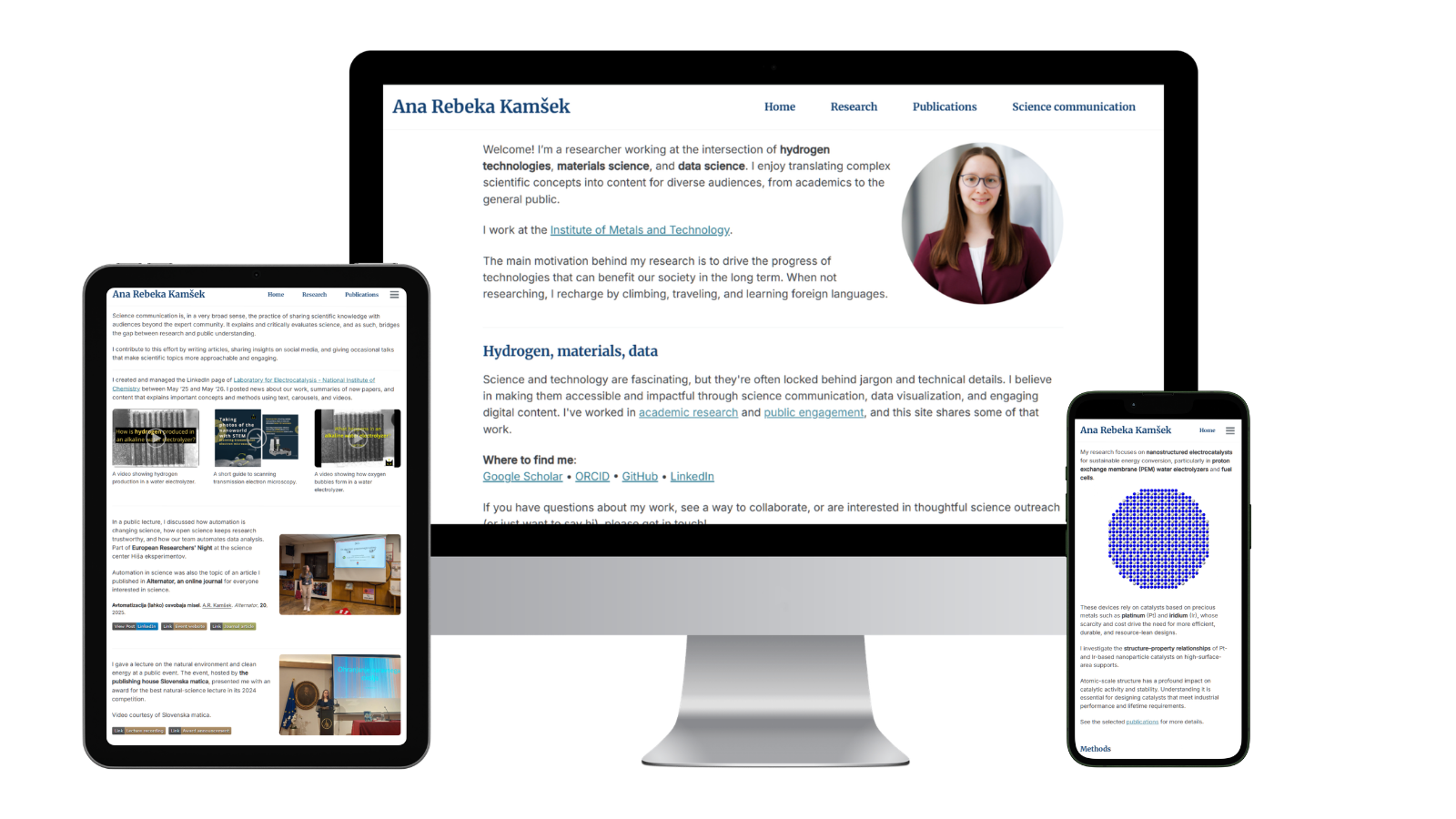
Rebeka: I wanted a minimalistic site. I didn’t want a very loud website, lots of colors. This just wasn’t me. My vision was just to create something simple that is clear, legible, accessible, and just understandable. I opted for simple fonts, simple colors, light background, stuff like that.
Jennifer: Is there anything that you tried that you didn’t like and you ended up taking it away?
Rebeka: Sure. Yes. I tried many things. I tried different color combinations and I actually had trouble sticking with one color combination. What I did was I visited a bunch of other academic websites to see what others were doing. And then I tried to think about what makes a site likable for me. I tried to identify elements that I enjoyed and at the same time I tried to identify elements that put me off. We could say that I copied others a little bit, but I prefer to say that they helped me find my voice.
Jennifer: Oh, I really like that. They helped you find your voice. And it sounds like you were someone who experimented. You tried different color sets, you tried things that maybe ended up in version one or two, but are no longer on the site. That’s really interesting. What is one way that your website has grown or changed over time? What wasn’t in version one but that you’re really happy is there today?
Rebeka: After that first version of my website, I didn’t make changes for a while. After a time I mostly updated content. I didn’t add a lot of new things to my website. For example, when I changed institutions a few months ago, I made sure to update that information and I changed an old photograph of me with the more recent professional one. I also realized that some parts of my site were difficult to skim, especially the short summaries of my papers. I played around with headers and spacing and so on. Part of what motivated me to do some changes was actually the feedback I received from the judges on your contest, especially the headers and spacing suggestions. Yes. That’s great. I don’t actively think about changing the site very often and I don’t plan any huge changes anytime soon. As my work life goes on, I guess I’ll just include updates when I’ll find them appropriate.
Jennifer: I love that. Something that adapts with you over time but doesn’t feel burdensome to keep improving or enhancing. That’s perfect. Okay. I am curious, what should other people consider? There’s people out there who feel like you at the start where maybe they’re not sure, do I need this space? Do I have enough stuff to put on it? You moved past that discomfort and you kept going. And so I’m curious, do you have a message or advice for someone who’s still in that space and wondering, should I do this? Should I make a website?
Social media platforms for scholars, what works for Rebeka
Rebeka: Online presence can mean so many different things. One of them as just mentioned is a personal website, but that’s just one way to do it. As we discussed already, most academics have the option for a personal profile on the page of their university or institute. There’s also several social media platforms that can be used to share updates. Obviously there’s LinkedIn, the professional platform, but some people communicate science really well through, for example, Instagram or TikTok. And then there are academia specific platforms like Google Scholar and ResearchGate. Having a profile on everything and keeping up to date with everything is a lot. For example, for me as a full-time researcher, it would probably be too much. Personally, I chose to make my own website, which was a one-time commitment and it only requires occasional smaller updates. I also have a LinkedIn profile where I post whenever there’s something worth posting about. For example, a new paper I like or a science communication event I attended and so on. I also have Google Scholar and ResearchGate profiles, but those two pretty much update themselves. I have almost zero work with those two and altogether that’s an amount of work I can absolutely live with. I think there’s also always the option of hiring someone to manage your online presence for you and there are several quality providers available to do that, but I haven’t tried that yet personally. Overall, I’m happy with the choices I made so far. I think it comes down to this for everyone. We should be content with our online presence, comfortable to some extent, quality over quantity and don’t force something that doesn’t come naturally.
Jennifer: I really like that. Are you someone who used to be on academic Twitter and then moved to LinkedIn or has LinkedIn always been the social media platform of choice for you?
Rebeka: LinkedIn has always been the platform of choice for me. I never use Twitter, so I didn’t experience this transformation of this platform. Yes.
Jennifer: Interesting, interesting. Okay. You have LinkedIn, you have Google Scholar, ResearchGate, but those are kind of easy to update. They tell you what papers you have when you get to add them. And then was there one other you recommended or was that it?
Rebeka: ResearchGate?
Jennifer: ResearchGate.
Rebeka: I’m not sure if you mentioned that. That one is very easy, not very dynamic.
Jennifer: Okay, having an online presence is something that is meaningful, but it doesn’t have to look the same way for everyone. And for you, thinking about what feels comfortable and fits into your lifestyle is what made the most sense and you’re always on LinkedIn.
Rebeka: This made sense for me. Although I don’t consider social media very important for me. The most important outlet I have is public science communication. Whenever I join an outreach event or write an article for a wider public, I believe this is a far more important outlet for me.
Jennifer: I love that. Okay, science communication for you is something that happens in person it sounds like. Is that right?
Rebeka: Sure. Yes, also in person. I enjoy outreach events that have different kinds of audiences, children, families, the elderly. They’re just fun to do and they’re very rewarding.
Jennifer: You are one of the few people I’ve seen that doesn’t just mention that they have science communication as a value, but actually created a page that acts like a portfolio for your science communication. I really admire that and find that I wish more people would create space to celebrate that kind of work on their websites. Do you have any advice for people who might want to create space for their science communication on their website?
Rebeka: Yes, I would say that this is the beauty of having your own website. Social media profiles usually have categories. Like on LinkedIn, we’re expected to assign our activities to either work experience or volunteering or education and so on. And on my website, there is no reason to limit myself. All of my science communication activities, which are different in format, different in topic that are sometimes months apart, but sometimes really close together. Everything can be included. My science communication side is a profile feed, but ordered the way I want it to be. I think this applies especially well to science communication because the activities are so diverse.
Jennifer: When you say it’s ordered in the way you want it to be, it sounds like it’s not in timeline order, is that correct?
Rebeka: Not always, yes. I wanted to show very different activities in one place. Articles for different audiences, social media content that explains science, outreach events, and so on. It’s difficult to just separate them. Different formats also meant I had to compromise a little bit, and in the end I chose to showcase each activity or each topic with one visual and a short description with relevant links, regardless of the chronological order of those activities. For example, I held a public lecture on automation in science at a local science center and I also wrote an article for an online journal on that topic. In my mind, those two went very well together. On my website, I included a photo of me at the lecture and the link to the article. And because the website is completely mine, there was no need to separate the two. For other activities, I also often had a photograph available. Planning that part of my website wasn’t very difficult.
Jennifer: Can I ask about that actually? Because I feel like one of the things people lack when they come to me for academic website design is photos of themselves at events or talking. Is that something that you planned in advance or how did that work? How did you get photos of yourself to share on your website?
How do you get photos for your website?
Rebeka: It wasn’t easy. To be completely honest, I didn’t think about photos for a long time. I didn’t mind having no photos, but then I realized that if I’m not proactive about getting photos, it’s not guaranteed that I’ll have any kind of proof or memories from that event. What I started to do was to just ask organizers what are their plans? And if there was no photographer, perhaps I would have a friend in the audience and I would ask them to just snap a photo or two of me in action so then I could use that as a memory and also to showcase online.
Jennifer: I love that. First you asked the event organizer if they had opportunities for photos available or if they were already planning something. And then if they said no, then you asked a friend or someone who was in the audience to take a photo of you. Is that right?
Rebeka: Precisely, yes. I think it’s good to ask the organizers first because then you can also plan some content together if that’s the case or you can ask how to properly attribute the photos. Maybe a photographer wants to be included by name. And if not, I also have to ask for permission to take photos of the event, right? In any case, it’s good to discuss with the organizers first.
Jennifer: I really appreciate you sharing that. That’s something that I really value. I do filming for … We have a family YouTube channel about art, art museums, art exhibitions. My father-in-law’s an art critic. And so we are going into spaces where there’s people who don’t expect to be filmed a lot of the time. And so we’re always really cognizant of one, asking permission. Sometimes they have signage that’s there to let people know that there’s filming in progress. But also sometimes we end up having someone walk into the shoot and we don’t use that section because we really want to honor people’s agency and their privacy. Not everyone wants to appear in a photo or a video. I think that’s really thoughtful and I really appreciate you sharing that about photos. People need this tip. They really do because they all want photos or just one even, one photo. And I think that there’s a lot of fear and anxiety that stops them from even asking the event organizers, which feels actually quite natural. I really like that recommendation. Thank you. Gosh, this has been such a fun conversation. We’ve talked about GitHub. We’ve talked about science communication. I’m curious, is there anything that we haven’t chatted about that you’d like to add before we wrap up?
How can people find Rebeka
Rebeka: Before we wrap up, I’d just like to thank you for inviting me to be a guest on your podcast and I really appreciate the opportunity to talk about things I care about.
Jennifer: Yeah. How can people find your website? I want them to all go check it out after they watch this.
Rebeka: You can find me on LinkedIn or you can also send me a message through the message form on my website. I also have to say that if you’re a scientist in my field, perhaps you’ll see me at a conference and in that case, please come and say hi.
Jennifer: Thank you so much for joining me here on The Social Academic. For everyone who has been watching, this is part of the series where we’re featuring winners of the 2025 Best Personal Academic Websites contest. Each one of them has their own journey and a different story to share about how they created their website and why it’s been meaningful to them. I encourage you to check out some of the other interviews, especially if you’re thinking about creating your own website and the next contest is opening up in mid-June 2026. We will be inviting entries for another round of awards. All right, thank you so much! I appreciate you all. This episode will be on Spotify, YouTube, and Instagram.
Rebeka: Thank you for having me.
Subscribe to The Social Academic blog.
The form above subscribes you to new posts published on The Social Academic blog.
Want emails from Jennifer on building your online presence? Subscribe to her email list.
Looking for the podcast? Subscribe on Spotify.
Prefer to watch videos? Subscribe on YouTube.
Bio
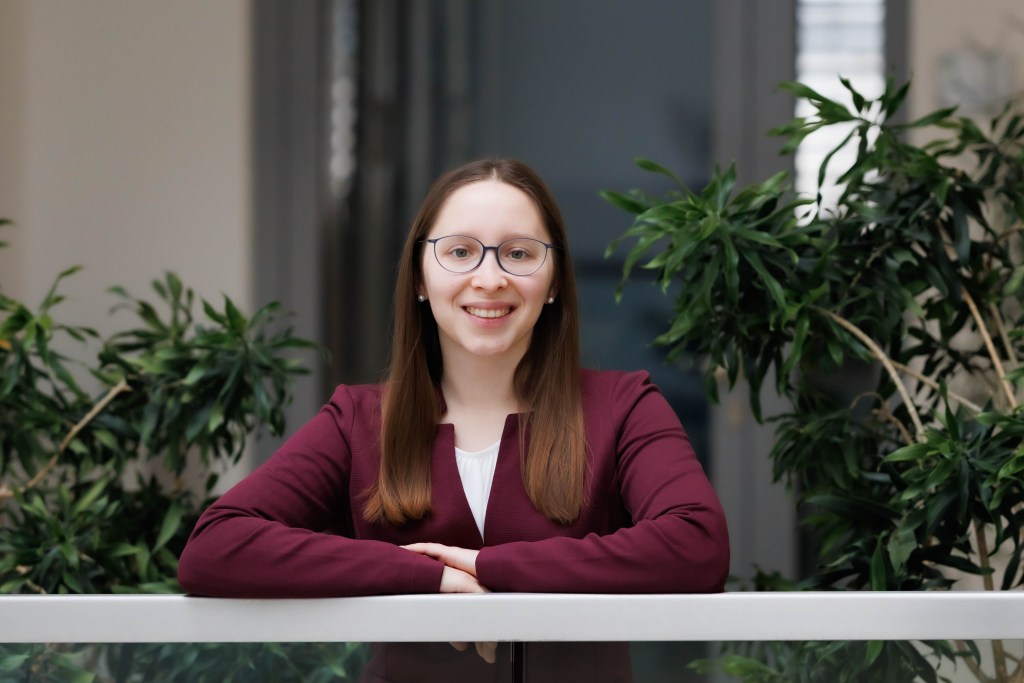
dr. Ana Rebeka Kamšek is a materials science researcher based in Ljubljana, Slovenia. Her work combines experiments with advanced data analysis to better understand what influences the lifetime of materials for hydrogen technologies. She also enjoys science communication and making complex scientific topics accessible to broader audiences.