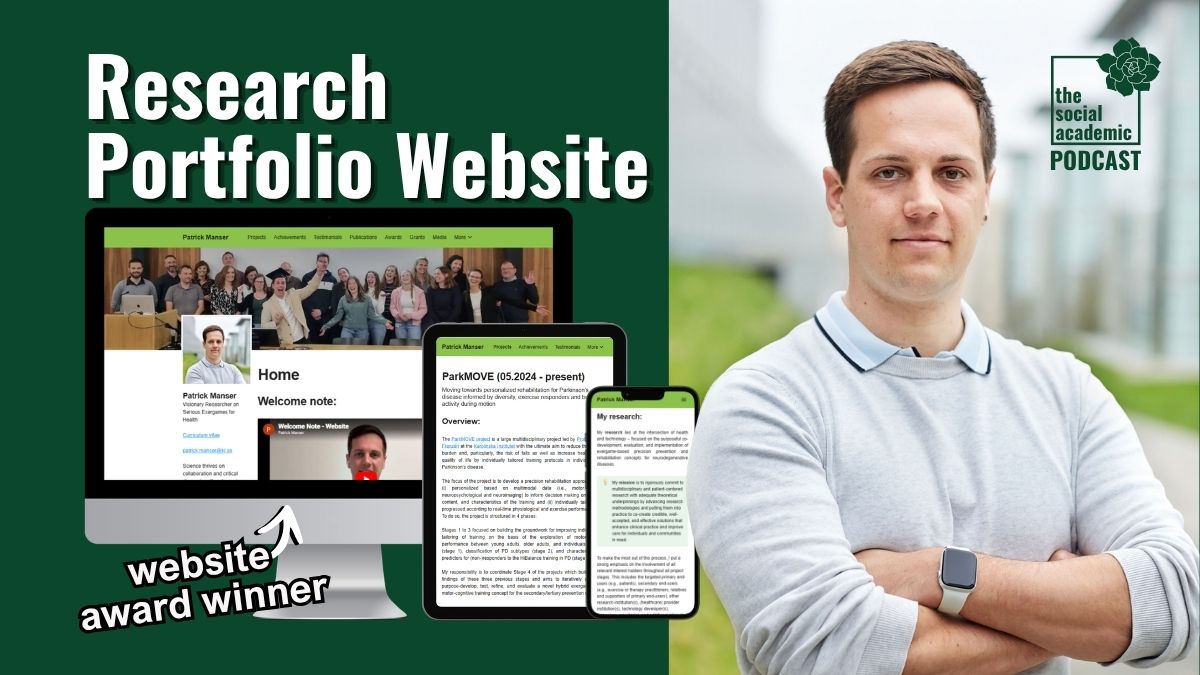
This researcher made his academic portfolio website with Owlstown and also worked with a website design agency for StepWave, the startup based on his exergame research. Dr. Patrick Manser joins host, Jennifer van Alstyne for this episode of The Social Academic Podcast.
Dr. Patrick Manser live from Switzerland, joins me on The Social Academic Podcast to talk about his personal academic website. This is an episode from our special series featuring winners of the Best Personal Academic Websites Contest 2025.
The 2026 Contest is open for entries through October 31, 2026. If you have a website as a professor, researcher, faculty member, research lab / group, or independent scholar, we’d love to celebrate your website too. View contest details.
In this interview, we talk about
- Dr. Patrick Manser’s exergame research and innovatio
- Launching his website with Owlstown with just 3 pages
- Growing his website overtime (it’s quite extensive now, Patrick calls himself an outlier)
- Working with an agency for his recently launched startup website
- His advice for researchers thinking about their own website journey
Hi, I’m Jennifer van Alstyne. This is The Social Academic Podcast, where I share interviews with academics about their online presence. There’s interviews and articles for you for when being intentional about how you show up online is a priority for you.
Subscribe to The Social Academic blog.
The form above subscribes you to new posts published on The Social Academic blog.
Want emails from Jennifer on building your online presence? Subscribe to her email list.
Looking for the podcast? Subscribe on Spotify.
Prefer to watch videos? Subscribe on YouTube.

Patrick won the Best Academic Portfolio Website in the Best Personal Academic Websites Contest 2025. Read what the judges shared in the award announcement.
Quotes
Public Dissemination of Our Research
“It should be part of our job description actually, public dissemination. We all kind of know that this is relevant and we should do it. But how many of us do actually do it? I feel like a website is the first step in that direction, just making it public, showing what we delivered out of the money that we thankfully received from foundations and other funding sources.”
From Outdated Info to Knowing What I Do
“One of the unintended positive benefits that it also had: now if you ask an AI about what I do, it knows exactly what I do because all the information is out there on my webpage. I feel like this is beneficial just for me as a researcher to build my credibility and reputation.”
Academic Website Builder, Owlstown
“I would actually recommend Owlstown because I worked with it for more than a year now and I still think it’s a very good solution because it’s tailored to us researchers.”
Make Your Website a Priority
“Having no time is never an argument. Time is always a priority choice. If you set the priority, you will make time.”
In the interview
Websites mentioned in this episode
The “Exergame as Medicine” researcher
Jennifer van Alstyne: We’re back on The Social Academic Podcast, and this is another special episode in our series featuring winners of the Best Personal Academic Websites Contest. Today I’m joined with Dr. Patrick Manser, who won an award in 2025 for his website. Patrick, would you please introduce yourself?
Dr. Patrick Manser: Well, hi Jennifer. Thanks for having me in this podcast. It’s really nice being here. It’s my first podcast ever, so it’s going to be a nice new experience for me as well. Yeah, so how did it happen with my webpage and what is my research about? I call myself the “Exergame as Medicine” Researcher. Other people call me the exergame guy. You hear everything is about exergames. What are exergames? Exergames are basically video games that you play through physical exercises. That’s the very simple explanation. Instead of having a joystick or a keyboard, the input device is your body. One very prominent example is the Nintendo Wii or Kinect or Ring Fit Adventure. There’s tons of example, also Dance Dance Revolution. Yeah. About 15 years ago, research started to recognize, well, maybe this is a good solution for us as well. Maybe this is not just about fun. Maybe we can use that for rehabilitation purposes and for promoting healthy aging. And that’s actually where my boss kind of invented the research field. He started applying it to seniors for falls prevention. That’s also my entry point to this research field. About six years ago, I started as a PhD student. We developed what we call serious exergames. Exergames purposefully developed for rehabilitation or for health promotion. And we did that for dementia prevention. Our research was fully focused on personalization of the exergame experience. Why do we call it exergame as medicine now? The reason is exergame had long or still have a bit of a credibility crisis because when I talk to people and introduce the field and what I do, they just say, “Oh, you’re playing Nintendo Wii as a researcher. Cool.” Of course, that’s not the complete story. The types of games that we develop, we develop them by ourselves and they’re built on a lot of scientific theory and principles. Then we tried to figure out how can we depict that in the name that we talk about. An early approach was to talk about serious games, about serious exergames or to shift it into VR enhanced rehab or something. Yes, but now that we’ve shown that our exergames actually have medical effects, I came up with the term “exergame as medicine,” similar to the exercise is medicine kind of approach. Yeah. And what do I mean by medical effects? Let’s go back to the project, mild cognitive impairment. This is an early stage of dementia. We did research with those people. We had them train for 12 weeks in their homes, personalized exergame training. After just 12 weeks, we saw not only improvements in behavior, like improvements in cognitive performance, but we actually showed changes in the brain. We showed brain protective effects. Now with this term “exergame as medicine,” we just want to show that this is serious science. It’s not just about playing and having a fun type of intervention for rehab, but there’s much more to it than just the fun aspect of exergames.
Jennifer: It’s backed by science and it’s intentionally researched to be good for people’s health. Fascinating.
Patrick: Exactly.
What sparked Patrick to create a website
Jennifer: I love that exergame is one of the first things that I see about you when I visit your website. “Exergame researcher and innovator.” I feel like that kind of tagline is so memorable. I’m curious about what prompted you to take action to make your website.
Patrick: It’s two aspects. One aspect was the website went live about a year, one and a half years ago. And this was just about the time where I was applying for faculty positions. And as we know as a researcher, it’s more and more tricky to get into a good position because the competition is just insane. And then I thought about, “Well, how can I stand out? What can I do?” And then one of the things that I felt like I did really well in the past few years is dissemination in general. We created promo videos about the research we do. We collaborated with the foundation that funded the project to work on public media articles, newsletter articles, et cetera. And then I felt like, “Well, I did a good job on the project level, but what about myself? Maybe I have to promote myself a little bit more.” And of course it’s a very egoistic kind of motivation, but on a research webpage, it’s about yourself and it’s about showing what you contribute. And that actually connects it to my second motivation. My research so far has always been funded by foundations. The first foundation is a foundation that on average got the, the average donation that they get is 30, 40 Swiss francs from … it means it’s really small sums from tons of people that feel like, “Well, I want to contribute. I want to do something that is good for us as human beings and for society.” In that way, I always felt like I owe it to all those people that I very transparently share what did I do with that money? On the project level, we did it well with the promo videos and all this, but then I felt like, well, I just need to be radically transparent about all the work that has been funded by these people and just put it all on my website.
Jennifer: You mentioned that the traditional way of sharing information was that old school business card and you wanted people to be able to Google you. I’m curious about the real world impact and how people have actually reacted to your website.
Patrick: Well, my idea was that I don’t have to print a card to share my contact details. Just about two weeks ago, I learned that I should still do that because some people are still very old school. It didn’t have the intended impact to the full extent yet, but I feel like we’re working there. There’s a ton of feedback I actually got after I went live with the webpage, just that people appreciate that they can instantly see what I do. I also felt like it impacted my online presence from another level, especially now with tons of AI that is in use, because in the beginning I also took the third person perspective. Okay, if I write an application for a faculty position now, what would I do if I were the person evaluating this application? Then I did online research on myself and I recognized that a lot of the information is inaccurate, especially with AI because my name is not that unique. Maybe in the US it is, but in Switzerland it’s not. That’s actually one of the unintended positive benefits that it also had, that now if you ask an AI about what I do, it knows exactly what I do because all the information is out there on my webpage. I feel like this is beneficial just for me as a researcher to build my credibility and reputation.
Jennifer: I’m curious if it’s had a direct impact on the research itself, maybe through collaborators or through people that you’re talking to about the projects?
Patrick: I wouldn’t say that it initiated new collaborations, but it certainly sparked some comments when we started new collaborations in the sense when I introduced myself, people were like, “Yeah, we already know that we checked out your webpage.”
The power of Owlstown, a website builder for academics
Jennifer: I like that. You could tell they were getting to know you. Okay. You designed your website on Owlstown, is that right?
Patrick: Yes, that’s correct.
Jennifer: Okay. And for everyone who’s listening, Owlstown is a free academic website builder that’s actually from my website contest co-host, Dr. Ian Li, and Owlstown helps you build a website pretty fast. Was that the case for you? Was it fast? I mean, you have a pretty extensive website.
Patrick: Yeah. I’m probably a little bit of the outlier in the website space. Well, it was pretty quick. The thing is, it’s just the whole design, it’s really well structured. It allows you to get into it very quickly. You can really focus on content and not so much on how do I build this thing? I feel like that was one of the main barriers that prevented me from creating a website earlier. Just if I want to do it in my style, it’s going to take a lot of time in creating my style because I’m not a graphic designer. I’m a health scientist. I don’t know about how to create my style. In that sense, having these templates was just a low threshold entry point for me to initiate the process and having first website online within, I don’t know, a week or two. Then of course I built on that because now you can see I have a lot of tabs and a lot of pictures and a lot of links and a lot of papers and a lot of news and stuff. And of course that takes time to get the information together, but the actual process of putting it online in the sense of website design is pretty lean, I have to say. Congrats to Ian [Li] on how he created this whole thing.
Jennifer: That’s great. It sounds like when you launched your website, it was smaller than it is now. Is that right? How many pages did you have or tabs?
Patrick: I think I launched it with just about three pages or so.
Jennifer: It’s so extensive now. Okay.
Patrick: Yeah.
The importance of a media page
Jennifer: Oh, I love that. Was there anything that you kind of deliberated, like does this go on the website? Does it not?
Patrick: Initially I just thought I need to upload all the media attention that we already had because that was one of the things I did not have centralized on some kind of public space yet. We were fortunate enough to gain a lot of media traction just about the time when the website went live. Then I felt like, “Oh, this is a great opportunity. I need to upload everything here because then people can really see what happened to our research,” also in the sense that we were not the sole people that communicated it to the public, but there were also others that picked up on the impact of what we did.
Jennifer: I think that a media page is something that people tend to leave off of their website, even if they have some media appearances. When people ask me, “Do you think I should have the media page or not?” I often encourage them to, even if there’s only one or two entries. If you’re listening to this and you’re thinking, “Oh, I’ve been on a podcast,” or “I was mentioned in the blog post of my university and they talked about my research,” or “I had an appearance on the project that I’m working on in national media.” If any of those things are true for you, a media page is something that you can build for your website. I really encourage it. I think that it’s not only helpful to the people like Patrick just mentioned, people wanting to come and learn more about the research. It’s also helpful for members of the media to know that you’re a good person that they could reach out to. Yeah, I like a media page.
Patrick: I guess one aspect that could explain why people don’t do it is that you don’t want to be a show off. I don’t know how the website is perceived now because I just put it all out there. I guess some people will think I’m a show off, but that was never the intention. I just want to be transparent about what I did and the impact that it made. In that sense, being transparent to different sources from one end to those that fund what we do, but then also to the research community and also the public because often research and the impact that we as researchers have stays in the academic bubble. I feel like that’s so important that we as academics, it should be part of our job description actually, public dissemination. I mean, we all kind of know that this is relevant and we should do it, but how many of us do actually do it? I feel like a website is the first step in that direction, just making it public, showing what we delivered out of the money that we thankfully received from foundations and other funding sources.
Patrick’s startup website, a completely different experience
Jennifer: I love that. Tell me a little bit about your startup because I see in that subtitle that there’s both your personal website and your new startup website. Tell me about your startup and then what was it like to do the process of that website? Was it different from your Owlstown website?
Patrick: That was a completely different experience. Yes. About the startup first, so the startup connects back to my PhD project, the project I told about before, about this “exergame is medicine” concept for dementia prevention. I had a lot of experience where two weeks before doing the post measurements and completing a study participations, participants approached me and were like, “Well, Patrick or Mr. Manser,” I don’t remember. “Patrick, I saw in my schedule that I will have the final assessments in two weeks. What are you going to do to the exergame system after that?” Then I realized, “Damn it, I have to disappoint them,” because we worked with different hardware that is not yet commercialized. It’s prototypical exergames, and I could not offer them a solution. And that was really painful because I felt like, “Oh, the project is going really well and I feel like we’re doing a good thing here.” But then I realized, well, all the work that we’re doing and all the impact that I thought we would have is just limited to the academic bubble. And that frustrated me. I don’t work to get a good h-index or to get as many citations as possible. It’s nice to have it, but that’s not what I work for. I work for the impact in the sense that we change something to the better for the public, so for healthcare. That was the moment I realized that it doesn’t work that way. We’re not reaching our goal. Yeah, and that sparked our motivation. We need to change something. Now two years later, two and a half years later, we founded our startup, StepWave. It’s about commercializing what we developed in the past six years of research and validated in the past six years of research. We want to solve the problem that our research right now is limited to the academic impact. Now with the startup, we hopefully make public impact and help people stay active and prevent dementia.
Jennifer: Amazing! Congratulations, by the way. That is very exciting to be stepping into the commercialization of this research. How was the website process very different?
Patrick: That was very different because the difference was we had funding available. We had an agency that developed the whole thing together with us. Basically we had kind of a kickoff meeting where they just got to know our startup and what is the vibe of the startup? In what way do we want to present ourselves to the public? What’s the emotions that we want to evoke? What type of information do we want to have on the webpage? All these kind of basic planning things. Then yeah, they worked out the first kind of wire frame, which just means where do things go and what kind of content do we present, but without the actual content. Then I had that as a template based on their suggestions and all the experience they brought. Then I went into vibe coding. First time ever in my life, vibe coding. I bought a subscription with Claude and I took their wire frame and I tried to make it even more our own and the way that we want to present StepWave to the public. Of course, filled it with all the content and then the iterative process between the agency and us started. They started developing it. We gave feedback and then iteratively improved it until it went live about a month or a month and a half ago or something. It’s quite fresh.
Jennifer: Very recent.
Patrick: Very happy to receive feedback on it. We can still change everything. Yeah, but it looks very different to my academic webpage. Everything is built from scratch by the agency. It’s not just filling in templates with text, but it’s actually creating all the interactive elements in the way that they depict us as a startup.
Jennifer: That’s wonderful. It sounds like you had a good experience working with the agency, is that right?
Patrick: Yeah. It was a difficult experience, not because of the agency, but because of myself. Because I have a lot of creative ideas, but I have no idea how to put it on paper or put it into a computer to have people know the style that I would like to have it in. It was a lot about learning how to communicate my ideas in a creative way because usually as scientists, we’re very, I don’t know the word, but it’s like very pragmatic in a lot of things. There we had to talk about emotions and colors. That’s a new world to me, but I got a lot of guidance, so that was really helpful.
Patrick’s website advice for academics: Just do it
Jennifer: If you were to do another website in the future, do you think you would go the agency route if you had funding or would you try to design your own website again?
Patrick: It depends on the context. And of course how much money I want to invest because an agency is quite expensive. I feel like as a researcher, just getting out there and having a first public appearance, you don’t need an agency.
Jennifer: I like that.
Patrick: Owlstown is really good because you don’t need to think a lot about design aspects. You just have a few templates, you can choose which one you like, and then the focus is on content. I feel like that’s exactly what research is about. You don’t care too much about how it is delivered, but more about what’s the message that is delivered. And for these types of webpages, these standard templates are really good. I would actually recommend Owlstown because I worked with it for more than a year now and I still think it’s a very good solution because it’s tailored to us researchers. You can upload your publications. You don’t have to fill in all the information manually. That’s really helpful, especially for the very productive scientists out there. Yeah. I mean, you also limit yourself in terms of the design aspects because it’s a template kind of fill in information style webpage. But to me that was okay because it’s about the content. Unless, I mean, if you’re a software engineer or a graphics designer, I guess there’s a third option. You don’t use Owlstown, but you also don’t use the agency, you just call the whole thing yourself. And of course that’s probably the ideal scenario because then you determine the price yourself I guess, or you do it in your free time, but you also have all the creative possibilities at hand. Yeah. But for those who are not graphic designers and don’t have the money to hire an agency, these templates are really fine for an academic website.
Jennifer: There are a lot of people who are maybe in that place that you were for a long time where you were like, “I want a website. I don’t maybe have time or focus to do it myself, but I think it should happen. I care about it.” Do you have advice for people who are kind of on the cusp of actually taking action to make their website a reality?
Patrick: Yes. You should catch two flies at once. That’s what I do right now. How do I do it? My thought was like, “Well, it’s the same issues with the CV. We should keep it updated and do we actually regularly update the CV?” Ideally, and especially if it’s about the complete track record of us researchers, we should upload that every time something new happens. Every time you have a new publication, every time you have a new media article, whatever it is, you should update it. And most of us don’t do it. And then I thought, “Well, if I want to have a website, I could just dedicate myself to connecting those two.” Every time something happens, new publication, I will update it in my track record, but also on my CV because then it doesn’t really need additional time. I just copy the information real quick and that’s it.
Jennifer: It sounds like updates are really fast for you, just a few minutes, right?
Patrick: Yeah. I would say I update my webpage maybe twice a week and it takes me two minutes per session. Yeah.
Jennifer: I love it.
Patrick: Setting it up the whole structure, that takes some time. You don’t have to do it that extensively as I do it. I’m probably an outlier here. Maybe it’s enough to do two, three subpages at first. But once you have the basic structure, it’s the same as in a CV. You just need to add a new line, copy the text, that’s it. Really easy. I highly recommend everyone to do it, even as an academic. We always feel like we don’t have time. My answer to that is always having no time is never an argument. Time is always a priority choice. If you set the priority, you will make time. That’s the same with meeting friends, that’s the same with taking new projects. It’s always the same. It’s always about priority. I would say that we owe it to the public that funds our research that we make this a priority.
Jennifer: Thank you so much, Patrick Manser. I wish you all the best in your startup and your research. Is there anything that you’d like to add before we wrap up today?
Patrick: Well, I’m not paid by Nike, but “just do it.” Create your webpage today, get started! I look forward to seeing it online.
Jennifer: Thank you so much. I really appreciate you.
Subscribe to The Social Academic blog.
The form above subscribes you to new posts published on The Social Academic blog.
Want emails from Jennifer on building your online presence? Subscribe to her email list.
Looking for the podcast? Subscribe on Spotify.
Prefer to watch videos? Subscribe on YouTube.
Bio
My research and innovation lie at the intersection of health, exercise, and technology, focusing on the co-development, evaluation, and implementation of personalized “exergame as medicine” programs for the prevention and rehabilitation of neurodegenerative disorders.
My mission is to pursue multidisciplinary, patient‑centered research and development with solid theoretical foundations – from mechanistic research on motor-cognitive integration, its translation into holistic exergames, and their implementation in innovative healthcare models.
My vision is to transform “exergame as medicine” from a niche area of research into a reimbursable pillar of modern healthcare – empowering an ageing population to train to retain a high quality of life.