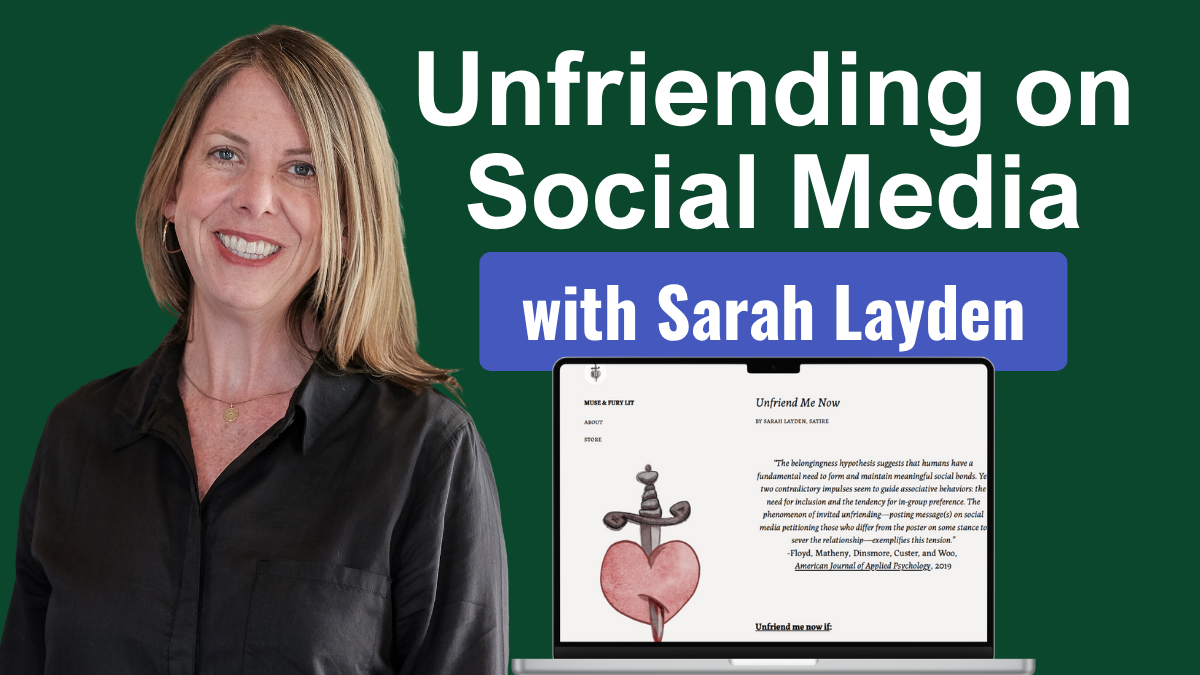
Don’t want to be friends with folks online who disagree with you? The ‘Unfriend Me Now’ social media trend may be for you.
Sarah Layden joins me to talk about her satire piece about the trend of “unfriend me now” on social media. Join us for this fun conversation with thoughtful advice for faculty on social media.
When she shared her satire piece, ‘Unfriend Me Now’ on her LinkedIn profile, I reached out right away about her appearing on The Social Academic interview series. The epigraph to the piece is a quote from research from Floyd, Matheny, Dinsmore, Custer, and Woo, “If You Disagree, Unfriend Me Now”: Exploring the Phenomenon of Invited Unfriending, published in American Journal of Applied Psychology.
In this interview
Meet Sarah
[Jennifer van Alstyne:] This is Jennifer van Alstyne. Welcome to The Social Academic. I’m here with Professor Sarah Layden. Layden, did I pronounce that correctly?
[Sarah Layden:] You did, yeah. Thank you.
[Jennifer:] Perfect. I’m excited because she has an amazing satire piece that is about social media. In fact, when I saw her post about this on LinkedIn, I knew that she was a guest I had to have here on The Social Academic. Sarah, would you introduce yourself to people?
[Sarah:] I would be happy to. Thanks so much for having me on, Jennifer.
My name’s Sarah Layden and I’m an associate professor of English at Indiana University, Indianapolis. I’m a writer, professor, I’ve written a few books, including most recently a short story collection called Imagine Your Life Like This, and co-authored a textbook called The Invisible Art of Literary Editing with Brian Furuness.
I started out as a journalist where you really are not including your opinion in anything, it’s just straight facts and quotes and things like that. When I went into creative writing and writing fiction and poetry and then moving into satire and humor, I really have enjoyed the freedom to insert that opinion and insert that bit of humor that I think we all have kind of bubbling under the surface sometimes, especially in moments of frustration, which is probably where Unfriend Me Now came from.
The ‘unfriend me now’ trend on social media
[Jennifer:] Oh, I love that. And actually, that’s my next question is about the inspiration for this particular satire piece. I would love to hear what prompted you to kind of actually get this on paper.
[Sarah:] Yeah, that’s a great question. So, I kind of have a running list of story ideas and things that I’m working on at any given time. And sometimes something will really spark and, you just start associating and taking it in all these different directions. And other times it might just kind of sit there in the notebook for a while. And this was one of those ones that was in the notebook for a little while. I had noticed that people on social media were beginning to post these like very passionate things about whether it was politics or movies or books or whatever. And they would say, unfriend me now if you disagree.
I thought that was so funny. I was kind of like, well, why don’t you just unfriend other people? But I think that part of is because people want to be in the group and they want to be a part of, they want to be connected to others, but at the same time, they want to kind of winnow out anybody who isn’t thinking in the same ways. And so, with satire, with short humor, you really kind of ramp it up and you take it to extremes and it becomes sometimes very ludicrous, as in my piece where it becomes about, preposterous things that would not necessarily happen. But sometimes that’s where we go in our minds, right? Like, if you say that it’s, we’re drawing a line politically, but also unfriend me if you didn’t agree that this was the best movie in 1996 or whatever, whatever the strange case might be. And that was also a little nod to my husband because it took him a long time to get over the fact that Saving Private Ryan didn’t win best picture that year.
[Jennifer:] Oh my goodness. That’s so funny. I’m curious, have you ever unfriended someone after seeing one of those posts?
[Sarah:] You know, I don’t think I have. I think because maybe I’m just a stubborn person. I’m like, no.
[Jennifer:] Oh, so like, even when it relates to you, you’re still, I’m not going to unfriend you.
[Sarah:] I’m just going to stick around. I’m going to see what happens next. I don’t want to, I don’t want to detach from this, whatever it is, this drama.
[Jennifer:] I love it.
[Sarah:] I want to, I also want to say, sometimes people are, they’re very passionate and they’re very upset about a thing, and that’s understandable. And I think that’s kind of where it comes from, but when it gets silly, I’m just kind of like, listen, we can have our different preferences. It’s fine. And I was curious too, because once you start thinking about sending a piece out, you want to see, has somebody already written about this? Is this a topic that has already been covered on various humor sites, or whatever the case is? And I didn’t find anything satire wise, but I did see that some psychologists had actually studied this phenomenon.
And that was really interesting to me too, to think that, others had noticed that this was something going on online and they wanted to get to the bottom of it, psychologically. Why do we do this? What’s behind it all? So that’s kind of fascinating to me too, just the way people interact.
Subscribe to The Social Academic blog.
The form above subscribes you to new posts published on The Social Academic blog.
Want emails from Jennifer on building your online presence? Subscribe to her email list.
Looking for the podcast? Subscribe on Spotify.
Prefer to watch videos? Subscribe on YouTube.
When did you join social media, professors?
[Jennifer:] Oh, it’s so interesting the way people interact online. I feel like kind of a social media native. I mean, I remember joining Facebook when I was in middle school. Really my whole life I’ve been on social media. What about you? When did you start on social?
[Sarah:] That’s a great question. So I am probably a little bit older, so I’ve got the, I’ve got that divide between analog life and digital life. So I remember life before the internet. My students are always, they always kind of gasped when I tell them we didn’t get the internet until junior year of college. They’re like, “What did you do?” And who remembers? Like, what did we do? I don’t know. But at the same time, you know, I remember being out of touch for years. There were people that you didn’t see for years and then reconnecting on social media and that caused all sorts of dramatic tension. Right? But it is really fascinating too, just sort of thinking about the fact that we’re all kind of trying to norm socially in this space where we’re not all physically present in this space, if that makes sense.
Everybody is getting a different version of the feed based on who they’re connected to. And so it’s like one thing may seem very normal on your feed and then on another feed it’s just, “What? What’s happening over there?” So I mean, when you think about reality and just the ways that reality can get distorted, I think that that’s kind of fascinating, too. But I do remember, I mean, I remember like dial up modem, AOL chat rooms, stuff like that when I was a teenager, right? And then just how fascinating sites like Facebook and MySpace and I don’t know if you remember Friendster?
[Jennifer:] Friendster. Yeah.
[Sarah:] That was like the original.
[Jennifer:] Right?
[Sarah:] Yeah, like it just, it, they were sort of game changers, too. But I think that they do creep into our like face-to-face lives too…
[Jennifer:] They do.
[Sarah:] We started speaking and acting and behaving in ways that we, that we might online and they’re just different places. Different spaces.
[Jennifer:] Yeah. And I think one of the things that I really like is sometimes it allows us to have deeper or more meaningful conversations with people because we’ve learned something they’ve been open about sharing on their social media. And so there’s this sense of unfriend me now, but also this sense of community and belonging. So I think both ways.
[Sarah:] Absolutely. No, I love that. And you know, like the, the high school reunions I’ve been to, one thing that’s been really nice is that, because we are connected on Facebook, you don’t have as much catching up to do.
[Jennifer:] Yeah.
[Sarah:] In terms of like, “Oh, tell me every little thing you’ve done in the last 20 or 30 years,” or whatever the case might be.
[Jennifer:] Mm.
[Sarah:] Instead it’s like, “Wow, you just took this really great trip.” And you can kind of pick up with people where you last saw them online. And that’s kind of nice, too.
[Jennifer:] That is kind of nice.
[Sarah:] It kind of bridges some gaps, I think.
[Jennifer:] Hmm. I like that way. Bridging some gaps.
‘Unfriend Me Now’ [Reading]
[Jennifer:] Would you be open to reading Unfriend Me now? It’s published on Muse and Fury Lit. I’d love to hear it.
[Sarah:] Yeah, absolutely. Okay. And I’m going to start with this bit from a group of psychologists. And this is what I was referring to earlier, and this comes from the American Journal of Applied Psychology in 2019.
Please head to the original place of publication to read Sarah’s satire piece, Unfriend Me Now. Or, listen to Sarah read her piece on YouTube (jump to the reading).
Balance on social media as a writer
[Jennifer:] Ohh! I remember reading this the first time and recognizing, honestly so many of my friends in posts like this. Just the feeling of wanting to connect can also lead us to this feeling of recognizing all of these unique differences between us as well. I would love to hear about, kind of how you use social media. I mean, as an author. The only reason I read this piece was because you shared it on your LinkedIn and I was like, “I got to read that one.”
[Sarah:] Well, and it’s so funny too because I’m probably least active on LinkedIn and I love that you came across it and I love that you found it. And I was sort of debating, “Oh, is this something I share here?” Because it feels like different sites have different personalities in some ways. LinkedIn is the more business-y version. Instagram obviously is going to be more photo heavy. I think we’re still figuring out some of these other ones, the newer ones, like Threads and Bluesky, and what they’re for. But yeah, the way that I use social media, I think it’s definitely changed over the years because, as a professor I do represent a university.
I do want to really be mindful and conscious of that’s going to reflect on my employer some of the things I say and do certainly. But I also, I know that my work is not going to get out there unless I share it, unless I post it. So, with satire, when I had a book come out, things like that, I just, I really do want to let people know about it, but I want to do it in a way that feels authentic to me and to who I am. And certainly there are times when it feels like too much and I’m like, “Okay, that’s enough for me.” I need to, I need to sit back and just scroll for a while and read other people’s posts and take in other things.
[Jennifer:] Ooh!
[Sarah:] So really it’s this balance. Yeah.
[Jennifer:] That is so interesting. So it sounds like the overwhelm comes from creating your own content, but that you are almost looking forward to consuming and engaging with what other people share that you get to see.
[Sarah:] Absolutely. Absolutely. And I think there’s kind of this maybe a, a weird disconnect too in the content that I’m sharing. The primary thing is the creative piece. I want to share the creative piece, but when you post something about it, you make something else out of it. And so in some ways that part is overwhelming. Yeah, it can be. And as a reader, as somebody who likes to take in other people’s work and and writing and yeah, I do want to participate as a member of a community and not just somebody who’s like, “Ooh,” blitzing you with a nonstop sign saying buy this, buy this, read that.
[Jennifer:] Oh, that’s such a good point. Especially for authors who are listening to this who are like, “I want to talk about my book, but I don’t want to be like, buy buy buy everything.”
How do you balance that when you are sharing stories about your book and your writing online?
[Sarah:] Huh. That’s a really good question. I mean, I think that, I think for myself and for other writers that I know, that we’ve all kind of we’ve been on lines for so long now that it just feels like you have to kind of show up as yourself. I think is the thing that we’re recognizing and realizing ’cause otherwise it just feels, I mean, especially as a Gen Xer, right? If you aren’t being authentic, there’s something that just feels, “Oh, you’re, you’re fake. Get out of here.” But that balance is so tricky. I think that it kind of points back to some of the things that we’ve spoken about a little bit that you want to be, you want to be a reader too. You don’t just want to be the person who’s saying, “No, my stuff. Here’s mine.”
And part of that is just figuring out who are the people that I’m most apt to be connected with? Who are the writers that, I read their work and it really resonates with me and I want to share it. It’s something that, that feels, “Oh yeah, this is something that needs a broad reach. And I would love to be part of that, to putting that out in the world.” So much of it, I mean, it comes back to this idea of the winnowing down, right? Like the unfriending in some ways, but it’s just you can winnow in ways that aren’t so comically negative. It could be just, “We have a similar aesthetic, we have similar tastes. We, we vibe.” That’s what my students, we vibe, they allow me to say it too, I guess. But that’s part of what it is. Just finding we’re on the same frequency, and it just makes sense that we would connect in that way.
Subscribe to The Social Academic blog.
The form above subscribes you to new posts published on The Social Academic blog.
Want emails from Jennifer on building your online presence? Subscribe to her email list.
Looking for the podcast? Subscribe on Spotify.
Prefer to watch videos? Subscribe on YouTube.
On connecting with your students on social media
[Jennifer:] Hmm. So you teach, right?
[Sarah:] I do.
[Jennifer:] Do you teach undergrad, graduate students?
[Sarah:] Both. Yeah, both.
[Jennifer:] Yeah. So there’s probably professors who are listening to this who are curious about, “Should I connect with my students on social media? How do other people kind of navigate that?”
And I work with so many clients who they, they’re like wanting to stay connected to the people that they’ve really mentored and supported through their academic careers onto seeing and celebrating what they’re up to next. And so I’m curious about how you navigate that personally as someone who’s working with students?
[Sarah:] Yeah, that’s a great question. It’s funny because when I think back to like 2009, 2010, somewhere around there, I used to be, I don’t know if the right word is strict, but I used to just really carefully monitor like, “Oh, we can’t connect until after the semester is over.” Or, there’s, I don’t want students looking at my feeds and saying, “Oh, she’s complaining about grading again.” But I also probably complain less about grading now than I ever did. So, it’s that two-way street, right? That just you become a little more mindful about what you post. You realize, this is not just a bulletin board where I’m throwing all my feelings every day. This is a place where like a lot of people from a lot of different aspects of my life know me and are connected to me and I’m connected to them.
So one thing that’s gotten a little bit tricky is there are certain sites that didn’t exist in the past where somebody can follow you, but you don’t have to accept if you have a public profile. It’s just they’re following you or whatever. So, that tends to be my looser rule now that if somebody connects with me and they’re a current student, that’s fine. But I probably won’t reciprocate that connection until after the semester is done. And that’s just, kind of a general rule. But it also gets tricky too, because I advise students on the campus literary magazine and so we’re like colleagues in some ways where we’re all working together on a team and they might not be my student one semester, but then they become a student later. Yeah.
[Jennifer:] In a different capacity. Absolutely.
[Sarah:] In a different capacity. I know, and I know some people have tried, they’re like, “I’ll just make two accounts, one will be my private account with friends and family, and one will be my more public facing account.” I think that takes a lot of bandwidth that I maybe don’t have. So I just, I don’t know, I kind of maybe think a little bit about how I’m sharing and what my audience is when I’m posting certain things.
[Jennifer:] Oh, I so appreciate your openness with that. And I like that you kind of have this policy for yourself that it waits till the end of semester, at least on your end.
[Sarah:] Yeah.
[Jennifer:] And I appreciate that. I think other people might like that as maybe a policy that they can have for themselves too. It’s helpful to hear your thoughts, so thank you.
[Sarah:] Good. Absolutely.
Imagine Your Life Like This, Sarah Layden’s new book
[Jennifer:] Yeah. I would love for people to hear about your most recent book. Is that something you’re open to sharing with us before we wrap up?
[Sarah:] Oh, absolutely. Yeah. My story collection, it’s called, Imagine Your Life Like This. And it came up from the University of Wisconsin Press in 2023, and it has 10 or 11 short stories. I think 11, count real quick. But some of the stories were published previously, a few of them were not. And I was really happy that this was selected as a shortlist book for the Indiana Authors Awards and the Wisconsin Library Association also picked it as an Honored Fiction book for 2023.
[Jennifer:] Congrats.
[Sarah:] And it’s realism, it’s, real life stories, but presented as fiction. Just real people, real situations. I say real people, I mean they’re fictional characters, but it’s not, fantasy or a genre or anything like that. And I’m really interested in, this is actually tied to our conversation today, Jennifer, but in alienation, in loneliness, in the ways that people connect and don’t connect or fail to connect or want to connect and what happens when we don’t get to meet with others in the way that we feel most seen, in the way that we feel most valued. And kind of the dysfunction that might, that might come from that. So, some of it is about work, some of the stories are about work too, and just being underemployed in various capacities.
And I was an adjunct for eight years before I moved my way into my current position. So I think, a lot of people have had that experience too in academia, but just sort of, what do you do with that? What do you do with wanting to mentor, wanting to teach, and feeling like you’re not in the position that you, that you want to be in? And then there are other jobs in the book too that, like temp jobs and some things that I have done, some things that I have not done, but that found their way into fiction just as I was exploring, what does it mean to be a person in this time and place and just trying to get by.
[Jennifer:] Oh, your book sounds right up my alley. I’m definitely going to get a copy after this call.
[Sarah:] Oh, good. Thanks!
[Jennifer:] That feeling of loneliness. That’s something that will really resonate with other academics who are listening to this.
Advice for social media for faculty
[Sarah:] This has been such a great conversation, so I really appreciate your thoughtful questions and thanks for having me on.
I want to share advice for others too as we’re talking about how do you present yourself online too. I think that burnout is so common and people tend to see it as this all or nothing where they have to be posting constantly and putting themselves out there constantly, or not at all.
I think it’s important to really tailor it to what suits you and what feels right. And if it feels like it’s too much, then it probably is. And it’s okay to take a break and to take a step back.
I would also say too, be open to the surprises and the opportunities that putting yourself out there can create. This, for example, never occurred to me when I was posting this humor piece on LinkedIn that you would reach out and that was so nice. And I’ve also had some other, writing and speaking and teaching opportunities that have happened because often something I was debating like, “Should I, should I promote this? Should I put this ad to-” can lead to something really great, something wonderful, a connection to somebody I, I couldn’t have predicted connecting with otherwise.
[Jennifer:] Oh, thank you so much for coming on The Social Academic. Where can people get in touch with you or connect with you after this?
[Sarah:] Oh, good question. My website is just my name, SarahLayden.com and my social media, I’m on Instagram as @sarah.layden and my Twitter, I’ll still call it Twitter, @BySarahLayden.
[Jennifer:] Perfect. Oh, thank you so much for coming on the show. This is it for our livestream, but we will be back on The Social Academic soon. Sarah, thank you so much for coming!
[Sarah:] Thank you, Jennifer!
Subscribe to The Social Academic blog.
The form above subscribes you to new posts published on The Social Academic blog.
Want emails from Jennifer on building your online presence? Subscribe to her email list.
Looking for the podcast? Subscribe on Spotify.
Prefer to watch videos? Subscribe on YouTube.
Bio
Sarah Layden is the author of Imagine Your Life Like This, stories; Trip Through Your Wires, a novel; and The Story I Tell Myself About Myself, winner of the Sonder Press Chapbook Competition.

Her short fiction appears in Boston Review, Blackbird, McSweeney’s Internet Tendency, Best Microfiction 2020, and elsewhere. Her nonfiction writing appears in The Washington Post, Poets & Writers, Salon, The Millions, and River Teeth, and she is co-author with Bryan Furuness of The Invisible Art of Literary Editing.
She is an Associate Professor of English at Indiana University Indianapolis.