

Dr. Zori Paul and Natalie Jeung started a podcast about their geeky passions and mental health. What’s it like to start a podcast with your friend? An academic interview with Jennifer van Alstyne.
What’s it like to start a podcast with your friend? Dr. Zori Paul and Natalie Jeung, LCPC, NCC met in their master’s program. Years later, they started a podcast together where two therapists nerd out about their geeky passions and mental health. Video games, movies, and interests they love are a scope for new episodes of the podcast. Zori and Natalie share about their podcasting journey. Not just the process behind getting started, but the emotional and social journey of putting your podcast out there too.
Thank you for checking out this episode of The Social Academic podcast. Watch the video on YouTube, Spotify, and Instagram. Or, find a full text transcript below.
0:00 Meet Zori Paul and Natalie Jeung
2:50 What sparked the idea for having your podcast?
4:31 Social media and video editing for the podcast
6:22 Different methods of doing the podcast
9:24 What’s Therapy on a Tangent about? What Zori and Natalie love to talk about
12:01 Video games, Inside Out, and Miyazaki, and clinical work as therapists
17:50 When is something not quite right for your show?
19:56 Looking back to the start, celebrating 1 year for their show
23:29 Podcasting equipment and skills you’ve grown over time
32:18 What’s it like to share your podcast with people?
39:15 At the heart of their podcast is friendship, trust, and collaboration
Meet Dr. Zori Paul and Natalie Jeung
Jennifer: Hi there. I am Jennifer van Alstyne, and this is The Social Academic podcast. I’m here with Dr. Zori Paul and Natalie Jeung, host of Therapy on a Tangent. This is a podcast that brings in all the things that they love to nerd out about and mental health together. I’m really excited for this conversation because it means that we can consider other options for how we show up online. It may be that you dream about a podcast, but the reality is you’re probably not going to do it unless it’s with a friend. And if that’s you, I’m really excited for this conversation. Podcasting can be a lot of fun. Zori, would you introduce yourself first?
Zori: Yeah, sure. Hi folks. My name is Zori Paul. She/Her pronouns. I’m a counselor, educator, researcher and clinical mental health counselor. And yeah, I am one of the co-hosts for Therapy on a Tangent with Natalie.
Jennifer: Natalie, your turn.
Natalie: Hi everyone. My name is Natalie Jeung. Also she/her pronouns. I’m a licensed clinical professional counselor in the Chicagoland area. I am a therapist in solo private practice right now, and it’s been a cool adventure being solo. I was in group practice before this and working with a lot of people, and now I’m just kind on my own. So it’s been an interesting transition, it’s been a good time.
Jennifer: Now, Zori was just saying that you met during your master’s program. Tell me a little bit about that.
Zori: I don’t know if we want to say names, but yeah, we went to the same master’s program back in, what was it, 2016?
Natalie: 2016, yep.
Zori: Yeah, 2016. And I think that’s how we met. And I think at some point we realized we went to the same high school, that we didn’t know each other.
Natalie: Such a small world.
Zori: Yeah. I think at just some point we kind of just talked and realized we had the same interests and we kept in contact. I don’t know if there’s anything more.
Natalie: I feel like whenever we talk about how we met in grad school, it’s that moment during orientation when you’re just looking around and you’re just like, “Okay, who do I try to make friends with, who do I try to connect with? And we joke about this, I think sometimes as a minority student, you look around and you look for other minority students to try to connect with. I think that’s when Zori and I just kind of connected and it was, “Hey, let’s try to get to know each other. It’s really awkward for both of us here, so we’re just roughing it out together.” That was the start of our friendship.
Zori: Yeah, yeah.
What sparked the idea for having your podcast?
Jennifer: I’m so grateful that you shared that because I’ve had that experience myself, and I feel like sometimes if there wasn’t that other person of color, especially a woman of color in the room, that discomfort didn’t always leave. Thank you for being open about that. Which one of you had the idea for a podcast first? How did that come about?
Natalie: I had this idea for such a long time because something that I really enjoyed as a therapist was what I would call cooler conversations, where hypothetically we had a cooler, water cooler, we would probably be standing around it with other therapists and just chatting about our work and chatting about things that we see in the world and things like that. And something that I always loved talking about was just psychology themes that we see in media, video games, things like that. And that was the premise of what I was hoping to do and talk more about. It wasn’t that I had intended to, “I’m going to create the best podcast ever.” It was just like, “I just want to have these cool conversations with other therapists and talk about these nerdy topics and mental health,” and things like that. And Zori, since we shared so many similar interests, she was somebody that I really wanted to just talk about. This is what we talked about when we were in grad school, and this is what we talked about when we became therapists too. It felt natural to just kind of roll into that as a podcast.
Subscribe to The Social Academic blog.
The form above subscribes you to new posts published on The Social Academic blog.
Want emails from Jennifer on building your online presence? Subscribe to her email list.
Looking for the podcast? Subscribe on Spotify.
Prefer to watch videos? Subscribe on YouTube.
Social media and video editing for the podcast
Zori: I had wanted to do podcasts as well for a while. I just knew I didn’t want to do it by myself. Then I think it was over lunch, we had a lunch date. Natalie was just like, “Hey, you want to do a podcast?” I was like, “Yes!” And it also works out that Natalie has had prior experiences with podcasts, so she knew some of the behind the scenes technical stuff, and I’m good with the social media, so it was just like, “Yes, you do all the editing, I’ll do all the social media. “We stick to our strengths.
Natalie: Social media is not my strength, so I’m so thankful all the time that Zori just handles all that and I just do what I do with video editing and stuff like that.
Zori: And I will say, Natalie took a break for the last few episodes of our season, and I had to do the editing. I was like, “Uuh, I can do it,” but Natalie does it so much better.
Jennifer: So it’s not just a friendship, but you really recognize each other’s strengths and also what you’re wanting to do with your time. It sounds like it kind of naturally fell in a way that works for all of the things you might need for a podcast. Is there anything that neither of you like to do?
Zori: I feel it’s not that we don’t like to do it, it’s just sometimes, it’s just how we do it, is like brainstorming for podcast ideas. Sometimes we’re just like, “I don’t know, what do you want to do?” Or who’s going to intro it or who’s going to keep us on track? Because both of us can, I mean, that’s part of the reason why it’s called Therapy on a Tangent. Both of us can go on tangents for a really long time.
Different methods of doing the podcast
Natalie: We’ve both tried different methods of doing the podcast. What if we had kind of written out our talking points, go through our talking points, or do we just kind of freeball it and just talk about whatever? We found that we do a little bit of a mix, that helps us. We do need to have some sort of outline, but for the most part, we do kind of freeball it. If we totally freeball it. I think we just start going on these rants and tangents, and that’s when editing becomes a nightmare because we have to cut out so many things where we’re just thinking or it doesn’t make sense and we have to backtrack and things like that. Yeah.
Zori: Yeah, yeah. I remember one episode I was editing was just me going on a tangent about, ‘Go where you’re wanted,’ which is, it sounds all good in the summary, but when you listen to it, it’s just me going on a rant about, “I’m going where I wanted, I’m going, I’m finding a new job,” and I’m just like oh my gosh, I need to cut basically 10 minutes out.
Jennifer: Oh my goodness. Okay. It sounds like there were some experimentations with the process of how you were doing episodes, but it was really the editing process that you recognized, “Okay, this is not working,” or this is making things harder. Was there something during the recording that clued you in that that mix was a good feel? Or was it mostly that editing process for you?
Natalie: Well, we did little check-ins at the end of each episode to be like, “Oh, how do we feel about that? Is there something that felt off,” and things like that. We just gave each other feedback to see. And then the editing process was where I really saw, “Okay, this is probably where we need to work on certain things, try to stay more on track,” whenever we get on certain topics and things like that. But I feel our little feedback chats, I think that helps both of us just point out things that we notice for each other and help build each other up.
Zori:
And also, I think there was one episode, I can’t remember which, but there was one episode where, or maybe it wasn’t one episode, but we sometimes record episodes, two episodes at a time, and I think there was one time where we recorded topics where it wasn’t, the person who was leading it wasn’t the one who created the topic or thought of the topic. That made it difficult for the person. Typically, the person who does the introduction is the person who’s kind of leading the episode, and I just remember we both feeling like, “Okay, that was a little rough” because this was your idea, but I don’t know if this went in the direction that you wanted it to go, so maybe you should lead it next time.
Subscribe to The Social Academic blog.
The form above subscribes you to new posts published on The Social Academic blog.
Want emails from Jennifer on building your online presence? Subscribe to her email list.
Looking for the podcast? Subscribe on Spotify.
Prefer to watch videos? Subscribe on YouTube.
What Zori and Natalie love to talk about
Jennifer: Oh, that’s really funny. I’m a solo podcaster, and so when I think about that, even that moment of feedback at the end of each episode. I wish I gave that to myself because I do not. And when I think about the benefits of starting a podcast with a friend or a colleague or someone that you have that shared interest with, Ooh, that was my next question. What are the topics that come up for episodes on the show? For people who are listening, they’re, “What do these amazing people like to nerd out about?” Because I like to nerd out about things too, and how can people know if it’s the right show for them?
Zori: Yeah, I mean, I think we kind of nerd about anything that we’re interested in. Also things that come up in terms of discussions that we talk about with our clients. But I mean, we’ve talked about video games and a lot about how, especially types of video games like RPG, so role-playing games, how that is connected to mental health and how we see that play out for not only ourselves, but also our clients. We did a mini series on the TV show Arcane as well, and about how some of the relationships with the characters, how we can see some of those relationship play out in other relationships. Or how we relate to some of those characters, can give us insight about our own stuff as well. Then there was the totally random ones where it’s, I remember one time I made Natalie, yes, I’ll say this. I made Natalie do an episode on fan fiction and on tarot cards, and Natalie was just like, “I don’t know anything about this, but sure, let’s do it.”
Natalie: Also, for context though, I did, I do know about fan fiction, but it had been, I think almost two decades since I last really got into it.
Zori: That’s what she says.
Natalie: It was that comparison of like, “Okay, I did know about this topic, but I don’t know about what this topic is about now in this age.” And I think sometimes that’s kind of what it is too. I know a little bit about a topic that Zori introduces, but not enough where I feel I have a whole lot to contribute sometimes.
Video games, Inside Out, and Miyazaki, and clinical work as therapists
Jennifer: So video games, TV shows, movies, it sounds like. Yeah, I’m so into that. I’m not really a podcast listener, and so whenever it’s something that I actually am thinking about in my off time, that makes it really interesting to me. And so I’m really excited about this kind of mental health and pop culture and experiential things like video games.
Can you give people an example of a video game that’s maybe helped a client in your work together? Because there is this tieback to the clinical work that you do. Is that right?
Natalie: Yeah, so I work with a lot of video gamers, so I call myself a geek and gamer friendly therapist. And so what that means is that I do draw a lot of people who identify as geek and gamers, and contrary to what a lot of people believe, I’m not just working with your middle-aged man who has not left their parents’ house and isn’t successful in life. The people that I work with range anywhere from kids and families working on boundaries and healthy habits around video game playing to adults who really, they are struggling to figure out how do they balance video games in their life, and also people who just simply identify as video gamers and they like to talk about that. They don’t want to feel stigmatized when they speak to their therapists about it. I have clients that are so excited to talk to me about the new game they just started and how they’re going and stuff like that.
A lot of the work that I actually do on the clinical side with video games is, it’s kind of twofold. Some of it is that I use video games as a medium to build skills, to explore different topics and things like that. I would do Minecraft a lot with some of my kiddos that I see just because that is equivalent to a sandbox activity in the therapy world. And so you can find video games that have different ways to incorporate different therapy topics and to utilize it that way. I’ve also used video games. I’ve watched somebody build their character or show me their character and tell me why did they make certain choices about their character that they built, and then that helps us kind of figure out what kind of things do you feel about yourself or believe about yourself and things like that. So that’s kind of how I integrate video gaming. And that’s the same with geek culture things too. I like talking superheroes too because I think we all see a little bit of superhero and villain in ourselves, and so that’s always a great topic to talk about when people relate to certain superheroes and villains.
Jennifer: I had Dr. Sheena Howard on the podcast and she was talking about her book, about Black Panther and Wakanda and mental health and how so many people found healing experiences during watching the film. Is there maybe a movie or a film that comes up maybe again and again for your clients in terms of their ability to talk about emotions or something?
Zori: Maybe I’m just thinking of this because I noticed your hoodie, but I’m thinking about Totoro and Miyazaki movies. I definitely talked to clients, especially, I’m thinking about either movies like Spirited Away or Kiki’s Delivery Service, where those are movies where I felt this, but also I had clients who felt this. Where it’s transition in some shape or form, like Kiki’s Delivery Service. I watch that anytime there’s any big changes happening in my life. So typically moving, new school year, Kiki’s delivery service, and we definitely talked, or I’ve definitely talked to clients about one, it being a comfort movie, you know what to expect and how that can help bring a sense of control, especially in times where it doesn’t feel like you have control. But also elements of Kiki talking about burnout, talking about when something that you love turns into a side hustle and then it’s not something that you love anymore. Yeah, so we’ve had conversations sometimes about that as well. Obviously other movies as well, but like I said, the Totoro made me think of Miyazaki, made me think of Kiki. Yeah.
Natalie: And Inside Out is one that comes up a lot with me and my clients, and I think that’s just such a great way for people to, I think conceptualize themselves and different parts of themselves, because usually when we’re talking about Inside Out, it’s because we’re talking about the part of them that gets angrier, the part of them that gets sad, and talking about how all these parts are okay and how do we get them to all communicate and work together so that we don’t overload the brain, the command center and things like that. That’s definitely a movie that comes up a lot. And then also, there’s a lot of Disney movies that have come out that has a lot of cultural ties to it that resonate with people, and so those are the things that tend to come up a lot too. Zori and I have talked on our podcast about Encanto, we’ve talked about Turning Red, and those have some deep cultural ties and family trauma and things like that. That’s when clients bring up those kinds of topics or those movies, it’s because those topics are embedded in those kinds of movies.
Subscribe to The Social Academic blog.
The form above subscribes you to new posts published on The Social Academic blog.
Want emails from Jennifer on building your online presence? Subscribe to her email list.
Looking for the podcast? Subscribe on Spotify.
Prefer to watch videos? Subscribe on YouTube.
When is something not quite right for your show?
Jennifer: I really appreciate that. Is there any topic that has come up that you really want to talk about, but it’s not quite right for the podcast? I guess I’m curious about, it sounds like everything is something that you’re interested in, but how do you decide when something’s not quite right for the show? Does that make sense?
Zori: I don’t know, you can correct me if I’m wrong, Natalie, but at least for me, when I’m thinking of topics, I think of, “Is there some sort of show or some, essentially medium that we can talk about it through?” And I think that’s helpful. I remember one time Natalie mentioned something about, and maybe I’m remembering this wrong Natalie, but relationships and singlehood or something like that. She was like, “Do you want to talk about that?” I was like, “I can, but we need to think about how we’re going to tie it to something geeky.” And I mean, I was actually thinking about this earlier. I was like, “Ah, maybe I have an idea.” But yeah, I think just because we try, it’s therapy on the tangent where two therapists talk about geeky passions and mental health. It’s like, okay, here’s the mental health, but what’s the geeky passion? But yeah.
Natalie: Yeah, I agree. I think sometimes we find that there are themes in therapy that come up in certain seasons of life. I think just different parts of the year brings up different things for people, and we kind of want to talk about this topic, but then what medium do we talk about that topic? What kind of geeky thing can we pull into? And I think that’s where it gets tricky because then if we just talk about the topic, I don’t know if that derails too much from what we’re trying to do then. But I think there’s lots of topics that from a mental health aspect we would love to talk more about. It’s just how do we tie it into the theme of our podcast.
Looking back to the start, celebrating 1 year for their show
Jennifer: You are coming up on your one year anniversary of the show, or has it already happened?
Zori: I think it’s probably already happened.
Natalie: Yeah, probably has-
Jennifer: Yay! Okay, cheers. Celebrating one year. I’m curious if we go all the way back, all the way back to when you were starting, Zori mentioned that was kind of one of the slowest or maybe longest parts. What was it like when you were just starting and then maybe what might you do differently if you were just starting now?
Zori: I mean, we spent a lot of back and forth on names of the podcast, on covers. I would send Natalie some covers and she’d be like, “Eh, no.” Or she would show her partner and he’d be like, “Uh, no.” And I was like, “Ahh!” Yeah, I think that was part of it. And then just also figuring out what are we going to talk about, exactly how this is going to look.
Jennifer: Well, I’m just, for everyone who’s listening, I’m going to switch over to the title screen so you can see the cover. What helped you decide on these colors and this cover? Because it’s really pretty. It stands out.
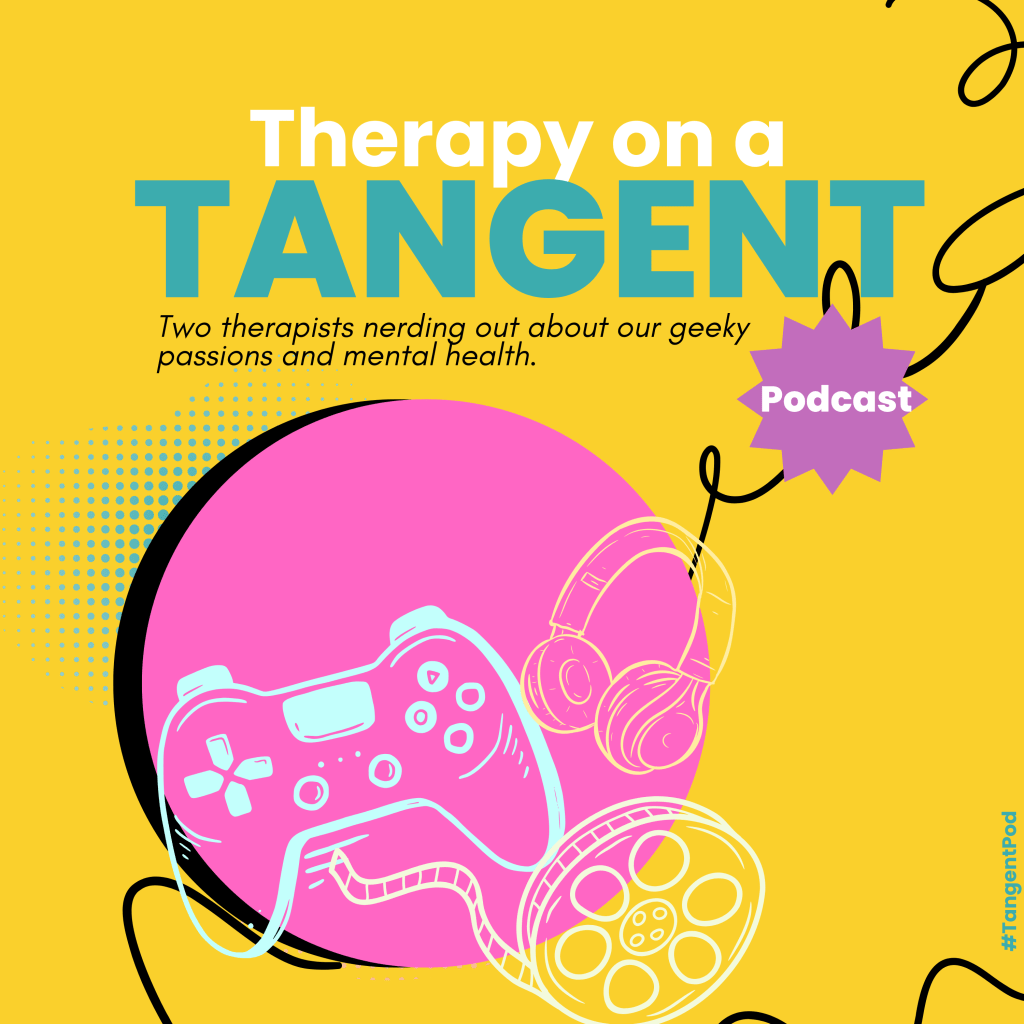
Zori: Oh my gosh, it’s been a while. I think I was just trying to go for a retro video gamer vibe. Especially when we first started putting social media stuff about our podcasts, and even sometimes now, sometimes Natalie leans into it, sometimes she’s just like, “No.” But I try to do it where Natalie’s player one, I’m player two type of thing, like old school video games. And especially before the podcast came out, I was trying to play around with the loading, game loading type of thing. I think that’s just what I was leaning towards and trying to, also video games, headphones, and movie reels on it. Also, I just like yellow.
Natalie: I tried to let Lori have the creative direction in all that, but I think part of, in the beginning I felt a little insecure about myself in starting another podcast. And so I think that’s kind of like, “I don’t know, how do we represent ourselves? How do we get people’s attention?” And I do really like the colors and I really like the design that we settled on cause I do think it’s eye-catching and I think it invites people to be like, “What is this about? What could this possibly be about?” Yeah, I think the creative aspect of it was the longest and toughest part in the beginning for us. And also this was kind of like we’re just kind of podcasting for fun, it’s not we’re here trying to spend money. It was also like we’re doing all these things ourselves, so it just takes a little longer and then we eventually, we probably need to upgrade our equipment. Zori had to get a new microphone just because the sound quality was so bad in the beginning and I had to do so much work on it. I think that’s just the logistics of getting through the creative process and then getting our setup correctly and then getting to this point where it feels a little bit more smooth. That was a process.
Podcasting equipment and skills you’ve grown over time
Jennifer: If we are at the starting point, it sounds like the investments in microphone and stuff came over time. In terms of equipment, what did you need to have to get started or what did you feel like you needed to have?
Zori: Yeah, so I mean part of it is just how we’re going to record. And again, though, I think both Natalie and I could have figured it out. It was really Natalie who figured it out, how could we MacGyver it. So we use Discord, and then Natalie does some sort of magic on her side to record it.
Natalie: Yes. So a little bit of lore on me. I’ve dabbled into streaming for a little bit, and so I knew that I could probably capture everything on OBS or Streamlabs. And so that’s just kind of how I MacGyvered it. I was like, “Okay, we’re going to do it on Discord, and then I’m just going to screen capture it, save it that way, record it, and then that’s how we’re going to do it.”
Jennifer: I love that you already knew something that you were familiar with and you were like, “This will work. Let’s just go with it.” I feel a lot of professors that I chat with, I don’t help them start podcasts, but a lot of people get stalled by the tech, trying to explore so many different options and make the best decision for them. But oftentimes it’s the best decision for us right now. And I really appreciate that you are open about that process. Okay, so technical stuff, it sounds like you had a solution that worked for you and then you just recorded and you have the editing skills to do it yourself. How did you get your editing skills?
Natalie: That’s just a lifetime of me getting interested in random things. I think it’s just throughout my lifetime I was interested in, was interested in the Adobe Suite basically. I had dabbled into Photoshop and Lightroom. I dabbled into different video editing software. I started learning on Blackmagic, which is an open source video editor. It is much more complicated than the average person needs to know. So it came from a random interest that I had where I just have acquired skills in certain areas. I am by no means great in any of these things, it’s just I know how to use it from me being interested in using it. I don’t think I’m the best editor out there, but I do think it’s passable.
Zori: She’s definitely better than me. I am just using my early 2000 AMV animated music video skills on iMovie, and sometimes I’m just like, “Ooh, that could have been smoother.” Natalie is doing a really amazing job.
Jennifer: I do not have great video editing skills. I use DemoCreator by Wondershare, which is mostly for tutorials cause I have to record videos for my website design clients so that faculty can know, “Oh, this is how I can edit things on my website once it’s live.” I don’t want you to have to come back to me every time you need a change. And so when I think about the tools that I’ve learned, it’s quite limited. Whereas my husband is doing all these certifications and video editing and learning all of these skills, and it’s a thousand steps beyond what I will ever be interested in knowing. And so I’m curious about skills that you’ve learned since you started. What skills have you been like, “Oh, I’m kind of surprised that this is something that I needed to focus on or didn’t realize would be so important to what I do now.” Any skill building that I should know about?
Zori: I mean, this is coming up for me because it was one of our most recent episodes, and it’s probably a skill building area of growth, partially because I was the one who was doing it by myself. But guests, having guests on the podcast, definitely a skill that needs to be built. We had the wonderful, amazing Dr. Breon Rose, who is a friend of mine, talk about his dissertation on black video gamers, which was great. I think it’s probably one of our best episodes. The feedback is, and we got this from a lot of sources including my mother, was some of the things that I as a host should have been like, “Hey, this is what this is.” Or, “Hey, can you explain that?” I could have done better. So I think that’s a skill that I’m realizing that could be better. And also, it’s funny because that’s something that Natalie and I do all the time as counselors: dive deeper, but for some reason on the podcast, I’m just like “La, la, la la.” Yeah, I think that’s taking some of my more counseling skills and delving deeper, but also making sure that I don’t unpack someone’s trauma who’s our guest on the podcast.
Jennifer: Ooo, that’s interesting. Maybe that’s part of why it didn’t come as naturally as maybe it does in clinical work. I think about that a lot because we’re live here on The Social Academic now, and what does that mean for people who are showing up. And decision-making about how to have an episode is different for me now than it used to be because I’m thinking, “Oh, what happens if people are asked something they’re uncomfortable with?” I may have asked you something that you weren’t comfortable with, but the reason that I like having guests on the show is because it really helps me talk about things that I don’t think would come up on my own. I don’t think it would come up starting a podcast with a friend because I am a solo podcaster, and honestly, a lot of the people that I know are solo podcasters. They don’t necessarily have someone to brainstorm ideas with or share some of the workload of editing. What’s something that is maybe better because you have each other that you’re like, oh, I’m so glad that we’re doing this together. That’s the question.
Natalie: I think for me personally, I can’t just talk to nobody. Of course there’s an audience, there’s a virtual audience out there, but if it’s just me just kind of talking, I think I have a hard time with that. And having a hard time figuring out maybe what direction I even go in because initially when I wanted to start podcasting, I was like, “Okay, how do I do this?” Because I definitely need to talk to somebody else, otherwise I can’t hold a conversation with myself. Basically, I think is what it came down to. Or I didn’t know how I was going to present what I wanted to talk about if I didn’t have somebody to interact with. I think that’s what makes it better for me, is that it feels more natural talking to a human being for me than for me to just talk to some space out there that I don’t know who my audience is, I don’t know who’s listening because I am somebody who likes the feedback from other people, the nonverbal communication that I observe from other people. I think that’s what helps me to figure out how do I talk to somebody? How do I move in certain directions?
Zori: I think I’m the opposite where if I were to do it by myself, I would just talk, talk, talk. Because I’m an only child. I’ve learned to talk to myself from a very young age, and sometimes especially listening back to episodes, I’m like, oh, look at Natalie reeling me back in, summarizing what I was saying that took 10 minutes to say in one minute. I really appreciate that about her.
Natalie: And maybe that’s the difference in our upbringing too. I’m one of three children, so I think that’s where I always have someone to talk to. I’ve never had to just talk to myself before, or at least if I talk to myself, it’s in my head. And then that’s me talking to me, and that’s different than if I were to podcast. I think that’s where it was helpful to have Zori because I don’t know if I want people to hear what my conversations are like in my head.
Subscribe to The Social Academic blog.
The form above subscribes you to new posts published on The Social Academic blog.
Want emails from Jennifer on building your online presence? Subscribe to her email list.
Looking for the podcast? Subscribe on Spotify.
Prefer to watch videos? Subscribe on YouTube.
What’s it like to share your podcast with people?
Jennifer: I’m curious about the social and emotional journey of sharing the podcast because I feel there’s a lot of people that they have the dream of starting the podcast, but then that other side of actually telling people not only do I have a podcast, but going and repeatedly sharing new episodes with them, that can be uncomfortable for people. What’s that like for you to be open that you have a podcast?
Zori: It was definitely scary at first. Yeah. I mean, I told my mom and my grandma, and they’re both people who will tell me exactly how they feel about it. But yeah, I think part of it’s scary, but part of it’s just this is something that we want to do and people are going to listen or not listen.
Natalie: Yeah, I think that nervousness was definitely there for me too, and it was really scary putting our podcast out there. I think part of it’s that I felt very vulnerable too, because I think in my life I try to keep my professional self separate from my personal self. And so there’s something that felt very vulnerable of, “Okay, somebody’s going to hear. Somebody in my personal life is going to hear about what do I sound like professionally or when I talk about a certain topic that I’m knowledgeable about in my field.” And I think that’s part of where the self-consciousness came in. What if I sound like a dummy and now all of my friends and family know about it? Or even the people in my life who didn’t necessarily know I was working with geeks and gamers, what are they going to think when they listen to the podcast?
Or do they even think that the podcast in general is dumb? Because I think throughout my life, I’ve heard people say that it’s just childish for people to be so into video games and anime and all this pop culture things, but that’s something that Zori and I really love talking about too. I think it was that kind of self-consciousness and that fear of what are people in my personal life going to think about this? And then I started sharing this professionally too. Whenever I did presentations or workshops, I would have a little QR code that would link the podcast too. And I think that was me just trying to get over the hump of, “Okay, this is something that you do and something you should be more proud of,” instead of just trying to, I wasn’t hiding it away, but I definitely wasn’t promoting it as much as I think Zori was. Yeah.
Zori: Oh, I was promoting it like, “Okay, I have a podcast. Well, bye.” And people were, “Wait, podcast? Give us a link. Tell us what it’s about.” I’m just like, “Oh, no, being perceived. Don’t like this.”
Jennifer: I really relate to that because when I started my podcast, I literally did not tell anyone. I didn’t announce it on social media. The episodes were just there along with the blog post that was already existing. And it really took me a while to be like, “Oh, this is actually something that is intentional, that I’m going to share with people. It’s not just for increased accessibility. I want to be proud of this. And I started thinking about myself as a podcaster, even though that was a label I never expected or wanted to have. It was something that was a reality of the action that I was doing to record audio episodes. And then eventually I started these interviews and I just feel so much has changed and now I share every episode. Is there any part of you that feels there’s still something that you could improve on when it comes to sharing your episodes or sharing your podcast with people?
Zori: I mean, on the social media side, I think I could be better at preparing posts. Even, we’ve had a bit of a break just because we both have a lot of new things happening, me moving, stuff like that. And I had this thought where I was just like, “Oh, okay, I should do the greatest hits of our podcast.” Or one of the things that Natalie and I do at the beginning of every podcast is talk about our current geeky pleasure, what we’re geeking out about. And I was thinking, “Oh, wouldn’t it be cool if I had a list, Natalie’s list, Zori’s list of geeky things, and at least to keep our social media up and running. And again, I was moving to a completely different state and I just didn’t have the energy or time, but I was just like if I had thought about it, if I had taken time to do that before I moved, then maybe I could have at least schedule post some things and stuff like that, because the social media algorithm is a beast. Yeah, that’s one thing that I can think of.
Natalie: Yeah, I agree. And I think on my end, because I don’t create the social media posts, I do think I could give Zori some more content for the social media posts because I think a lot of times she’s like, “Hey, anything I should put on social media or anything you have for me?” And generally be like, “Oh, I don’t know. I didn’t even think about that. I guess I’ll pull something together.” Usually it’s something about my cats then if we have nothing about the podcast. I think that’s something that I need to continue working on, just being able to partner with Zori to provide the content, especially because I don’t do any of the social media and nor am I great at it. I don’t even think I would be very helpful if I actually did the social media part of it.
Zori: Though I will say two of our most interactive social media was one, this video of Natalie’s cat, Neptune, kind of just plopping down on the ground. I was just like, “Uh the feeling when you don’t have a new episode of Therapy on a Tangent.” People respond to that. And then there was a second one where I think I messed up the introduction to our podcast, and Natalie was like, “How Dare.” And she put some weird funny sound effect in the background, and I was just, “Wow, this is perfect.” She has a talent. I just have to keep poking her.
At the heart of their podcast is friendship, trust, and collaboration
Jennifer: It sounds like if you collaborate, it comes up with lots of fun things that’s not just about the podcast, but about kind of behind the scenes stuff, about real life, and that kind of mix is what really helps people get to know you. Not only are you sharing things on your show about your interests and the things that you’re nerding out about now, but you’re also open to that part on social media too. I think that’s unusual. I think that there’s a lot of people who avoid doing that in a way that it’s almost like hiding ourselves. I really like that it feels authentically you.
Natalie: Maybe it’s the therapist part of us that kicks in because I think something that Zori and I both kind of practice is that we want people to know that we’re real people with flaws because I hate that illusion of ‘We’ve got it all together’ because there have been numerous times Zori and I have just texted each other, “Yeah, life’s falling apart. We’re doing our best.” And I think that helps other people just be more comfortable with the idea that our lives aren’t always going to be together, and it’s totally fine. And I think that helps other people be more comfortable being authentic when they see, especially a therapist, when you model that to clients. They’re like, “Okay, it is okay that this professional that I’m seeing isn’t always perfect or isn’t always having it together. That means I could let things slip sometimes. I don’t always have to be perfect.”
Zori: Yeah, because I think a lot of times, or I know I have clients who think that about me. And honestly, one of the reasons why that I keep thinking back on, especially when I think about our podcast is I worked with some teenagers a few years ago, and one of them was telling me how, “Oh, I shouldn’t be reading fan fiction anymore. I shouldn’t be writing fan fiction,” or whatever, blah, blah, blah. And I was like, “Why? I do it.” And they’re like, “What? You, an old person is still writing/reading fanfiction? And I was just like, “Yes, yes, I am. I’m still an adult with an adult job. Wish I was making a little bit more adult money, but yes, yes, you too can read and write fan fiction as an adult.”
Jennifer: One of my first guests on The Social Academic video podcast was, I don’t even know if it was video, it might’ve been audio only, was my friend Dr. Jessica Doble, whose dissertation was about fan fiction, about how people interact with it, about how they think about it and create it. And when I think about the things that we love that we limit for ourselves, it makes me really happy that a podcast like yours exists and that a friendship like yours exists to have even sparked the idea in the first place. This has gone on a little bit longer than I expected. Just to keep us on track, is there anything that we haven’t talked about today that you’re like, “Oh, I want to share this with people” or, “I have this tip for people who might be starting a podcast.” Anything else you want to share before we wrap up?
Natalie: I don’t know if this is helpful for starting a podcast, but I think when we started we kind of set the bar low and we were just like, we’re just here for fun. We don’t really care if it’s ever going to take off. It’d be cool if we got monetized or sponsored, things like that, or if people started calling us for speaking engagements and things like that. That’d be cool. But we’re really just here for fun. And I think that really helped us just kind of take the pressure off of starting it because this is where we went back to our production was so low budget because it felt like we didn’t have to have this professional setup and we didn’t have to figure everything out. We could just figure it as we were going along. I think just lowering the stakes for you really helps to just get over that hurdle of starting because once you start, I think it’s easier to stay on a roll.
Zori: Yeah, and I think especially for anyone else who may want to do a podcast with their friend, I think you do need to talk about things. I know there’s been some instances, mainly because of me, where Natalie and I had to have some conversations because I was being a diva for a second. And I think you have to, it’s a partnership and you have to be able to have those hard conversations because sure, you can have a great relationship on air, on the mic or whatever, but even if it’s for fun, even if it’s for the money, which hopefully that’ll be, but still for fun, I think you still have to want to talk to that person. Not only for the podcast, but outside. And again, we haven’t really been doing a lot of podcast stuff, but Natalie and I are still talking and mostly me being like, “Moving sucks, where’s my couch?” But I think you should be able to do that with your partner, with your podcast partner, but any type of partner as well.
Jennifer: Thank you so much, both of you for coming on The Social Academic. How can people find Therapy on a Tangent after this ends?
Zori: Yes. We are on Apple Podcasts, Spotify, YouTube, anywhere where you listen to podcasts. And you can also find us on the link tree that’s being shown as well. We’re also on Instagram. Yeah, just type in “therapy on a podcast” and you should find us.
Jennifer: Amazing! Okay. Thank you so much. And for everyone listening, we’ll be back soon with another episode of The Social Academic.
Subscribe to The Social Academic blog.
The form above subscribes you to new posts published on The Social Academic blog.
Want emails from Jennifer on building your online presence? Subscribe to her email list.
Looking for the podcast? Subscribe on Spotify.
Prefer to watch videos? Subscribe on YouTube.
Therapy on a Tangent Podcast
Bios
Zori Paul, PhD, LPC, NCC

Dr. Zori Paul (she/her) is a Chicago native, licensed professional counselor, counselor educator, and researcher. She is also the co-host of Therapy on a Tangent, a podcast where two therapists nerd out about their geeky passions and mental health. Dr. Paul received her Ph.D. in counseling from the University of Missouri – St. Louis, her M.A. in clinical mental health counseling from Northwestern University, and her B.A. in comparative human development and minor in gender and sexuality studies from the University of Chicago. Her research focuses on the mental health and stressors of individuals with multiple marginalized identities, specifically bisexual+/queer people of color; cross-cultural mentorship in counseling programs; and the ethical use of social media and AI by counselors and other mental health professionals.
Natalie Jeung, LCPC, NCC

Natalie Jeung, LCPC, NCC, is a Licensed Clinical Professional Counselor. She is the owner of Side Quest Counseling Services, which provides counseling services in Illinois, Indiana, and Iowa. She enjoys doing life with people and destigmatizing gamers and geeks in the mental health space. Her passion for working with video gamers came from her journey as a video gamer and desire to bring inclusive care to those who feel marginalized by society. Her clinical work also includes working with people navigating their different identities, family systems and family of origin issues, parenting, and inner child work. When she is not wearing her therapist hat, she enjoys hanging out with her cat, playing video games, being a foodie, and going on random adventures.
