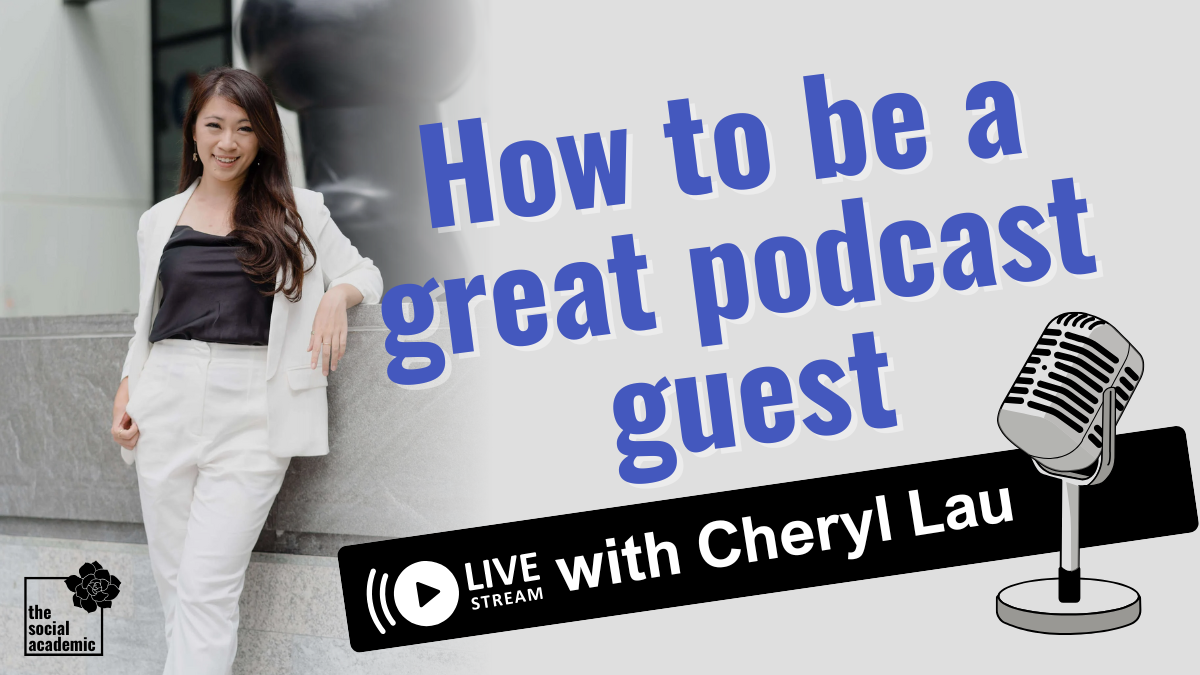
Podcast coach and producer, Cheryl Lau shares her top tips for being a guest on a podcast. Advice for first timers and podcast lovers alike.
Academic voices should be heard. Are you open to sharing yours? This episode of The Social Academic is about podcasting. Podcast host, coach, and producer, Cheryl Lau joins me to talk about podcasting for academics like you.
Have you been a guest on a podcast? Have you thought about starting your own podcast as an academic? Much of this conversation is advice for people who want to be guests on the show.
Cheryl Lau shares great advice toward the end specific for those of you dreaming about having your own podcast. What else do you dream about for your online presence, academics?
Update on September 5, 2025: Congratulations to Cheryl Lau! Her podcast, EDIT HISTORY took hope awards in two categories at the Asia Podcast Awards. This award is hosted by RadioInfo Asia. EDIT HISTORY won Best Education Podcast and Best Money and Business Podcast categories 🥳
In this interview
Cheryl Lau is back on The Social Academic
[Jennifer van Alstyne:] Hi everyone, I am Jennifer van Alstyne. Welcome to The Social Academic. I am excited to be back here live with Cheryl Lau. Cheryl has been a guest here on The Social Academic in the past. We’ve gone live together on Instagram. And, she’s someone I’ve worked with personally as a coach and for my podcast.
When I think about podcasts and academics and researchers, I feel like there are more unknowns or feeling unsurety, then there are answers. Having Cheryl back really to create this resource, this interview for you so you have a better feel for what podcasting could look like in your life? Cheryl, I’m so glad that you’ve joined me again.
Would you introduce yourself and your podcast for people?
[Cheryl Lau:] Sure. Hello everyone. My name is Cheryl Lau. I am the host of the EDIT HISTORY podcast. On this show we talk to creators and entrepreneurs and we look back at their past content to review it, reflect on it, and sometimes even have a good laugh at it. To talk about how it got them to where they are today. And Jennifer has also been a guest on EDIT HISTORY.
[Jennifer:] Yes, it was so fun. Some of my early podcast experiences were really informed by people like you who are out hosting these conversations with people and sharing your own thoughts with people in this accessible way.
I’m actually not a podcast listener, for everyone who’s out there. Even though I create this podcast, I’m not very good at listening to podcasts. I do listen to individual episodes. But I’ve really seen quite a bit of your podcast content because it ends up reaching me in different formats, whether it’s through your newsletter or through social media.
I’m curious, you have different roles when it comes to podcasting now. You’re a podcast host, a podcast producer, coach, and someone who actually has their own podcast too. Can you tell me a little bit about what are the different roles when it comes to podcasting?
[Cheryl:] Yeah, I wear a few different hats. For me, podcast hosting, having my own podcast is one of them. I’ve been doing that for over five years now. The podcast has gone through different iterations and currently it is called EDIT HISTORY.

Another hat that I wear is I am a podcast producer for organizations or established shows here in Singapore. What that looks like is that some of them might be producing a new show or they might be have an existing show already and they want someone to be a project manager. Or, they just don’t even want to think about how to, how to plan, how to execute the show. They will bring me on and I will essentially direct the whole thing from start to finish. Except for the tech. I will say that I’m not well versed in cameras and microphones and lighting. We usually have a assistant who is well versed in those skill sets. But everything from ideation to the concept to the episode narrative arc, and also the editorial post-production, reviewing the episodes, all of those falls under my role.
Finally, I also work one-on-one with individual podcasters through online coaching. We help them go from idea to execution as well.
[Jennifer:] I’ve seen some of your journey into growing into these more strategic and producing type roles. I’m so excited for how many people you get to help because of this.
Tips for first time podcast guests
[Jennifer:] One of the groups that you worked with recently, they had a powerful story to tell and a lot of the people who were involved in the recording of that maybe hadn’t been on a podcast before.
I think people who are listening to this, maybe they have never been on a podcast before. I’m curious if you would be open to sharing what that is like for people as someone who served in different roles. I imagine you’ve seen people who are at different stages of preparedness for being a guest.
[Cheryl:] Yeah. When it comes to being a guest on the podcast, I think number one is get a lay of the land of what the episode is about, right? Sometimes you could just ask, if the host hasn’t already shared the episode direction or a brief or questions with you. You can ask the host for the questions. Sometimes they have it ready, they just thought we’ll keep it conversational and they don’t think to share it with you. But if you want to, you can always ask the host in advance for questions, topics, or the general direction that they want to take the episode to so you can just in advance think about specific examples or stories that you might want to share during the conversation.
Another tip that I have is if there is already an episode that exists on the internet, do check out one of their past episodes to get a feel of how do they interact with the guests. Are they more of a conversational kind of host? Or, are they more an interview: answer, question, answer, question, answer kind of style? Every host has their own style and it always helps if you check out one of their past interviews that they’ve done with a guest like yourself.
Another thing I can think of is a lot of guests usually get nervous about being asked on topics that might be out of their wheelhouse. I think it’s usually helpful to stick to your strengths, so focus on topics or examples or sharings that you are comfortable and confident speaking about so that you can sound natural and engaging. These are some of the high level tips that I can think of for anyone who is going to guest on a podcast.
[Jennifer:] I really appreciate that. One of the things that I have loved about The Social Academic is how many of the guests who come on the show are first time podcast appearance people. Or, who are sometimes going live for the first time ever. I really feel excited about creating that space.
Sometimes I’m not aware though if someone is a first time podcast guest too. I feel like if there is a podcast host who wants to have you on their show and they’re not aware, it’s okay to let them know. It’s okay to be like, “Hey, I might have more questions than usual.” Or, “I am curious about this one thing” because there’s always information that I feel I’m over communicating as a podcast host. Sometimes I forget to include things that maybe actually you need.
Feel open to reaching out if you are unsure about something. Or, even asking at the start before you start recording.
[Cheryl:] That’s such a good insight. Yeah, definitely. If it is your first time guesting on a podcast, I think the host would be more than happy to help make this experience a breeze for both parties.
[Jennifer:] What about someone who maybe they’ve been on podcast before, but they want to be more intentional about it now. They’re like, “Oh, okay, actually I liked podcasting [as a guest]. I want to consider being on more shows.” What’s a good place for them to start?
[Cheryl:] Yeah. If there is a particular podcast that you want to guest on, make sure that they do guest interviews, because some shows they genuinely are a solo episode type of format or they have a certain format.
Be familiar with the show itself that you are a fan of or you want to guest on. Make sure that you can actually fit their show concept or the format that they already have. I think that’s one thing: I get a lot of guest pitches in my inbox, but you can tell that they haven’t really listened to any particular episode. It’s very clear from the pitch that they send.
Usually rapport, I think from a podcast host point of view, already having a preexisting rapport or relationship with a potential guest helps a lot for the host wanting to invite you onto the show. For example, for Jennifer, you and I have a long history already. I knew about some of your past experiences and I felt like they were a great fit for EDIT HISTORY. I wanted to fit that story into the existing structure and format of EDIT HISTORY.
If you want to guest on a specific podcast, be familiar with how the show operates. If you think you’d be a great fit, let the the show host know exactly how you see yourself fitting into the existing narrative arc that they want to paint in their episodes.
[Jennifer:] I appreciate that. ’cause that work is something that I feel like academics and researchers are used to doing when it comes to their publications, their research, all the things that they care about in terms of the outputs of their academic life. But maybe weren’t sure if they were deserving of giving that intention to themselves too.
I hope if you’re listening to this and you’ve been curious about being on a podcast that you will consider taking that step, maybe pitch yourself sometime in the coming months.
Oh, Cheryl, I’m glad we chatted about that because there’s probably a lot of first time people who are listening to this. Probably most people are like, “I’ve never been on a podcast before.”
Subscribe to The Social Academic blog.
The form above subscribes you to new posts published on The Social Academic blog.
Want emails from Jennifer on building your online presence? Subscribe to her email list.
Looking for the podcast? Subscribe on Spotify.
Prefer to watch videos? Subscribe on YouTube.
Virtual vs. in person podcast recording
[Jennifer:] Ooh. Is there anything different when it comes to podcast recording in person and virtually? We’re virtual right now, but I know that you’ve recorded and produced things that are in person as well. What are some things to expect?
[Cheryl:] Yeah, if you have the opportunity to do an in-person podcast interview, the experience is a little bit more nerve wracking. Not going to lie. It is a little bit more because you see the behind the scenes. You see the set. You see the cameras and the lighting. Usually in-person sets have more of the fancy gear in place. So you will naturally feel a bit more of the nerves.
I will also admit that I think body language, posture, how you appear on the video, you will be a bit more self-conscious of those things just because generally speaking, if you are doing an in-person recording, they will use either an iPhone or maybe even a fancy camera. So you will be captured in even greater detail. You will appear sharper on the camera, so you will naturally notice a lot more details on the camera.
One thing I always suggest is pick your outfit intentionally because you want to sit comfortably on the chair. You will be self-conscious of how you’re sitting in the chair. Wear a shirt, or pants, or whatever outfit that feels comfortable, but also flattering on you. Right? Because you don’t want to be feeling self-conscious throughout the entire conversation.
Another interesting thing that you might find is that you’ll feel a lot more connected and present with the host. You’re literally staring at them in the eyes without any digital screens. I think you can still create that experience virtually, but it’s even stronger in person. I will also say remember the audio experience is the most important for any podcast because generally speaking from a listener point of view, they’re not staring at the video for the entire 20, 30 minutes. They might be glancing at the screen and then going off to do something else during the viewing experience. Usually you don’t have to be so self-conscious the entire time. Just know that the listening experience is the most important for the viewers and listeners.
Look and feel confident, considering hair and makeup
[Jennifer:] I have a question for you that I did not send you in advance. I’m hoping that you’d be open to chatting about it. It’s about professional hair and makeup. I had some guests here on The Social Academic, actually my wedding team who did my hair and makeup. I worked with them for a photo shoot for new photos from my website. I loved the experience.
I’m curious, have you ever invested in professional hair or makeup before a podcasting experience? Or in-person versus a virtual kind of thing? I’m curious about that.
[Cheryl:] I have not had professional hair and makeup done for a podcast appearance. But I can say that if I were going on a very big podcast or on TV, I would definitely invest in my hair and makeup. For a casual, for depending on the vibe of the podcast, so far I have not decided to invest in hair and makeup before the interview. Just because I feel quite skilled enough to do my own hair and makeup. But I can definitely see that if there are certain opportunities where I feel inspired and called to do so I will. So far I have not decided to do so. But it’s not off limits for me. I will consider it in certain situations.
[Jennifer:] Yeah, I love that because I feel like one of the things that, I can’t remember if it was either Amanda Thorne or Melissa McClure, but they said, ‘If it helps you feel more like you can be more yourself, or more confident and comfortable in your body for that thing, maybe it is worth the investment. And, that investment is a business write off so it can be helpful for you and maybe good for your taxes too.’
What materials do I need to appear on a podcast?
[Jennifer:] Now Cheryl, I wanna chat about the things that people might need to prepare if they’re gonna appear on a podcast in advance. Because high resolution photos are something that I know I’ve been requested before. I didn’t have professional ones until this year. But I’ve been requested for photos for podcast appearances.
What are some of the other things people might need to prepare in advance to appear on a podcast?
[Cheryl:] Yes, those high resolution photos definitely help for the host when they prepare promotional graphics and assets to share your episode afterwards. Definitely a big fan of good photos that we can use to share your episode.
Another thing that usually hosts would like to ask from you is a bio, usually in 3rd person. It’s helpful if you write it in 3rd person so that they can introduce you at the beginning of the episode or record a narrative intro afterwards. Or even just in the description of the episode. Having your bio will be tremendously helpful if you can provide one.
Links to your website, social media accounts. I think those things would be also very helpful so the host doesn’t have to scramble and like think, ‘Oh, is this something that the guest wants to share?’ If you can just collect a list of social links that you want to share for the host, that will make their job a lot easier.
Some other things that might sometimes be requested is sometimes the host would want to co-create the episode with you. They might ask you what are topics or angles that you want to talk about in your episode? Sometimes you will create the episode together.
Another thing I can think of is pronunciation of your name or certain pronouns that you prefer. Those things you can usually provide if you wish to do so.
And another thing I can think of is, depending on the podcast episode format or the topics that you talk about, sometimes providing relevant work samples or previous work might be helpful for the host as they create the narrative arc of the episode. Sometimes just providing a little bit more information and context into your work can be super, super helpful for the host as they plan your episode.
[Jennifer:] Yeah, I think about people who are academics. There is sometimes this hesitancy of, ‘People won’t really care about what I do,’ and typically what people need the opportunity to do is: to to learn a little bit more. If you have something that can help them take that step, if it’s supportive in their process of preparing for your interview, do that. If you have something ready, please share it because I know I would definitely appreciate that. And I think so many podcast hosts would too. And it may be something that it doesn’t come up during the interview, but the link still is something that supports the show notes or is a resource that can be shared for people later on. I love it.
Being on an interview style podcast (Q&A)
[Jennifer:] Do you have other tips about being a podcast guest that you are open to sharing?
[Cheryl:] Yeah, I think one that comes to mind is generally speaking, and it depends on the host and the dynamic they like to create on their episodes, but generally speaking, I find that podcast hosts likes to keep it back and forth, back and forth, very conversational.
So one thing that I’ve noticed is that guests are usually not sure how long to talk for. If they are asked a question, they’re not sure: ‘Should I go on for 5 minutes and add all the context? Or, should I keep it brief? Right? So usually my personal tip here is keep your sharing to about 1 minute, no more than 3 minutes. 1 to 2 minutes is usually a good length. That gives the host an opportunity to pick out their favorite parts that they want to go deeper in. I think Jennifer, you are an excellent host because you’re so good at that ping pong back and forth, back and forth.
From the listener point of view, having that back and forth is actually a much more enjoyable experience rather than hearing one person speak for a prolonged period of time. When you’re recording, try to keep your answers within 1 to 2 minutes so that the host can then pick out their favorite parts to dig deeper into.
Is starting a podcast right for me?
[Jennifer:] Okay. I wanna switch gears a little bit. There’s probably people who are listening to this that have dreamed about having their own podcast. Maybe they started a podcast and they didn’t actually launch it. They have been hoping that this thing that they’ve been wanting is magically gonna happen. But they don’t necessarily know if they should have a podcast or if [that idea] should stay in dreamland.
What do you recommend as someone who coaches and works with people who are taking action to launch their podcasts into the world, to be more intentional with their podcasts? How do you know if starting a podcast is right for you?
[Cheryl:] Yeah. I’ll dissect my answer into two parts. The first part I’ll answer this with is asking a few high level questions and seeing where the listener lands.
- Do you want to build a body of work around a specific topic? If the answer is yes, a podcast might make sense for you.
- Another question to ask yourself is, do you like having interesting, meaningful conversations with yourself or with others? If yes, podcasting might make sense for you.
- Do you like to document your journey or thought process and share it with others? If yes, podcasting again might make sense for you.
- Do you enjoy long form content? Whether it’s creating it or consuming it, I think either or could be a good indicator that a podcast might make sense for you.
- Are you okay with potentially a slower growth trajectory and not going viral overnight? Because podcasting as a format, it’s harder to see quick growth compared to TikTok, Instagram reels, even LinkedIn posts. The ability to get traction very quickly early on is a bit more limited.
So if you are okay with that, and your answer to the previous questions were yes, yes, yes, yes, yes, then podcasting would make sense for you.
The second part that I want to answer this with is talking about a few hesitations that people usually have when it comes to podcasting.
One of the big concerns that people have is, do I even have the time and capacity to podcast? Right? A question to ask yourself is, can you commit to a sustainable cadence? That could be weekly, biweekly, monthly. If not, but you still want to have a podcast, then you can consider having a limited series, or whether it could be a seasonal show, or having a one-off series. That can still be a substantial body of work. Having a 6 episode, 8 episode, 10 episode series. That is still a body of work. That is a podcast, that could be in a podcast format. Do consider whether your capacity allows you to be ongoing or a limited series.
Another question to think about is: What do you want to talk about? If you feel like you have expertise to share, you can consider having solo episodes that position you as a thought leader in that space. But if you feel like, ‘Oh, I, I really don’t know if I feel confident enough right now to talk about that topic,’ you can consider bringing on experts who are “qualified” to talk about it and interview them on that subject matter. You can build your learning and knowledge around that topic as well.
All that to say, if you have certain question marks in your head, don’t let that be a deal breaker to to not starting a podcast.
One last thing I will share is tech. Tech, whether it’s editing or where do I even upload the podcast? Do I need video? These are questions that can feel like a deal breaker for many people and they don’t even start. But what I will say here is that yes, it will feel overwhelming at the beginning.
I will acknowledge that it is a big hurdle at times to get through. Once you overcome that hurdle. Once you set up the tech. Once you set up a podcast hosting service. Or, set up your YouTube channel, your Spotify accounts, and you learn to upload your first episode. The rest of the journey, it is usually quite seamless. So don’t let the tech be a a hurdle right now. Even the editing, it can feel very slow right now. But you will get faster. Do not let tech or editing be a deal breaker right now.
[Jennifer:] Ooh, I love that. Yes. Tech is something that even you feel like isn’t your best skill. You said you work with an assistant as when you’re producing. We don’t have to have skills in all of these areas to move forward with something that we’re dreaming about and that we can see helping people.
What do you want in your body of work?
[Jennifer:] I love talking about podcasting because a lot of people who are maybe hesitant that they are deserving of media attention. I think of my friend, Dr. Sheena Howard. She supports professors who want to have more attention and agency when it comes to sharing their research and the things that they care about online. I love that she helps people with that and book promotion.
But I feel there’s a lot of people who feel they don’t deserve that. But, they’re open to being on a podcast. They’re open maybe even to having their own podcast. So thinking about what are you open to doing that feels comfortable to you? What are you open to using your voice for? I’m glad we got to have this conversation about this.
[Cheryl:] Yeah, I really love that point because some people building your own podcast makes complete sense. Mm. But sometimes guesting on multiple podcasts is how you built your body of work. Either path could be a fantastic fit for you to get your work out there and get your message and story out to more people. Both paths work, but depends on your capacity and whether you want to create your own or guest on others and curate the list of podcast episodes that you’ve been on. And that playlist is your body of work. There’s options.
[Jennifer:] What does it mean to have a body of work? I know between us what it means for me when it comes to my blog, my YouTube, the things that I put intention into creating and sharing with people online.
What does it mean for someone who’s first starting out and considering what do they want to put in their body of work? What does that include?
[Cheryl:] I feel this is a term that is up for interpretation, but the way I see it is it’s something that you want to show others. You’re so proud and excited to share it with others. It could be a website. Sometimes I love sharing my website with others and that’s part of my body of work. I love sharing my podcast, or podcast episodes that I’ve been a guest on, that also compiles and builds into my overarching body of work. Clients I’ve worked with, their results and testimonials, that’s part of my body of work. Anything that you want to showcase and highlight. Even your academic publications for for professors and researchers. That is your body of work. Whatever touchpoint that you want to show proudly, I would say that that is part of your body of work.
How to share the podcast episode once it’s live
[Jennifer:] Okay. One more question for podcast guests, and maybe this will help some podcast hosts too. Let’s say, I’ve been on a podcast. What are some things I should do to help share that episode once it’s live if I’m a guest?
[Cheryl:] Hmm. I think number one is if the episode is on YouTube, you could curate a YouTube playlist of all the episodes that you’ve been on. I do that. I think, Jennifer, you do that too. if I’m not wrong, we both have a playlist on our channels where people can click on and go through all our interviews in the past. I think you can do that on Spotify as well. I believe that is a feature available on Spotify. If not that you can manually create a list of episodes on your website, on your blog or, even on your
[Jennifer:] CV. This is a media appearance on your CV for sure.
[Cheryl:] Such a good point. So, that’s one way making sure that people can easily go through a number of your interviews all in one place and having links to those episodes. It could be the audio episode, the video episode doesn’t matter. Sharing your episode, re-sharing the hosts when they share about your episode. You can share it, reshare it on social media. Tag the host so they can reshare it again and get the momentum going. Those things can work as well.
Behind the scenes content is something that people usually forget about. Taking a selfie together after you record the episode, or remotely, you can take a screenshot of it. Or, going on your Instagram stories afterwards and say, ‘Hey, I just recorded this episode with da dah dah dah dah. We talked about da dah dah dah dah.’ Just having some behind the scenes content is super, super fun to view from an audience point of view.
Continuing to mention it even months after the episode has aired if a relevant topic comes up and you’re like, ‘Hey, I also talked about this on x, y, Z podcast, I’ll leave the link here.’ Even if it’s a year later, you can still reference the episode because podcasts are long lived compared to short form content. And that’s why people love to guest on podcasts because they can always reference back episodes that they’ve been a guest on months or even years ago.
[Jennifer:] I love that because there are podcast episodes that I did as a guest back in 2018, 2019, that are still relevant to people today and that I haven’t talked about since. I haven’t talked about that topic since. Being able to share it again, having it not just in my Media page on my website, but something that I have actively shared as a resource for someone. I feel lucky to be able to do that because I gave that time years ago and now it’s just a link that I can easily share to help someone now. When I think about the agency we have to reshare things that were meaningful to us or that are meaningful to other people. That is really special.
And, thank you for reminding me because I always forget to take a behind the scenes screenshot. I’m definitely gonna do this when we wrap up the episode. As a podcast host and as a podcast guest, there’s things that we can do to remind ourselves that this time has purpose.
[Cheryl:] Yes, we will definitely take a selfie after this recording.
[Jennifer:] Okay. How can people work with you one-on-one? There are people listening to this who are like, ‘I want a podcast. I really do need the help of an expert to envision or get it going.’ How can people work with you?
[Cheryl:] Hmm. You can find out about my one-to-one… It’s an interesting program because it is podcast coaching and me as your podcast producer. That is something interesting that I offer, which is where in addition to coaching you through how you show up on your podcast, helping you ideate your show concept and making sure that is differentiated and well positioned in your specific podcast category. In addition to that podcast coaching, I can also work with you as your podcast producer so I can help you script your narrative intros. I can help you prepare a list of questions you want to bring to your guests. We can also script out your episodes together. That is something that I offer uniquely to podcasters that I work with as well. For all the details, you can head on over to my website CherylLau.com.
[Jennifer:] Okay, so if you are listening to this and you really want support with not just getting the podcast ideas out of your head, but actual producing, getting all of the components that you need to get your episode out there, including the episodes themselves. I love this.
Being on a podcast is fulfilling
[Jennifer:] Cheryl, thank you so much for coming on The Social Academic to talk about podcasting. Is there anything you’d like to add before we wrap up today?
[Cheryl:] Hmm. I think the last nugget I want to leave is for anyone who wants to either start a podcast or guest on a podcast, I think you would feel fulfilled afterwards.
People don’t expect to feel as fulfilled as they do. Because sometimes when you go into a recording you’re a little bit nervous. You’re like, ‘I don’t wanna mess up.’ ‘I don’t want to look unflattering on the camera.’ You have so many thoughts going into the recording. Or, even when you start your own podcast, you’re like, ‘Can I really do this?’ ‘Will people listen?’ But once you record the episode and you publish it into the world, you’ll oftentimes realize, ‘Wow, that was not bad at all.’ ‘I’m so happy I did this.’ So if there is an opportunity to guest on your a podcast or to start your own, I think it is a worthwhile decision to consider.
[Jennifer:] Cheryl, thank you for coming on and being such an amazing guest here on The Social Academic. I’m glad we came back because the first time we talked about fear of judgment on social media, and I think this is really something that we need to address when it comes to how we show up online. The fear of judgment holds a lot of people back from maybe considering a podcast for themselves or actually creating one for other people. And so thank you so much for coming back on the show.
How can people find you on social media afterwards?
[Cheryl:] You can find me on my website CherylLau.com, or Instagram @CherylTheory.
[Jennifer:] Amazing. Thank you so much, Cheryl.
[Cheryl:] Thank you so much.
Subscribe to The Social Academic blog.
The form above subscribes you to new posts published on The Social Academic blog.
Want emails from Jennifer on building your online presence? Subscribe to her email list.
Looking for the podcast? Subscribe on Spotify.
Prefer to watch videos? Subscribe on YouTube.
Bio
Cheryl Lau is the host of the EDIT HISTORY podcast, podcast content strategist, and podcast producer.
Cheryl started her own podcast in 2020. Her show was shortlisted for the 2024 Asia Podcast Awards (by Radioinfo Asia) in the “Best Money and Business Podcast” category and won the 2023 Golden Crane Award (by the Asian American Podcasters Association) in the “Best Entrepreneur/Solopreneur Podcast” category.
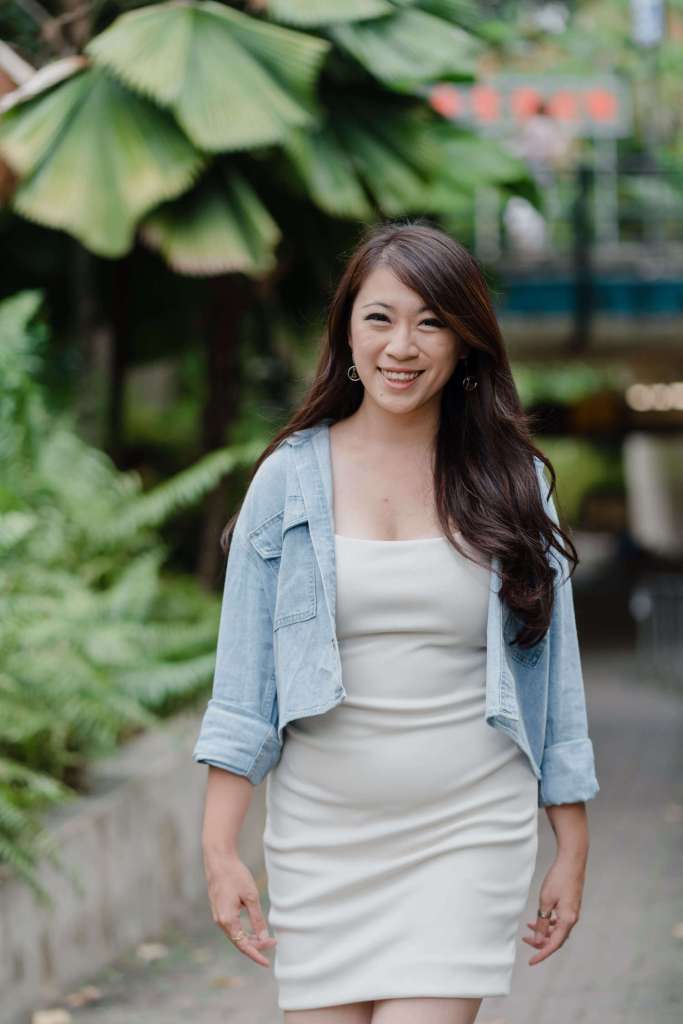
Today, she helps business owners, consultants, and creators build a podcast content strategy that resonates with their audience, differentiates their brand, and establishes their position in the industry.
She also works with organizations and established shows through podcast production. From ideation and guest prep to editing, publishing, and promotion, Cheryl oversees every stage of podcast production.