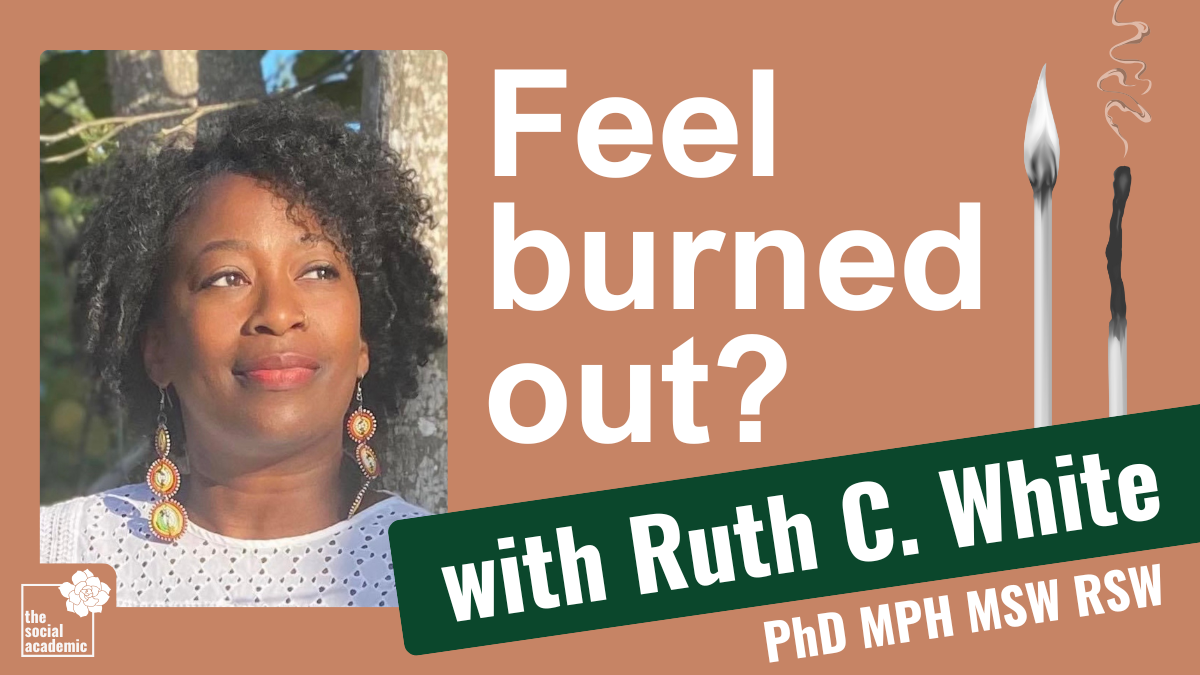
Faculty, you deserve wellbeing. Burnout coach, Dr. Ruth C. White is back to help you, especially if you’re experiencing burnout.
We’re back with Dr. Ruth C. White to talk about her life beyond academia. Join us for this conversation about why female academics suffered through the pandemic, and why they are feeling so burned out.
What is burnout? Why are women academics especially feeling it in 2025?
In this interview

Dr. Ruth White is back on The Social Academic
[Jennifer van Alstyne:] Joining me here on The Social Academic, Dr. Ruth White is back, and we’re actually going to talk about burnout for academics. And I think this is a topic that is especially important right now. Ruth, thank you so much for joining me again. Would you introduce yourself for people?
[Dr. Ruth C. White:] Hi everybody out there in the socials land and in the internet. I am Dr. Ruth White and I am a therapist here in Ontario, Canada. I’m also a coach, a career coach. And one of my specialties, ’cause my friends called me out on it, is about burnout among academics because I had all these programs and they were like, “what about for us?” And I went, “Oh, right, I was one of those people. So yeah, I’m at Lumora Coaching, you can find @LumoraCoaching on Instagram and you can find me Ruth White PhD on Facebook and I am also on LinkedIn.
[Jennifer:] Perfect. And I actually, I feel like I see you on LinkedIn most, and one of the things that I love that you are open to is really talking about mental health and talking about what people are actually experiencing in their everyday lives and how we can notice it, how we can counteract it or take action about it.
Academics experiencing burnout
[Jennifer:] I’m curious, why burnout? Why is that the topic you wanted to chat about today?
[Ruth:] So one, everybody’s feeling it, right? I have been, I wrote a book around stress management many years ago. I think it’s, I don’t know, was it 10 years ago? My goodness. It was called The Stress Management Workbook: De-stress in 10 Minutes or Less. And at that time, stress management was something that was really blowing up in the, people were talking about it more. People were realizing that stress is the number one reason why people go to seek medical attention, especially in the developed world. So anything you can think about, whether it’s heart disease or cardiovascular things or hypertension, diabetes, obesity, all these things are related to stress. And then my sister just kept sending me articles on burnout. There it is. In Harvard Business Review, it is in Fast Company, it’s on the news, it is on the, the daytime talk shows as well as recently in the Chronicle for Higher Ed, there was an article in February just about, ’cause they do a survey, I think every year they do a survey. Anyway, they did a survey in the fall checking in with academics. They interview several thousand academics. Well they survey them and people are feeling it, right?
In this particular moment, this political moment in the USA right now, how do I put it? I’m going to put it gently. Universities are under a lot of stress, right? Whether it’s funding, whether it’s what you teach, how you teach it, students need more support. Students kind of hold your future in their hands. So if they don’t like you and then give you a bad review, you might not get another teaching gig.
And I know people were leaving, I ran into somebody recently at a big, it was a festival, literary festival in Jamaica. And it turned out, turned out we went to the same high school and we’re in the same year. Had no, we had no idea. And we decided to set up a zoom meeting. And when she set it up, she said, by the way, I looked into the yearbook and yes, you were at, we were in the same grade in our high school in Jamaica many, many years ago. Anyway, she was just, she’s leaving, before retirement age. And a lot of people are, they’re just fried.
I have friends who don’t want the dean job, they don’t want the dean job, they don’t want any of these jobs. They want a nice fellowship where they can teach two classes, write and do research and kind of, we’re at that, I’m in my sixties, so people are trying to slow down even though academia’s a place you can stay, as long as our brains work and we still want to be out there doing all the things.
So that’s why burnout, it wasn’t long ago that the World Health Organization defined burnout as a condition of the workplace. Which is interesting because the way people use it, it’s not just about the workplace, but the World Health Organization defines it now and it’s not yet a official disease. Right? But also it turns out HR people are reporting just how many people are going out on stress leaves. So burnout, it is
[Jennifer:] Burnout it is. And I feel like since I was in grad school, I mean people have been talking about academics, in particular female academics experiencing burnout. I’m curious about what that looks like for different people because burnout can be experienced in different ways. And so I’m curious for people who are listening, how can they tell if like, I am in the middle of burnout right now?
[Ruth:] Right? So the WHO definition includes three things. One is emotional exhaustion, two is what they call depersonalization, which is, you’re cynical, you’re kind of, you’re just detached from work. And then the third is reduced professional efficacy. So what that means is, emotional exhaustion is when you’re just like, “Oh my God, I got to get up and go face these people,” right? Some of these stories in this article that I read in the Chronicle of Higher Ed was, people talking about just how much they have on their plate.
And then if they’re a really good teacher, that means everybody signs up for your class, which is great to be popular, but TAs are so rare. I think I had a TA one time in my 20 plus year academic career and it was a summer class at Berkeley and I was like, oh my goodness, I don’t even know what to do with myself. Right? Because somebody was grading, somebody was taking care of all the accommodations that we had to do. Which student needed more time, which student needed a different setting and quiet or whatever it was. And so there’s more being put on people’s plate.
Tenure is harder and harder to get. Not only is tenure harder to get, the academic job is harder to get, right? So the academic job is, when I graduated back in the bajillion years ago, you got a PhD from a place like Berkeley. You were going to go out and find a job and you started, and you did have to publish. And it really depended on which school you were at. Whether it was R one or whatever, you still have to publish. You had to do service, you had to be a good teacher. Okay, now you’re doing a postdoc and you’re not doing a postdoc for one year. You’re doing a postdoc maybe for two years. And I still have to compete with everybody. And the pay is awful. There was so many articles being written about academics who were needing food stamps or whatever. I mean, I see what adjuncts get paid. It’s awful. I keep telling people you could go work at a bar on Friday night in any hotel and make more than an adjunct makes.
So that emotional exhaustion is legit, right? Especially as women. Women are the emotional caretakers of their families, of their households, of their friendships, all of that. And we are often in caregiving roles and a lot of women try to strategize about when to have their kids, if that’s something that they want to do when they’re on this tenure path. More schools are doing things like stopping the tenure clock. That was a big thing when I was at Berkeley. We had a professor who studied women’s stuff and and she was like, “We got to be able to do this.”
So that emotional exhaustion is real. The cynicism or detachment is you come in with, we come in with mission and vision, right? Like nobody decides to go through the hell of a PhD and join academia hoping for this permanent job. Which again, is so rare in the workplace. That’s why everybody’s hanging on tied to their tenure. Nobody does that without having a passion for the thing they study, a passion for students, for learning, for teaching.
And so once you start to feel like, why am I here? Okay, people are cheating, they’re using AI, they’re cheating, they were cheating before AI. This just helps ’em cheat more. There’s all sorts of platforms that we used to use back in the day and, and then people were buying papers, whatever. But the cynicism is there because you feel committed, but you don’t feel valued because the salary doesn’t reflect your value. Some of that low salary, we used to be like, “Oh well, you have your summers off, you can do extra things, teach a summer class, do workshops, write a book,” whatever.
But now it’s like you don’t really have time for any of that. And so you start to get detached because you kind of get cynical about the whole thing.
I call it the academic industrial complex, right? I was feeling that way a long time ago where it’s just kind of, we’re on this treadmill, we’ll get the money. We teach the students, the students want the world and they think they pay for the A or whatever. And I get it, students are also on a stress, ’cause school costs way more than when I went to school. And then the reduced professional efficacy is if you have to do more, it’s hard to be good at everything. And in fact, it’s practically impossible. That expectation should not be there, that you’re going to be good at everything.
So the more things you have to do, the less efficacious that you are, the less effective that you are. And that also leads back into that emotional exhaustion and cynicism. And so a lot of people are feeling they just can’t do it. They look at the summer and they’re like, “Thank you.”
And then when the last two weeks of August are approaching and the emails start coming and you got to log onto whatever platform you’re teaching and start loading up things and there’s just so much knowledge out there and students are coming, they walk some TikTok-y or Google-y thing and now you’re dealing with all of that. So that is what it can look like. And it shows up for people in different ways. So those are the three characteristics or themes.
But emotional exhaustion might look like I’m on the verge of crying or I’m in the bathroom crying. It might mean that I’m snapping at people, I’m cranky. It might mean sleep is a mess because you’re anxious, you don’t want to deal with tomorrow. And then you start perseverating on thoughts. So your sleep’s a mess. Emotional exhaustion can come out a lot like that. People just lose patience. And then the cynicism or detachment, it’s literally when students start saying, “I don’t think this person cares anymore.”
Or you try, you show up. And then students say things like, in your evaluations. And people are like- You know what, separate yourself. I just told a colleague recently, I was like, “Don’t even, don’t drive yourself nuts.” ‘Cause one class they thought he was amazing. The other class they thought he was trash. And he said, “I am the same person. Like they’re not talking about the content, they’re talking about me.” And it has to do with whether they like the class and all of these things. So, and nobody, you don’t go through all of this to get this far to not feel effective. And those are all the different ways. And of course people are still individuals, so it might show up a little differently for some people.
Subscribe to The Social Academic blog.
The form above subscribes you to new posts published on The Social Academic blog.
Want emails from Jennifer on building your online presence? Subscribe to her email list.
Looking for the podcast? Subscribe on Spotify.
Prefer to watch videos? Subscribe on YouTube.
Office Hours for the Soul
[Jennifer:] I feel like there is not enough support on campus for academics who are feeling burnout. And of the reasons why I really wanted to have you on the show is because you offer support in the form of your Office Hours for the Soul program. Tell me a little bit about that.
[Ruth:] So when I was putting, over the years I did a lot of coaching of students, right? That’s part of the professor’s job is to help students with their careers, et cetera. But then I was also finding myself talking to friends and colleagues who were just like, “I don’t know about this.” And I would be helping them with different strategies. How do you get the most out of a conference trip? How do you do this? How do you negotiate things? I had friends who were very wonderful coaches before I even registered for my PhD who taught me there are things you can get that nobody tells you about. Like nobody at Berkeley told me I could go ask for travel money. That wasn’t what the university gave, that I could go and argue for that. I got lots of travel money because I was a global health person.
Anyway, so over the time of helping friends, et cetera, and I, when I decided, I’m going to go bet on myself and I’m going to launch a coaching practice, which I launched May one, so it’s brand, brand new. My friend said, “Well, what about us?” What about all the academics? Especially after COVID? ‘Cause a lot of women were feeling it during COVID.
I decided to specialize in coaching women, coaching women through different points in their careers. Coaching women who, I have one thing called modern ambition. So it’s for women who are mothers and having to reassess the way things look. But for Office Hours For The Soul, it’s really about helping people get back to
- Why am I here?
- Why am I doing this work?
- What are my values?
- If I value community work, is this showing up in my research? Is this showing up in my service? Is this showing up in the way that I engage with the university?
- If my family’s important, how do I create the boundaries that allow me to show up for my family the way I show up for myself at school?
- As well as how do I maintain my creativity?
Because research is about creativity. And I’m not saying making up things. I mean you have to be thinking about new ways of doing things. You have to find gaps in the literature. So you have to think creatively and innovatively about the work that you’re doing.
Ultimately, we as academics, we are creating new knowledge, right? But if you are burnt out, there is no creativity happening. So the coaching is really to help people figure out, is this where I’m going to stay? And if I’m staying, what does the next three years look like? You know, if I’m two years into tenure, how do I spend the next four years if I already got tenure? Am I going for full professor or am I not? Is there a way to build a life beyond academia? So for some academics that might be me helping them to leave academia, which can be challenging. ‘Cause people just think that once you have a PhD and you spend some time as a university professor, you don’t know how to do anything, right? But there are lots of ways that people can transition from academia or stay part-time in academia.
I have a full-time job in DEI, which of course is going away, but I can say now ’cause I’m like a little official about it, that I’m going to go full-time working for myself. September one, I have been teaching adjunct as well at different schools, staying in social work. I’ve been a social work professor. I think I taught my first social work class as a professor in 1992. I’ve been around the block a minute. And I’ve taught here in Toronto, I’ve taught at USC, I’ve taught at UC Berkeley, I’ve taught at Simmons [College]. I got tenure at Seattle U. I’ve taught at big schools, small schools, private schools, public schools. And I have a long career and I’ve written books for a public audience. I show up on television, KRON4 in the Bay Area. I’m their mental health commentator. I’ve been on their news, various programs at least three dozen times in the last five years. I’m able to bring that experience of consulting with major organizations. I’ve consulted with JP Morgan and Indeed and PWC all by myself, not working for other some big organization. So I bring that experience into the coaching environment.
I’m a registered social worker, I’m a therapist. And actually it’s a therapy practice that I recently launched. Yeah, I’ve been a therapist now for about two years, but I’ve been a social worker since 1991. No, 1988. I got my BSW. I’ve been a social worker for a really long time. I brought the social work experience, the experience of coaching so many students, mentoring so many students, and my experience as a therapist and I’m willing to help women who are feeling the burnout or want to prevent burnout, right? It’s really about the alignment and because as a public health professional, I got a master’s in public health and maternal and child health.
And as a master’s in public health person, we learn that prevention is better than cure, right? And the goal in public health is always to prevent. And so we shouldn’t wait until we are falling apart to go get help. So many women walk into my sessions that are, they literally walk in and say, “I can’t do this anymore.” They like, as soon as the session starts, they’re crying, right? And you don’t have to wait that long to go get help. And that’s what the message really, I want women to realize, you’re not weak. You’re not, “Why can’t I, power through it? There’s not, there’s nothing wrong with you. You’re just trying to figure out, “Let me figure out my life again.”
Because I want to say, if you’ve been in this field for a while, there is no doubt it has changed. It has changed, the technology has changed, all of these things have changed. And so that’s what Office Hours for the Soul is, is about. And I do individual as well as if somebody wants me to come in and do a workshop for faculty at a retreat or you want to do a group series. Definitely I can custom build things for departments or for groups of women who want to do this together. Because I think in community, women will feel more supported than just the one-on-one. If you have, four or five or six other women going through what you’re going through than you can share resources. If you’re at the same school, you can figure out strategies, et cetera.
[Jennifer:] Oh, I am so appreciative that you’ve come on The Social Academic to share this. Ruth, I feel like you are someone who I first met at kind of like a precipice of making sure that what I’m doing is in alignment with my goals. And when I invited you on The Social Academic the first time, it was really like my first time doing video at all. And this is my first time doing this new kind of live broadcasting process for The Social Academic. And I’m so glad that you are the guest to accompany this journey for me as well. Because alignment really affects how we feel about our work. It affects how we feel about our life. And I love that you help people find that alignment for themselves.
Women in academia do 50% more service
[Ruth:] Thank you. And I want to also say something about women academics.
There is research that shows that female academics do 50% more service work than male colleagues. Now, women do this in other settings as well. So there’s corporate settings where women also tend to volunteer for things that are what we call unpaid work or unrecognized work. And the kinds of, so service burden falls disproportionately on women, but especially on women of color as well, right? And so women tend to want to mentor other women. Women of color or faculty of color feel like, “You know what, I want to take on this sponsorship and support of students who are struggling,” because they feel somebody helped them, or I’m here and the privilege of being here means I help other people. And then the overwork is normalized in academia. And so they have, they’ve done studies where like you have couples who are in academia and they’re both professors or whatever. And then of course the woman is still cleaning the house, she’s still taking care of the kids, she’s still doing all those other things. And during, again, during the pandemic, that’s when it really became clear just how much, because women’s productivity fell. ‘Cause now you’re in the home and guess who’s taking care of doing all the house stuff?
Subscribe to The Social Academic blog.
The form above subscribes you to new posts published on The Social Academic blog.
Want emails from Jennifer on building your online presence? Subscribe to her email list.
Looking for the podcast? Subscribe on Spotify.
Prefer to watch videos? Subscribe on YouTube.
Bring your life into alignment
[Jennifer:] What are some ways that you found more alignment in your life since we last chatted on The Social Academic?
[Ruth:] That is a really good question. Well, one of the things I did, I started doing travel writing and it was something that I love writing. I’ve always been a good writer. It’s just been my skillset for a really, really long time. It helps in academia. But I write things for podcasts and I write things for Fast Company and Harvard Business Review. And I had a blog back in the day before blogs were big. I was on blog spot writing and I’d always traveled and there were a lot of influencers who were like, they would be in my DMs and say, you should do this. And I realized, I don’t know if the whole influencer thing is my shtick because I don’t like editing videos. And so I would video everything and then I’d have to edit it.
But then I pitched my first travel story and it was about the little town that I grew up in in Jamaica. And I got my first story in Conde Nast Traveler. Now that was, I feel bad sometimes ’cause travel writers are like, “What?! That was your first story?” It’s my first story. And then after, yeah. And part of it is because this little town, nobody talks about it, but it’s a cute little town and it’s in a really great area on the south coast of Jamaica. And that started to trend, and I grew up there, so I really knew the place well. And then I got another story that was Conde Nast Traveler, but the UK edition and they asked me to, write a story about the top 10 hotels in Jamaica. That story led hotels to be like, “Oh, can you write about me? Oh, can you write about me?” So yeah, travel writing. And then I did another story on Kingston for an Australian outlet.
What happened was, I was traveling anyways, I’ve always traveled, I’ve written about the Bleisure trip. So you go to a conference and you add on, you fly me to Singapore, I’m going to tack on Thailand, and I’m going to spend a day, I did a day trip to Kuala Lumpur, but out of Singapore. And so travel is always, something everybody knows that they don’t know where I am half the time. I mean, I’m a lot more settled now that I’ve had a nine to five for the last two years. But that travel and writing really allowed me to write in a much different way. I was telling a story in a way that I don’t get to tell stories in academic writing or even wellness writing, right? Yeah, there’s a little bit of story about the lady that this happened to, but it’s not, therefore you should sleep more, whatever. But weaving together and reporting on the travel bit, that was something new for me.
And that was something that I said, I want to do more creative writing. I would love to write a memoir, but again, I don’t got, I did not have time in my nine to five life. Another way is that I decided to step outside of academia.
So when I gave up tenure, and I know that sounds crazy to everybody listening out there. Yes I did. Yes I did. I gave up tenure from Seattle because USC at the time was groundbreaking. I like innovation. And it was the first face-to-face online education experience in the tertiary space. I was going to get more money. I was trying to move from Seattle to, back to Oakland for family reasons. When that opportunity came, everybody thought I was a little bananas and I did it. Now we were the only school in the field in terms of online. After the first few years, there was 70 online programs at the time.
I got laid off. And when I got laid off, I had a conversation with a friend and she said, you’re not going back into academia right now. And I said, what? And she’s like, “Well, you, you thought you wanted, you’ve been looking to leave, now you have the opportunity. Take that leap.” And so she works for AirBnb, shout out to my girl, Nana. And Nana, I was at her house during the pandemic and she said, “You’re only applying for tech jobs.” And I said, “What am I going to do in tech?” And she’s like, “Well, you got skills, like figure it out.”
I got a job with a tech firm in San Francisco as their DEI person. And it was an amazing experience. I worked with people that I really, really liked. They hired for nice, I worked with bosses that were, they said yes to almost everything. I was able to make an impact. And that was, it was so freeing in many ways because it was new for me and it freed me from the, I got to produce, I got to do service, I got to do this thing. I still had to show up for work, but there was also boundaries around the work. And that was new for me because in academia it’s like there’s always something in your head. You’re always writing. You bring the laptop everywhere, you’re grading all the time. You’re, you have to be the one to create structure where you say, ‘At five o’clock, I’m closing the laptop.’ This provided different structure. It also allowed me to make a bunch of money that I would not have been able to make in academia.
And that aligned for where I was at the time because I was thinking about retirement, I was thinking about just the ways I wanted to live my life. And also just doing more public facing writing was something I wanted to do. Let me be clear. I don’t get paid to write for Harvard Business Review, but it gave me an audience that otherwise I might not have had. And I don’t write as a researcher, I write as a person who’s translating research. To help people with stress, et cetera.
So definitely, also putting boundaries around my work where I would be like, you know what? We’ve done enough for today. We just going to close our laptop and we’re going to go on. Grading was the same. I mean, grading has always been the bane of my existence. But in terms of getting more in alignment, I decided, “Okay, I’m going to have to do grading in a way that sorts of limits, not limits, but when students read my comments, they’ll know why they got the grade they got. Because I have colleagues, you’re on Facebook and they’re like, “Okay, I’m about to press enter on the grades.” Here come the complaints. You know, it’s five minutes later somebody’s like, “Ugh!” Took five minutes, right? “Can I get my grade changed? Or whatever.”
I tried to think about how do I want to show up for myself? I started sailing on Wednesdays and I had a friend who had a boat and they were, had races in the Bay Area on Wednesdays. And I just said, I was busy on Wednesday evenings, I went home and worked sometimes after. And I worked on the weekends. But I loved my sailing time. And that was amazing. I started telling my students. I said, “Hey, you email me Friday after five, you will get an answer on Monday.” I teach social work. There is no such thing as an emergency, as a professor. What? What? Like, nobody’s going to die. You know? Like nobody’s getting injured. I don’t work in an emergency room. I’m not a cardiologist. I started setting boundaries around my work because I didn’t want work to own me. I didn’t want to end up where I saw a lot of people losing their hair, getting stomach issues and anxiety and taking antidepressants. I didn’t want to be that person.
[Jennifer:] Oh, I didn’t want to be that person. I don’t want to be that person. I think there’s people who are listening to this that are hearing your experiences and realizing, “Oh, maybe I share some of these. Maybe I don’t want to be this person either is their next step to visit the Lumora Coaching website. How can they get in touch with you?
[Ruth:] Yes. So if you go to LumoraCoaching.com, you will see a form on there and it’ll send an email. I’m also Ruth@LumoraCoaching.com
When you go there, you’ll see a little description about who I am and what I do and the description about the program, but also know if there’s other kinds of coaching you want. I have these flagship programs, but at the end of the day I’m a career coach.
‘My students would always go out and make more money than I did as a professor’
[Ruth:] I really want to work with academics and especially female academics. I mean, one of the things that I saw in another article in Chronicle of Higher Education in their faculty survey was like 69% of faculty felt emotionally drained and 35% were considering leaving academia. That is, that was 2022 before we got this current president. That was 2022.
[Jennifer:] Oh my goodness. It must be so high now. Hmm.
[Ruth:] Right? Because I know faculty who are like, “Oh, doctoral student, how am I going to fund them because my funding is cut? How am I going to fund them if I don’t know if my funding is going to cut?” And you can’t just get PhD funding for one year, ’cause a PhD takes several years. What are you going to do the year after the kinds of work that a lot of my friends and and ex-students do?
Like, if you’re in the health field and you are looking at women’s health or minority health of any kind, a lot of those webpages are even gone, at the CDC or whatever, or at SAMHSA. ’cause I’m in mental health. So all of these, NIMH, all of these places. So with this clawback on academia, international students are having a challenge. Actually right now, the University of Toronto has offered, they’re working with Harvard. And if students can’t get their student visa to go back to Harvard, they can come to the University of Toronto until things calm down.
[Jennifer:] Ooh.
[Ruth:] You understand?
[Jennifer:] New partnerships.
[Ruth:] Yeah, new partnerships. Because students, faculty, they don’t know if they’re going to get a visa and they don’t know about funding, and you’ve seen, I mean there’s a lot of hardball tactics being played out there with Ivy League Schools, whether it’s Columbia, Harvard, Penn, whatever. So everybody’s going, “Okay, well how do I avoid being part of that?” So there’s declining student enrollment. ’cause students are like, “Okay, now I’m in debt, can’t find a job.” I always joke that Starbucks is the most educated workforce, right? So, yep. Lot of pressure. And at the same time, so many more people are getting their PhD, which means the competition in the workspace is a lot. Universities are paying professors $5,500 for a whole semester. Come on.
[Jennifer:] The adjunct rate. I mean, I know there’s a range, but I remember when I was out of grad school and my university was like $1,250 US dollars for an entire semester. And I was like, “Absolutely not.”
[Ruth:] I won’t even name the schools, but I can tell you, ’cause I’ve been offered. And I go out there looking and literally I said to my sister, I calculated, I said, Okay, $4,000, even if you’re at the $6,000 level, $6,000, $7,000, when you’re at that level, you’re in high cost of living cities. So you might be in the Bay Area and if you’re working for a UC system, you might get around $8,000 or whatever, but it’s going out. And so if you’re $5,500, $6,000, $7,000, that’s for 15 weeks. So do the math. What are you making per month, per week?
And if you’re a good professor, if you’re a good professor, right? You’re reading the new things, you’re tweaking your syllabus to put the new thing [in], you’re watching all the videos. Do you know how long it takes for me to find the right TED talk or the right video for my class? I am watching a ridiculous amount of videos! So all of that time to get your class to be cutting edge, are you learning new strategies for things? There’s all kinds of new technology and then you’re not getting paid. And so when I hear people saying they’re going to get their PhD, I often ask them why in my field, in social work, lots of my graduates were making more money than I was as a professor with their —
[Jennifer:] Ooh. Yeah.
[Ruth:] My students would always go out and make more money than I did as a professor. Not that uncommon. Especially I lived, I worked in expensive cities. So I lived in the Bay Area, I lived in Seattle, and I worked for USC at one point. So those cities tend to be expensive, very expensive. They’re some of the most expensive areas in the country. So, think about how many classes you would have to teach if you are an adjunct. And I still look, even today ’cause I get the CSWE, and I see the Higher Ed things, they’ve got jobs for $70 grand for PhDs who are going to live in Seattle for like a one year contract. $80 grand. And people are coming in with student loans. So yeah. Professors are burnt out. And that’s why a lot of people are going, I could make more money doing X, Y, or Z.
Subscribe to The Social Academic blog.
The form above subscribes you to new posts published on The Social Academic blog.
Want emails from Jennifer on building your online presence? Subscribe to her email list.
Looking for the podcast? Subscribe on Spotify.
Prefer to watch videos? Subscribe on YouTube.
Your wellbeing matters, academics
[Jennifer:] Let’s say you’re burned out and you’re wanting to stay in academia. In fact, looking elsewhere isn’t even something that’s on your radar or that you want for yourself. What’s something that female academics could do now to lessen the feeling of burnout or to move forward to being more aligned?
[Ruth:] So one is: name it, identify, am I anxious? Is this everywhere? Am I depressed? Is it work? Right? Because if it’s work, then this is what we’re going to talk about. Because if it’s other things, we’d have a different conversation. So once you name it, reclaim the boundaries. Decide for yourself what is going to look like for you. Protect that research and rest time. You got to sleep, you got to eat, you have to exercise, go for a walk, right? I started doing walk and talk meetings. Life changing. Because I’m getting my steps in. It turns out the research says we’re more creative when we’re walking, all of those things. But protect that research and rest time. Use your out of office email. You can decide to check it or whatever. If you’re on sabbatical, and I often laugh with my friends. I’m like, “Do you know what the word sabbatical means?” Because they’ll be telling me all the things they’re going to do on sabbatical. I’m like, “Let’s go back to the dictionary and understand what a sabbatical is.”
But also set boundaries with students. Students respect those. They go to work, they come home, they have a job, they go to class, it’s three hours, there’s a block. Let them know when you will be available. Set the expectation. So we claim that boundary, find support. So whether it’s therapy, coaching, what I do, which is focused on burnout prevention, burnout recovery, or even if it’s not focused on that specific thing. But I’m focused on academics and I understand that life. I do peer support groups. I know I was talking to a postdoc at UFT and she’s Indigenous, and she and several Indigenous PhD students and postdocs started a group and they would meet online, and they were across Canada, actually across North America. And they would just provide support to each other as Indigenous women going through the doctoral process as well as academic jobs. Union advocacy: I know a lot of women, they’re like, “We settin’ boundaries, we gettin’ paid.”
Reconnect to the meaning. So what, why did I, why did I take this job? Where am I missing the joy part? What parts of my job still brings me joy? One of the things I didn’t particularly want to do was, what I call selling the school. Like, oh, let’s do the tours and the this and then I found out that I really like connecting with the potential students and the parents. So I like the selling part. Yeah, I didn’t like the selling part, but I like the, “Well, what do you want to do?” Sometimes the parents had their own missions, whatever. So find that part of the role that still brings you joy. And if you had to rewrite your job description, what would you prioritize more? And then there has to be the institutional level because obviously people aren’t burning out themselves, right? So there has to be some kind of normalization for protected time for recovery. The departments, the leaders. If you’re a dean or chair or whatever, how do you normalize protected time? How do you offer leadership training for burnout prevention? I’ve done those, I’ve done those at corporations, I’ve done them at law firms. I’ve done it with the county, right? How to prevent burnout and what to do to recover. I’ve done all kinds of stress management workshops. And then how do you recognize and compensate emotional labor? And DEI work because women find themselves doing those things that need to be done, that they’re passionate about, that they don’t want to be ‘male’ and just kind of being this sort of narcissistic kind of thing where, well, I got to get my six articles and it’s all about me. It’s all about me.
A lot of women especially, but academics in general [Though], they come because they want to see the world be a better place, right? And then lastly, what I want people to know is that you’re not alone. I read you that data, 35% in 2022 wanted to leave academia, or 69% were feeling burnt out. So you’re not alone. It’s not a personal failure. It’s not because you don’t know how to manage your time.
There are systems in place, there’s a political environment, there’s a major shift going on in tertiary education, and you’re at the center of it. You’re at the center of it. You can recover and remember that your well being matters more than your output.
Your well being matters more than your output. And again, if you’re feeling burnout, feeling stressed out, feeling at the end of your rope, all of those things, reach out to a friend, a colleague, your dean, your chair, a coach, a therapist.
But don’t suffer in silence. You are not, there’s no prize. There is no award for suffering in silence. There’s no award for stomach issues. There’s no award for, “Oh my goodness, I powered through, my hair is falling out.” There’s none of that. So really take care of yourself. ’cause at the end of the day, when you do leave this academia thing, you want to still have your wits about you and your body still functions so that you can go enjoy that time, however that time is going to look for you.
[Jennifer:] Dr. Ruth C. White, thank you so much for joining me on The Social Academic today. Is there anything you’d like to add before we wrap up?
[Ruth:] I just want to say to all the academics out there, I’ve gone through all sorts of phases of academia and I really feel it for all of you who are in the United States of America and in this current environment, whether it’s just demand, the student loans, the political environment, the shifting tides. And so reach out by email. I am willing to hear from you. I will respond to you whether or not you want to get coaching service directly from me, but I’m here to support you and to share stories and all of that. So, and I want to thank you for having me on your podcast and on this live. And we got to figure out how the live even worked. And I hope it all works out. I keep track of what you’re doing and I watch some of your podcasts, so people subscribe, subscribe as she is out here really taking care of the academics and focusing on, this tertiary education space that we have found ourselves in.
[Jennifer:] Oh, I so appreciate you and I celebrate your new journey as a full-time coach/consultant. I love this travel writing that you’re doing. So thank you for sharing your story with us today. Everyone who’s listening, please go follow Ruth on social media @lumoracoaching and visit lumoracoaching.com to connect with resources and with the amazing Office Hours for the Soul.
[Ruth:] All right. Thanks!
[Jennifer:] Yay!
Subscribe to The Social Academic blog.
The form above subscribes you to new posts published on The Social Academic blog.
Want emails from Jennifer on building your online presence? Subscribe to her email list.
Looking for the podcast? Subscribe on Spotify.
Prefer to watch videos? Subscribe on YouTube.
Bio
Ruth C. White, PhD, MPH, MSW, RSW is on a mission to help women find success that feels like them.
Dr. White’s career has taken a meandering path with success in many roles. She has worked as a social worker in the USA, Canada and the UK, and gave up tenure in the social work program at Seattle University to teach in the ground-breaking virtual program at the University of Southern California. Yes… She gave up tenure! Then she left academia for a role as a DEI executive at a Silicon Valley tech firm, and followed up with another DEI role in academia.

Ruth is the author of four books, and has written articles on mental health for Harvard Business Review, Fast Company, and Tracy Anderson Magazine. She built a consulting practice in DEI and mental health, with clients such as PwC, Indeed, JPMorgan Chase, Premera Blue Cross, Aetna, Applied Materials, Protiviti, Gainsight, among others. Since 2020, Dr. White has appeared 30+ times as a mental health commentator on KRON4-TV Bay Area, and she has also appeared as an expert on The Today Show, BBC, podcasts, and radio. Her groundbreaking research on the LGBTQ+ community in Jamaica, led her to be an expert witness in more than a dozen cases in collaboration with Yale, Columbia and NYU Law Schools, and advocacy groups across the USA.
In addition, Ruth has a modeling career, that has included major campaigns, and representation by agencies in Toronto, San Francisco, Paris and London. Recently she merged her love for words and travel to become an in-demand travel writer, with articles in CN Traveler UK & US editions.
And she accomplished all this as a mom with an atypical brain: one labeled with ADHD and bipolar disorder. Her sense of adventure has led to PADI diving certifications, kayaking across San Juan Islands and rapids on the White Nile and Pacuare, hiking solo up Mt. Ellinor, and racing sailing boats in the San Francisco Bay for several years. She is also competent with crochet hooks, knitting needles and sewing machines.