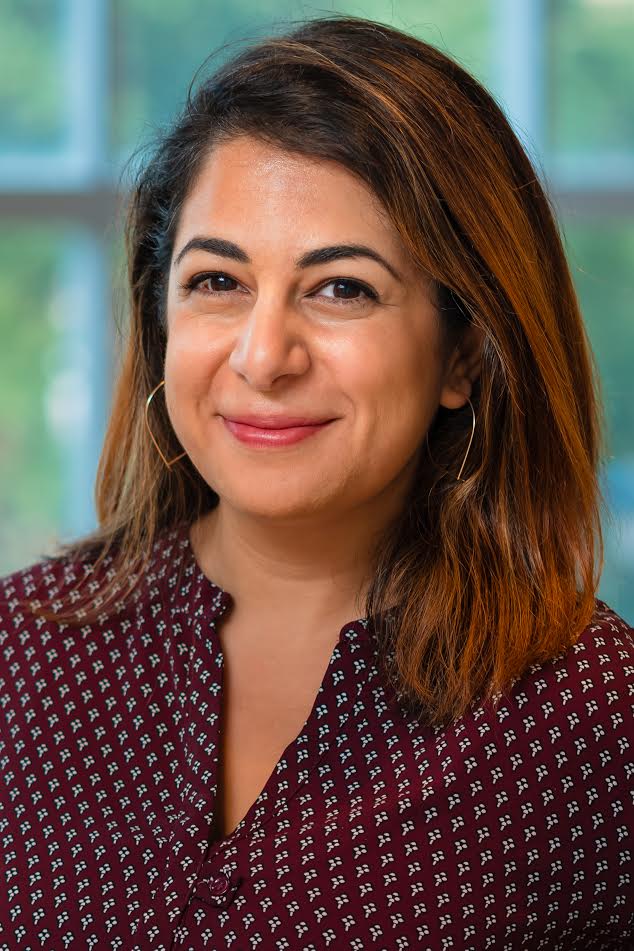
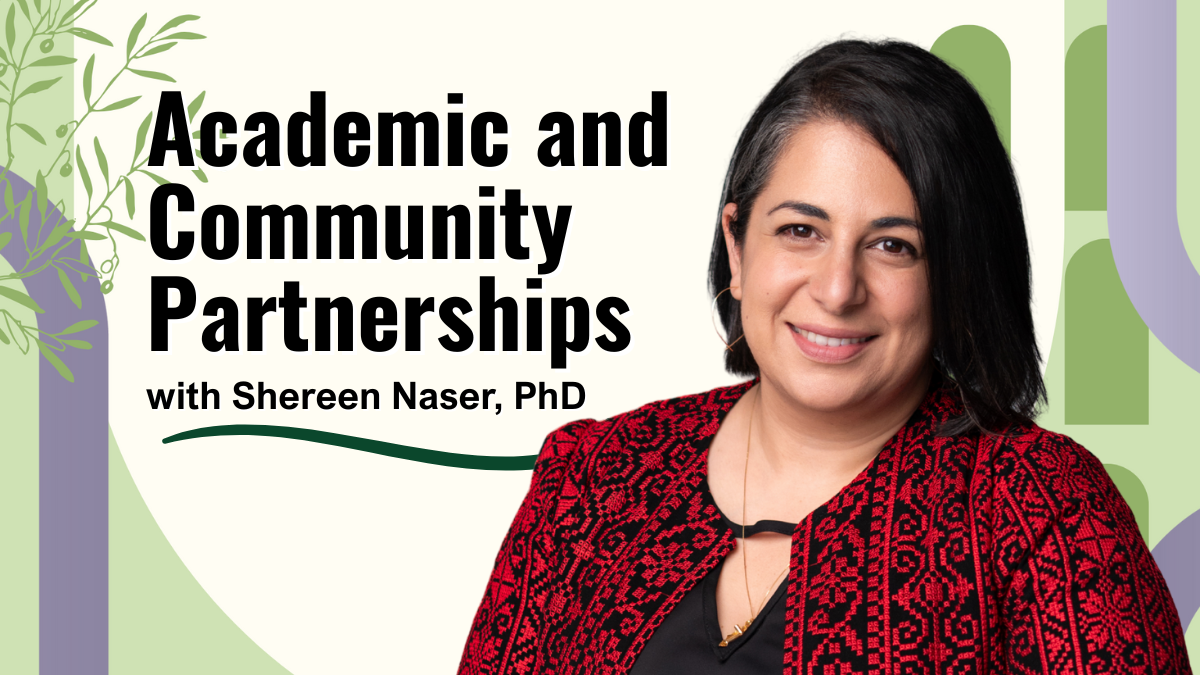
Are you a faculty, scientist, or grad student who wants to connect with the communities your research supports? Dr. Shereen Naser joins me to talk about academic and community partnerships.
Have you ever thought about partnering with an organization or group in your community? I’m excited to share this episode of The Social Academic podcast with you.
Quotes
In Community
“The point of entry is the community and the university becomes a resource and a question that starts on the ground in our communities.”
Being Authentically You
“The less I started trying to separate who I’m as a person from who I am as an academic, the more authentic I could show up… and where people could trust me.”
Power of Community Safety
“The more open you are and clear about who you are and why you’re here, the more others that are like-minded can find you… building the bravery and ability to stand up to that fear and real threat.”
Interview
Jennifer van Alstyne: Academic and community partnerships. This is something that I don’t think that I really recognized as a tool, but also a value that people can have when it comes to their research. I’m from a English literature background. I’m a creative writer, and now I do this business full time. And so I help faculty who want to make community partnerships have a stronger online presence. I’m really excited to have an expert today to talk about these kinds of partnerships. Dr. Shereen Naser. Shereen, would you please introduce yourself?
Shereen Naser: Yeah. Hi, it’s great to be with you here today. Dr. Shereen Naser. I’m an Associate Professor of Psychology at Cleveland State University. I’m specifically trained in school psychology and was a practicing school psychologist before coming into work at Cleveland State as an academic. I’m a mom. I have two beautiful young girls, a little urban farmer. I’ve got some chickens and I like to plant things and vegetables in my tiny little yard here in Cleveland, Ohio, and I’m a community engaged researcher.
Jennifer: What does that mean? What does it mean to be engaged with the community as a researcher?
Shereen: Yeah. I think for me, and we’ve done some writing about this, me and my colleagues, thinking about the point of entry. When we think about research, oftentimes we think of the university as the point of entry. You write a grant, you have a recruitment process that starts at the building of the university. But for us, for me specifically, that’s not the point of entry. The point of entry is the community and the university becomes a resource and a question that starts on the ground in our communities. And from that framework, it becomes a lot easier to be authentic in the work, to answer questions that have actual impactful, meaningful outcomes for the communities with which you are engaging and working alongside.
Jennifer: Would you be open to sharing an example of a community partnership that you’ve created for your research?
Shereen: Yeah, absolutely. And this one I can give a lot of really institutional kind of examples, centers and organizations that we’ve worked with, but I think there’s a lot of writing and literature about that. I think something that might be a little more unknown to some of our listeners or other academics is what does it mean to be a member of a community and use research as a tool to answer questions that naturally and organically kind of come up in that space. I’m Palestinian American and a member of the Palestinian American Cleveland community, Northeast Ohio community. And I do research asking about ways schools can be supportive to marginalizing, minoritized youth, but also ways that they cause harm. And we know very little about this for Arab American youth broadly and specifically for Palestinian American youth. But these questions are important, considering also things like increasing anti-Palestinian racism and anti-Arab racism in our school buildings.
But when you go to a community that’s experienced marginalization and say, “Hey, I would love to research your children,” the initial response is always, “No thank you.” And that comes from decades of experience of being marginalized and harmed. And the university is one of the places that harm can come from and school buildings as well. As a new researcher, I was like, “I’m going to do this research. I’m going to interview Arab youth. I’m going to ask ’em about their experiences in school. It’s going to be great.” And doors kept getting shut in my face. But if I think about the point of entry not as the university building, but as the community, I spent time in this community. I have children that live in this community. We take Arabic classes together. I attend events. I show up in solidarity and support even in the hardest moments from this community.
And even if it is at sometimes risk of my professional safety or my personal safety, I show up with these communities over and over again. More recently, I wanted to do, kind of revive this work that I was doing, and I sent out this research request and all of a sudden no closed doors. I’ve had an overwhelming response of high schoolers wanting to come and do these interviews, wanting to be a part of it over time, ones who have come and wanted to be a part of my research lab. There’s this one funny story where someone shared the research link for information about participation in a old uncle WhatsApp group, and they were like, “What is this? We don’t do research.” And then someone else just went, “Oh, it’s Shereen. She’s the best. This is great. Yeah, absolutely.” And it’s actually, that relationship for me is incredibly important because it’s not Dr. Naser who does research over at Cleveland State. It’s Shereen who we know has disseminated this information here for us to use, it’s Shereen who stood next to us even in the hard moments and stood up for our safety and our collective needs. It’s Shereen who’s constantly giving all of herself professionally and personally to make sure that we’re doing okay. And that to me is powerful. And what I mean by community engaged.
Subscribe to The Social Academic blog.
The form above subscribes you to new posts published on The Social Academic blog.
Want emails from Jennifer on building your online presence? Subscribe to her email list.
Looking for the podcast? Subscribe on Spotify.
Prefer to watch videos? Subscribe on YouTube.
Jennifer: I think that there are so many communities that really have no idea that this kind of research that doesn’t, that considers harm at the start, and that considers how the engagement of the community can participate in ways that respect is there. I really feel, this is not something that I knew about when I was in grad school. It’s not something that I learned about until many years later. And so I’m really curious, at what moment did you decide, “Oh, this is a new path that I can go down for my research?” Because there’s so many people who are probably listening to this that are like, “I kind of want that for myself too.”
Shereen: Yeah, for sure. It’s been a really tough road. I think as academics, particularly in psychology, I can’t speak to many other fields but in psychology, we’re kind of fed a colonial myth of objectivity. I think about psych science and I think about the Skinner box and all these experiments done in a research lab. People come to the lab, it’s very sterile and recorded and there is a place for that kind of research. But what we’re finding in many marginalized communities is that research doesn’t really answer a lot of the questions that we need answered. And for a long time, I was afraid to do this kind of work because I didn’t think it would get me anywhere in that traditional academic building.
But the less I started trying to separate who I’m as a person from who I am as an academic, the more authentic I could show up in the spaces I lived and the places I worked and where people could trust me because I knew they were getting the same person, whether it was the teacher in the classroom, the researcher in the lab, or the mom who was taking her kids to Arabic classes on Sundays. And I was not trained like that. But what I find is that my research, I can better answer these questions more effectively in a way that’s more generalizable, in a way that’s more authentic and truthful with, when I’m able to open up my authentic self as a researcher.
Jennifer: What do you want communities to know about who you are and how you approach research?
Shereen: My lived experience is one in which I can see schools as both a place that harms kids and families, but also a place that can save kids and families. Even for me going to school was, I love school. I went to school as long as I possibly could. I’m still here. And also, I had a lot of really terrible f**king experiences in the school building. And when I came into academia, I thought that lived experience wasn’t going to be useful, but actually ended up being the most useful thing that I could possibly do. And has helped my research take off both in my lab with students here at the university who want to do this kind of research and with the actual work that I’m doing that can answer questions from my community. But while I talk a lot about this research with Arab American youth, that vantage point, the ability to see the school system as dynamic and being able to hold it in all its complexity has informed my work with queer youth where we created a sex ed curriculum informed by queer youth that prioritize decision-making and queer-affirming strategies, as well as with thinking about mental health screening and behavioral response in the school building and how it impacts kids across racial and different racial ethnic groups and different identity groups.
My vantage point hasn’t just informed or allowed me to be engaged as an era, but also as an American living in a diverse society. And I think that is powerful and it’s allowed me not only to bring more value to my work, but more value to the people I’m working alongside.
Jennifer: For people who are like, “Okay, I’m already at a place where I think I can start putting and implementing new partnerships.” I’m thinking of one faculty client who actually moved to a new place and her goal was to create new partnerships because she’d moved from one city to another. What is the start of that process look like? How can people first reach out?
Shereen: I think part of it is showing up where the work is already being done. I think that there’s a lot of, in academia, you kind of have to be a little egotistical to do this work, to deal with all the rejections we get and to put yourself out there so bravely to speak in front of a classroom, in front of people, write, and put it out into the world. I think there’s a lot of ego that goes into our work kind of naturally, so being able to step past that ego and be like, “I actually don’t have all the answers, but that’s okay. I’m excited by the process of finding them.” For example, I came and I was like, “Oh, I’ve got a PhD in psychology and Arabs suck at mental health, and I’m going to come in here. I’m going to bring mental health to the Northeast Ohio Arab community.” That couldn’t have been further from the truth.
I started going to talks that were being done and asking people like, “What do you know about mental health? Who do you know is doing the work?” I started a WhatsApp chat with everyone I ended up networking with who was doing mental health work in the Northeast Ohio Arab community. So just going and seeing where is the work being done and not how can I do it alone, but how can I collaborate in those spaces and what resources can I bring? And again, if the point of entry is community, I’m not just thinking about my publications, I’m thinking about actually, can I use my access to library resources to answer a question that people are struggling with by using my research skills and digging into it? That’s just one example. Or can I bring my students into this space to provide some hands while they’re also getting really good research experience?
Just thinking from that lens. Of course, especially for pre-tenure faculty, thinking about your publications matters, certainly, because we need folks with ideologies to stay in academia and help break through some of these walls and barriers between academia and community. I’m not saying abandon publication, but you might get creative about the kind of publications you’re doing. For example, I write sometimes with my students, my high school students that I’m doing participatory action research with. I collaborate with colleagues who are in a similar place in their career, and also have similar values. And those kind of collaborations have not only broken my own isolation, but allowed me greater access to community.
Jennifer: It all ties into each other. It feels very holistic. It’s something that I feel like the traditional view of a researcher is someone on the outside looking in, and this feels like such a part of it.
Subscribe to The Social Academic blog.
The form above subscribes you to new posts published on The Social Academic blog.
Want emails from Jennifer on building your online presence? Subscribe to her email list.
Looking for the podcast? Subscribe on Spotify.
Prefer to watch videos? Subscribe on YouTube.
Jennifer: And I guess that’s maybe my next question. One thing before I get to that is, what is community participatory research? Or youth participatory research?
Shereen: Yes, yes. Youth participatory action research is a methodology by which you’re kind of training youth to do the research themselves and coming up with the answers, which is exactly in line with my values. However, the implementation can sometimes get really watered down where it ends up just being a class or a workshop that students take and then they finish it and look, they made this finished product. We actually worked with the LGBT Center of Greater Cleveland to do what our students called Youth Research for Social Change, which was a year and six month process where we did teach them research. We met weekly, we learned about research, but we also brought queer researchers from the community in. We answered really place-based questions, and then we actually integrated local decision makers into the dissemination. For example, people from the mayor’s office or from local nonprofits or school buildings to come and meet with our students to learn about the information and built authentic relationships with our kids. Our attempt there was to use the participatory action research methodology, which is research alongside of and teaching research as a methodology too, the people we’re working with, but also to empower the students not only in the process of learning, but in creating knowledge and being valuable knowledge makers and in dissemination of that knowledge.
Jennifer: What’s your hope for those students? They’re not just getting a one time workshop or lesson, they’re with you for a year and months. I’m curious about what’s your hope for them long-term?
Shereen: Well, my hope for them long-term is actually really manifested, and that is to have these long-term relationships, these students. It’s been a bit since we did that. It’s been, I think a year and a half now since we’ve wrapped up the program. And some of them have become college students here with us. Many have kept in touch, they’ve shown up to events and things that we’re doing. When we were doing that project, a lot of queer youth are really pushed out of schools academically because of discrimination. And I didn’t realize until halfway through our action research project with them that many of them were struggling academically in school. And one student during the course of time actually got pushed out of her school and had to move schools. And one of the reasons I didn’t realize that was because they were so brilliant in the space that we were in and being able to articulate themselves, critique broader structures, provide solutions, and think through answering research questions in their communities. For us, my hope for them was they could take those skills way past the time that we were spending with them. And in fact, they have, and many of them are just doing such incredible things right now.
Jennifer: You’re an educator, a trainer, someone who really cares deeply about the next generation of researchers. I am so glad that I asked you about this. I’m curious from the organization’s perspective, from maybe the center that you worked with, what is something that if they’re wanting, maybe they don’t know any researchers like you already, if they’re wanting to have more academic partnerships because they want high quality research that engages their community, how could they maybe reach out to academics to potentially work together?
Shereen: Yeah, that’s a good idea. Creating partnerships between academics and community organizations can be really difficult because it’s time consuming and with all the demands on our local organizations and on our academics, increasingly so over time now, finding that time to build an authentic relationship can be really difficult. I would say being able to find someone who’s value aligned, maybe by looking at their website, looking at the materials they publish, and kind of seeing their reputation in the community too. Where do they show up? Are they in similar spaces and saying like, “Hey, we have a program we’d like to evaluate, or we have this idea that we’re curious about.” And kind of coming from that place of relationship building first on both ends from the academic and the institution, and playing around with how to have then a collaborative project that meets the needs of both.
Jennifer: Is there anything else that faculty should consider when reaching out in terms of what does that email look like? Or do you really recommend go to an event, go to something in person first?
Shereen: I really recommend going to something in person first.
Jennifer: I really appreciate that.
Shereen: Yeah, I can’t emphasize that enough. Now there’s going to be some researchers who can run their entire career off of surveying college students, but even then go to student meetings, go to club meetings. I’ve built so many beautiful relationships with undergrads who I do not teach because I go to their club meetings, I learn what they’re doing, and then if I do have a research project, they want in. Even then, if your whole career can be done through research just on your university campus, how are you building community even geographically in the university? But I think a lot of us, especially post-COVID, it is so much easier to sit in your office and type-ity type on your computer and not be the thing you do. But really there’s no substitute for a relationship that’s built from just knowing each other.
Jennifer: I recently was chatting with a museum that was wanting to make more community partnerships, and they were very surprised when I actually shared a little bit about how you work with the community. I said, one of the things that Shereen is really looking for is a partnership that goes both ways. You want to support each other. And they were like, “Well, we just want to help, we just want to help academics know about our museum.” And I think that’s something that maybe organizations out there are not realizing. You can help each other, and so I guess, I’m curious, what makes a really good community partner for you?
Shereen: Someone who communicates clearly. It’s really difficult when people come in, just try to be nice to each other. Not saying be mean to each other, but when you have clear communication around the needs and capacity. An organization that’s like, we love this idea and also we suck at responding to emails right now cause we get 400 a day from people who need food. We have to prioritize those. That kind of clear communication is so easy for me because you know what then I can do? Let me help distribute that food for you. How can I figure that out for you? I’ve got some students who are really interested in food sovereignty work, I’ll connect them. And all of a sudden I’m making more time for you, which makes more time for me in our project. That clear, authentic communication, really can’t emphasize it enough.
Jennifer: Gosh, I’m so happy I asked that question. That was a lovely story. I am curious, I did not prompt you with this in advance, but is there a teaching related story for this where maybe you have an undergrad student or a grad student who’s first engaging with the community and what that’s like for them? What’s that experience like?
Shereen: Yeah, actually with the Youth Research for Social Change group that we did, we actually had a grant for that and brought undergraduates in to help us note take and memo throughout the process. And it’s changed the trajectory of their careers to be in that space. And it was also awesome cause now we had this intergenerational space where we have high schoolers, graduate, undergraduate students. We have the old fogeys like me, and then people from the center. And having this intergenerational intraexperience space is really powerful. And I would say for our undergraduates, you can learn something in the classroom, but until you have to do it, it doesn’t sink in that way. And I think being able to take our students off the campus and into the real world in so many ways, it creates the connections they need for better job opportunities moving forward, the experiences they need to have a better interview and speak more eloquently and clearly about what they want from jobs and what they want to do in the future, and just exposes them to something outside the classroom that can really make concrete what they’re learning in the classroom.
Subscribe to The Social Academic blog.
The form above subscribes you to new posts published on The Social Academic blog.
Want emails from Jennifer on building your online presence? Subscribe to her email list.
Looking for the podcast? Subscribe on Spotify.
Prefer to watch videos? Subscribe on YouTube.
Jennifer: It’s not only good for the community, for the research, it’s good for the students who can engage in the projects at every stage. I love that there’s so many generations that were involved with that grant and the youth research. Fascinating. Okay. I want to ask about your website now because of something you said earlier, which was that you were really choosing to show up. You wanted to bring all the parts of your authentic self together and didn’t want to feel like you were separating things for certain groups or certain buildings specifically. And so I mean, I think I’ve heard from dozens of faculty, “I need to keep my personal life and my professional life separate. I need to separate these identities.” What helped you decide to bring them together?
Shereen: Yeah, because no matter how much I wanted or thought it was the right thing to do to keep them separate, as an Arab-American, and particularly as a Palestinian American, I’m always under a microscope. Hyper surveillance is part of our community experience as Arab-Americans, as Palestinian Americans. For me, it became a thing of I can continue to retreat into myself and into silence or instead of letting other people tell my stories, I would tell it clearly, openly without any questions. For me, creating my website was part of that. Instead of letting other people tell my story, “Oh, she’s this, she’s that.” I’m just going to put it all out there. Here, it’s yours. I think my website has poetry on it. It has pictures of me out in the community with my community partners. It’s got all my publications. There’s nothing hiding. It’s all right there.
Jennifer: Yeah.
Shereen: I think that to me is a form of not only my authenticity, but also safety. Instead of letting other people say what I’m about, I’ll just tell you.
Jennifer: When you first started the website, did you imagine that all of these things would fit on there?
Shereen: I sure did not, and I think I’d always, it was really difficult for me to decide what my story is because it can feel so disparate. Because in academia, especially in the doctorate level, you have to have an expertise, and that expertise has to be so niche. And so finding what that niche was for me was a bit difficult. Then I realized that I am the niche. Me, my story, it’s the niche, and I could bring it all together. It was clear in my head, so then I just had to be a good communicator and make it clear for other people.
Jennifer: I love that. Do you have advice for anyone else who is maybe feeling like they’re under hyper surveillance and they’re wondering, should I go into the shadows or should I bring all of my identities together and be myself? Do you have any advice or tips for them?
Shereen: Yeah. I’d say two things. One, if you’re struggling with that, sit with some curiosity. Where does that struggle come from? How much of it is fear based? Because the reality is for people under hyper surveillance like myself, there is real fear there, but sometimes that fear can get blown up. And then find your network cause there is safety when you have community. The more open you are and clear about who you are and why you’re here, the more others that are like-minded can find you. And you’re able to create that community, which one, builds the bravery and ability to stand up to that fear and real threat. And two, it just for me brings so much more peace into my work. It’s easier to write. Very few writing roadblocks now because I’ve pushed through some of those barriers, and then I have just now, I’ve just got the best collaborators, the best collaborators, and I found them because of being able to speak clearly about who I am.
Jennifer: Is this the research group that you’re talking about or just in general?
Shereen: Yeah, just in general. Community collaborators, students, the research groups that I’m in, I’m part of the Thrive Research Collaborative here at Cleveland State. My colleagues are phenomenal. We have very similar value-driven work we do together. I’ve got other school psychologists across the country that I’m really, I’m working with and I love to shout them out, Dr. Amanda Sullivan, Dr. Lisa Aguilar, Dr. , people that I just have deeply admired for so long and now I get to create with. Incredible! And so many others, really. I can name folks for a very long time, but the only reason I was able to connect to this community is because I showed up as myself, which also meant that some bridges got burnt. Some bridges I thought were going to be my professional ladder. I had to let them go and kind of grieve that as I was building something more authentic and real.
Jennifer: When you think about that grief, do you still feel like you made the right decisions in terms of your trajectory?
Shereen: Yeah, in the moment very difficult, but now in hindsight, I’m like, “Oh wow. I can’t believe I waited that long to make that change.” Yeah.
Jennifer: Oh, that’s really insightful. Thank you so much, Shereen. I feel like this conversation has been so warm. I’ve learned so much, even though I’ve already talked with you about these things quite a bit. I feel like the stories that you shared, they’re going to be so valuable for the people who are listening. And I think that we can reduce harm in many research fields and being intentional, being thoughtful, taking meaningful time at the start to consider who we’re working with. It sounds like that can make a really big difference for folks.
Shereen: Yes, for sure. 100%. Thanks so much for having me. It’s a pleasure to have this conversation with you.
Jennifer: Yeah. Is there anything you’d like to add before we wrap up?
Shereen: Not at all, but folks should feel free to reach out if they have questions. If I can provide any brainstorming for them, I’m happy to do so.
Jennifer: Amazing!
Subscribe to The Social Academic blog.
The form above subscribes you to new posts published on The Social Academic blog.
Want emails from Jennifer on building your online presence? Subscribe to her email list.
Looking for the podcast? Subscribe on Spotify.
Prefer to watch videos? Subscribe on YouTube.
Bio
Shereen Naser, PhD creates transformative frameworks and programs for schools that challenge dominant narratives in Psychology and prioritize human dignity and collective healing toward systemic change. She’s an Associate Professor of Psychology at Cleveland State University.
Her research focuses on how marginalized students, especially queer and Arab youth, experience school settings. Using resource mapping and participatory program development and implementation models, Dr. Naser facilitates initiatives and interventions that support the social, emotional, behavioral and academic needs of marginalized youth at the individual and whole school level.
Shereen is part of the THRiVE Research Collaborative and director of the Cleveland Child and Adolescent Research in Education (CARE) Lab.
P.S. Jennifer designed Shereen’s website!