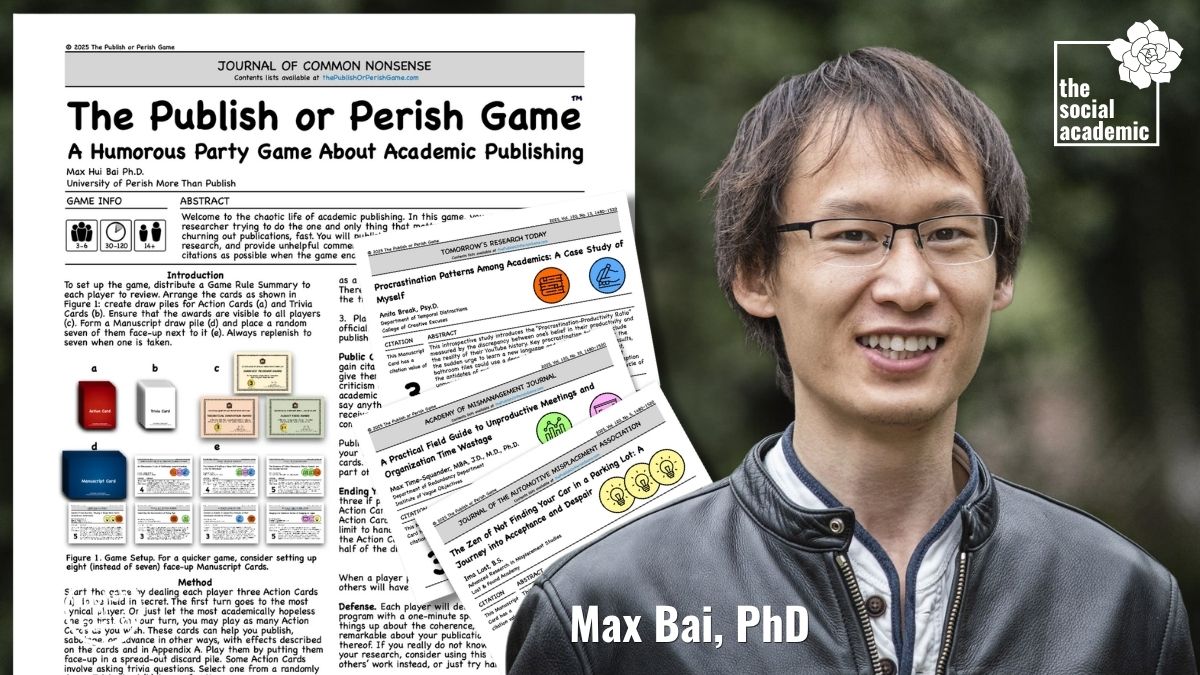
Max Hui Bai, PhD creator of The Publish or Perish Game joins Jennifer van Alstyne on The Social Academic Podcast to talk about satire, academic publishing, and entrepreneurship for researchers.
The idea for The Publish or Perish Game was sparked at Stanford. Max Hui Bai, PhD shares about his journey creating the game. And, how “launching” on Kickstarter is more like hitting the submit button when publishing an academic article. There’s a lot that goes into it first. When Max reached out to introduce the game to me, I shared, “my professor client played with her research group. She loved it.” And of course, I asked if he’d come on the show to talk about it.
The Publish or Perish Game is a great gift for academics. When the new gift guide for academics goes live in November, this will for sure be on the list.
Hi, I’m Jennifer van Alstyne, host of The Social Academic Podcast. Follow for interviews about online presence for faculty, researchers, and grad students.
This episode is up on YouTube, Spotify, and Instagram. Thank you!
Disclaimer: This game was purchased full price by Jennifer van Alstyne. No gift, money, or partnership exists for the game, or for any recommendation on The Social Academic. Thank you!
Subscribe to The Social Academic blog.
The form above subscribes you to new posts published on The Social Academic blog.
Want emails from Jennifer on building your online presence? Subscribe to her email list.
Looking for the podcast? Subscribe on Spotify.
Prefer to watch videos? Subscribe on YouTube.
Quotes from Max
A game for academics
“This game is by its core designed for academics. Anyone who has experienced the academic pain, the revenge from reviewer two, which is literally the title of a expansion, the bureaucracy that we have all been too painfully familiar with.”
On Kickstarter
“Launching Kickstarter, then that part is the easy part. It’s like clicking submit button for your research paper. That’s not the hardest part.”
Entrepreneurship
“It’s like people think many academics think entrepreneurship is such a different animal. It’s not a moment when I’m doing it. I was like, ‘Wow, this feels so similar.’”
In the episode
Creating the Publish or Perish Board Game
Jennifer van Alstyne: Hi everyone. I am Jennifer van Alstyne. Welcome to The Social Academic Podcast. I am so excited to be back with the second half of the 2026 season. This is a special episode because we are actually talking about games. Hi, I am here with Dr. Max Bai. Did I pronounce that right?
Max Hui Bai, PhD: Yeah, that’s correct. Yeah.
Jennifer: Wonderful. Would you be open to introducing yourself? I’d love to let everyone know about you and about this game.
Max: Yeah. Before designing this game, I was fully in academia as a social psychologist. My research was mostly on how people think about some of the most controversial issues in society: politics, racial tensions, AI, all these things. And one of the last things I did while I was still fully immersed in the academic environment was a startup program. It was at Stanford University. The entrepreneurship spirit is pretty heavy in there. I was thinking, “Oh, this is a quite interesting alternative career trajectory,” so I wanted to explore. And in one of those game nights with the fellow program attendees, many of which are also academics, PhD holding researchers doing similar research about social psychological research. One of the things that came up was like, “Oh,” I was thinking for all this time, “we’re just pretending we’re doing all these cool jobs. We’re pirates, we’re doctors doing procedures, we’re bird watchers.” It’s like, there’s not a game, a board game or anything that we can remember, we can immediately think about that’s about the life of scientists and researchers. There’s tons of things we can talk about, we can be having fun about. I just threw all the ideas like, “Okay, what about a game, about publishing academic research, except everything’s useless nonsense?” And people just pile up. They were like, “Okay, let’s put RB [Review Board] review in there. Let’s put the reviewer two needs to be in there. The plagiarism undergrad not doing what they’re supposed to do,” all these things. I was like, “Wow, this is the level of engagement that I did not anticipate at all when I was bringing up the idea.” At that time I was actually working on a tech startup, and that one was just, the level of engagement was nowhere near as high as this one. I was thinking, “Okay, there’s something interesting going on here.” I just put together a prototype and have people tried it. Then just the rest of it is the history. Today, I have this board game.
Jennifer: How long has it been out? When did you release The Publish or Perish Game?
Max: It was about two years-ish, I would say. Yeah, 2026. Yeah. 2023 was when I was starting to work on this 2024, the Kickstarter launch. Now you can buy almost anywhere.
Using Kickstarter, board game R&D
Jennifer: I didn’t prompt you with this question, but I’m kind of curious about what Kickstarter was like. I know that Kickstarter and other crowdfunding platforms are something scientists have used for their research, but you’re using it for a game in this purpose. What was it like to create the Kickstarter to help sell this game?
Max: Yeah, so that’s interesting to say. Some scientists are actually doing Kickstarter for a scientific project, which I think is really a cool idea to solve a problem of gauging the interest and the impact for committing a lot of things, which I think, I don’t know, maybe grant agencies should also consider doing this for research funding. I don’t know how it would be translated in that way, but at least for a high inventory product like a board game, this is really useful. Essentially in this stage when I was still putting together a prototype, I have been just asking people to try it and if they want to write anything about it online, I would really appreciate it. And people started to do it. And there was one thread that I think has hundreds of thousands of views when it was out. I think it was helpful that the premise of the idea is just ridiculous enough that it rings a bell with the audience. And also I just pour a lot of my time into the R&D [Research and Development] to make sure that the game is fun to play and to make sure that it’s not just like it’s out there, people talk about it and it’s gone. It is something that actually has substance in it that will engage with people. I would say having careful thought about that during the R&D was really important. Then before Kickstarter, people tend to have this romanticized view about how Kickstarter works. Many people think it’s like, “Okay, let’s just put together a really nice page, release it and people will come.” That’s actually the easiest part, to release things on the Kickstarter. The real work happened before it. It’s not just the R&D, but also putting together a pre-launch campaign. A lot of advertisement, marketing promotion going on there to tell people that, “Hey, this is something that’s going to launch soon.” And before that, there’s seven days before people going to get an email, three days before they get a reminder one day before they get another thing. And usually before launch, you actually know about how many people will order the game on Kickstarter. The model is now that accurate for all these things. It’s like you just know based on the traffic, based on the different-
Jennifer: Wow!
Max: Engagement people do. Launching Kickstarter, then that part is the easy part.
Jennifer: Oh, that’s so interesting. And helpful for people who are listening, who are thinking like, “Oh, maybe I should do a Kickstarter.” It sounds like there’s a lot that goes into it before the actual launch and that the launch is maybe one of the easier of the tasks.
Max: Yeah. It’s like clicking submit button for your research paper. That’s not the hardest part. It’s checking off all these things.
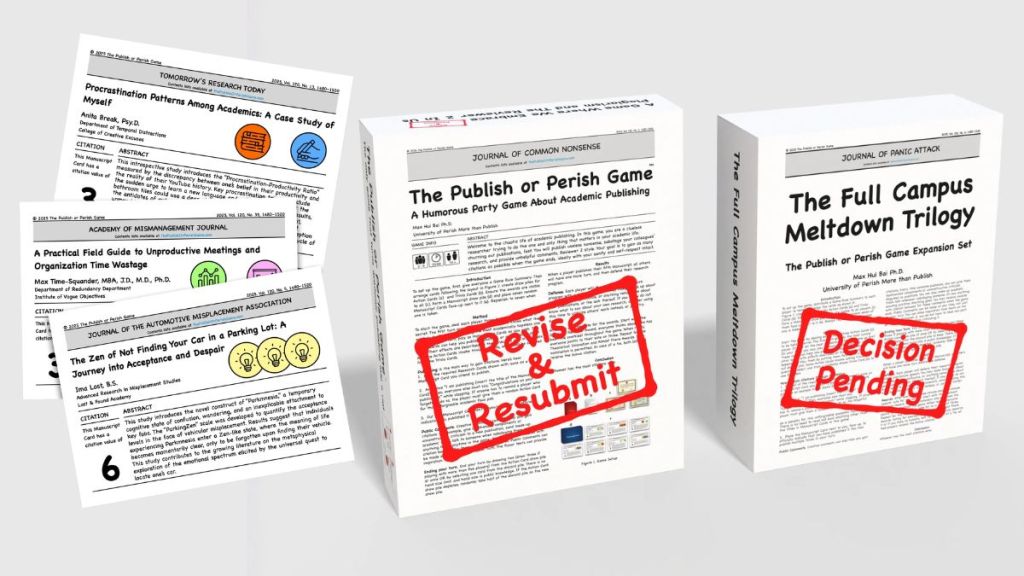
Jennifer: I really like the inside cover of your game because you’ve actually listed a lot of the academics who have contributed to the R&D or commented on what the quality is like, how it’s actually like to play the game. Tell me a little bit about the process of getting people involved.
Max: Yeah. It was helpful that when I was doing the R&D, the game kind of went viral a little bit. It has a lot of organic content going on. People write about it on social media. And of course I was also doing active paid marketing. On the website, I just left a sentence. It’s like, “If you want to try the game, help us play test it, send us an email.” So I got a lot of those. Most of the people you see on the box, they essentially found me that way. Of course, there are my friends, colleagues from different departments and area that I’m like, “Hey, I have this art history question about Chinese painting. I really need a reviewer for this. Can you please just help me with this?” And she was like, “Yeah, I’ll do it.” Okay. There’s the general play test of the game, trying to make sure the game works, make it feel like academics will enjoy playing it, but then there’s another specific component, the trivia questions. I think there’s 200 trivia question in the base game and 320 in the expansion. There’s a lot of trivia questions. And one thing I wanted to make sure I do differently about this game from any other trivia games on the market, (and this game is not just trivia) but just the trivia question, I want it to be different in the way that it is interesting, particularly interesting for academics. If we look at the trivia question on the market, half of the things I’m just not interested and I would imagine many other academics are not interested. Things about which sports team did this thing or which actor appeared in both of these two movies. I just don’t feel ever engaged at all. For the scientific and academic kind of trivia questions, I just don’t see the qualities on the market that great. They’re either just too esoteric or just not. Or if they’re esoteric, but they’re not putting an interesting angle on it, they’re kind of boring. It’s like I don’t care to know about that, so I want to address all these things in my game. And so a big part of it is I involve a lot of people just asking them to help me with the development of the trivia question, help me peer review it. I asked them what are some interesting finding in this area? One of the question actually says that. Let me think, what was it? It was some question about a insect. Oh no, no, no. Okay. It was a question about manatees. The question itself was which one of the methods manatees might use to control their buoyancy: by eating, temporarily holding rock in their mouth, by compressing a body to adjust their volume of the body and by farting. Which one of those is true? And I thought that’s one of those really interesting questions and it’s actually by farting. That’s how they do it. I know, right? It’s a zoology question. And one researcher actually commented on there. There’s actually some observation[al] evidence that constipation among manatees has been observed to be associated with difficulty in controlling buoyancy as well. It’s just those kind of really interesting, I would say frontier knowledge that doesn’t even go into [a] research paper, just some researchers find observation[s] that go into it. I just find those things really inspiring and interesting that this trivia set actually contain those things. Yeah.
Marketing game presence vs. personal online presence
Jennifer: That’s so cool. One of the things that you mentioned was that there was marketing, that there was really intention and outreach in sharing the game along with the virality and how people found it organically. I think a lot of people maybe are similar in that they have something that they care about, that they want to put intention into their online presence, maybe even more than their own personal online presence as a researcher or scientist. And that was one of the things that you said was true for you. Can you tell me a little bit more about that, the game’s online presence versus your own?
Max: Yeah. It’s kind of interesting that there’s more people. It used to be to the case, all I am is a social psychologist and people who know me, if they know me outside of my immediate life, they know me by my work. They saw my last name on citations, that’s the only way. But nowadays the game itself has built a bigger audience. There’s more people know about the game than people know about me. If we randomly select any person in the world, ask them what’s the probability they know about me versus the game. Game is more and why they know me is because of the game. Yeah, definitely there’s a more just diminish the presence in my own compared to the product, which I think is totally fine. I mean, I don’t know. I think internally I’m still very much an academic person. I don’t really like anything about too much self-promotion or anything, but when I’m selling a board game, promoting the product or a game, it’s just what marketing is. Otherwise people wouldn’t know about it. But yeah, I think just in private life, I would say I’m pretty low key private person. If you look at my academic Twitter account, I mean, I only have one Twitter account. And [my] Twitter and Bluesky account, the only thing that’s on there ever is when I’m announcing a research paper publication or releasing the game. There’s not much else going on. Yeah, there’s a little of those disjuncture in how I feel when I transition from being an academic to being an entrepreneur. One hand it’s all about being humble, being open to criticism, all of these characteristics are actually really useful in entrepreneurship as well. But then here, when you are promoting a product, being too humble doesn’t work. It has to be like, “Okay, this is the product, this is why it is good.” I mean of course, we should still stick to the truth about the promotion, but it’s like you have to say those things. I feel a little bit uncomfortable in the beginning, but it’s, “Oh yeah, otherwise, how would people know about this thing?
Jennifer: Exactly. Exactly. It sounds like you’ve put more intention into sharing the game because marketing feels like a necessity, because it’s a product, because you want people to know about it. And that seems like way more effort than most people would put into themselves as an academic or researcher.
An alternative to careers in academia: entrepreneurship
Jennifer: Now that you’ve kind of transitioned into more entrepreneur life, I’m curious if that will shift in how you approach your own online presence maybe in the future.
Max: I think one thing that matters a little bit for me is that … okay, a little background. Tied to what I think about academia as a way of a life and a career trajectory for many academics. I think the traditional way of thinking about what happens after getting a PhD or after whatever, or after a postdoc is usually kind of this almost binary consideration. You’re either in the industry, you’re some kind of a scientist or researcher doing some kind of work. You’re working for others. You have this nine to five job and that is, not many people think that is the most desirable thing. And what is desirable? It is staying in academia, getting a professor job, ideally in R1, you write research grant and everything. And this is a kind of binary thing. Maybe you have a tiny portion of people trickle to a nonprofit government sector for which the work life will be pretty similar to the industry role, but then you still retain some level of public impact. Now where I am, I’m marveling at the fact that no one consider[s] doing their own business, becoming an entrepreneur or becoming an artist/creator. I’m all of these things. I’m essentially artist who commercialize my own thing, AKA an artist entrepreneur. I’m surprised not many more people consider it. I’ve been thinking about just being more vocal about this overlooked career path consideration. This is something I also think in this day and age is particularly relevant because in academia, funding are squeezed in so many major funding sources and we also have a lot of AI replacing, going after people’s jobs. Even in the industry, that option is not as viable as in the past either. And also, a third reason is that I do see a future with how much AI impact[s] where the labor market is going, more people are going to have to find way to mobilize their own labor capital through ways of not selling their labor to others. Even when we’re in university, we’re essentially selling our labor, contracting with a university who redirect it to students or we’re selling our labor to grant agencies who essentially buy our product and the one who receive it is someone like the public. But being an entrepreneur is one of those things where I will say that all of these things are kind of controlled within you. There’s still a lot of randomness, a lot [of that] factor in there, but I would say you do have probably a lot more agency in controlling where the direction of things go. Another thing is, I think the academic research, a lot of things could just be that end. My hypothesis is this, there’s only two ways this thing will come out. It’s true. Okay, I got a publication. It’s false. Okay, most likely it won’t go anywhere. Sometimes you may be able to spin it, say the expectation is this, false is this, there’s something going on here, but the outcome is very binary. For a entrepreneur endeavor, you almost have infinite new direction to pivot to because your goal is to get something that work well for your audience. It’s like p-hacking here is almost encouraged. You’re hacking the result out. You’re an engineer trying to find a solution for it. Just for that reason, I think this is something that has more untapped potential and it’s a more vastly underexplored opportunity for many academics. For many things that we do, we’re already doing very similar thing[s], like R&D for a scientific paper versus for a product. It’s the same thing. You are trying different thing[s], you’re trying it again and again until it makes sense, until it work. You’re polishing things. And the same thing for project management. You are executing task from end to end, you’re reassessing risk. It’s like people think, many academics think entrepreneurship is such a different animal. I, it’s a moment when I’m doing it, I was like, “Wow, this feels so similar.” If you are academic, you’re considering entrepreneurship and you’re deterred by this perceived barrier, don’t. Just go ahead and try it. It’s more similar than you expect. But of course there’s a lot of other risk factor we can talk about and there’s trade off. It’s not just everything is rosy here.
Jennifer: Oh my goodness. I love that you shared your perspective on this and it really feels like a conversation that more academics should be having with themselves. I think that there’s so many people who maybe would find joy in entrepreneurship or the lifestyle that they’ve been dreaming of and couldn’t quite find in academia. But also the longer that I’ve been working with academics, I’ve been doing this company full-time for eight years, the more academic entrepreneurs I’ve met. Folks who are still in academia full-time that do startups or that have a consulting company or that create a product or something on the side that’s really meaningful to them and to their lives. I love that creativity is something that you embraced and entrepreneur lifestyle. I’m so excited. Okay.
Max: Oh, I almost forgot about actually bringing it to the point of the question you were asking in the last one because I went down this thing, the academic side of me just went on and on. All of that is to lay the ground[work] to say that one thing I wanted to do is to be more vocal about all these things. That might change a little bit about how I might want to present myself in terms of the online presence. I want to tell people these things, I want to help people build startups. And I actually have been starting to advise different startups and doing some smaller angel investment in some of them. This is something that might slightly change the equation on how low key I might want to be because people need to know I’m helping people here if that’s what I want to do.
Who should buy Publish or Perish? Who is it for?
Jennifer: Wow. I love that. Okay. I want to go back to the game because I want more people to know this game. And just for everyone who’s listening, I’m not a paid affiliate or anything. I purchased this game myself and played it with my family myself. And honestly, I wanted to have Max on my show because one of my professor clients was like, “I played this with my research lab and we had so much fun,” that I was like, “Oh my goodness, I need to meet this guy.” When Max reached out, this was all organic. He reached out by email and he was asking me, can we add the game to the gift guide? Because I do a new gift guide. I’m going to have one in the fall. Everyone who’s listening, remind me if I don’t put it up. There will be a new gift guide this year for academics and I’m very excited to include The Publish or Perish Game on it. So Max, who should buy The Publish or Perish Game? Who is it for? Who should bring this into their lives, bring some happiness?
Max: Yeah. First, thank you so much for supporting the game and buying it. I was totally happy to send you a copy, but I really appreciate that you did that. This game is by its core designed for academics. Anyone who has experienced the academic pain, the revenge from reviewer two, which is literally the title of the expansion, the bureaucracy that we have all been too painfully familiar with. But also it is for people who are the family and friends of academics who want to understand a little bit what’s going on. I have a lot of very interesting positive feedback from people who are buying it for their spouse or for their daughter. Then they play together and their academic family was just going at it. They’re like, “Oh, this is what I’ve been talking about.” And it’s just a way for them to truly understand this aspect of their life. And beyond that, I will also just say that sure, this game is designed for academics, but frankly, anyone who is interested in intellectual or academic humor, I’m positive they will find this thing interesting. There’s so many of those made up research paper in there, they’re just jokes. If it is someone who enjoying things like Big Bang Theory. Okay, you probably will enjoy the similar type of humor in there. And it’s also not that, how do I say this? Sure, on the surface it looks like, “Okay, this is a daunting research paper,” but when I’m testing it with entirely non-science, non-academic group, people still can have a great time enjoying it. Whether it’s college students or, I brought it to a whiskey tasting party a long time ago. I was, someone invited me to it. I don’t drink any alcohol. When I’m going there, I was like, “Okay, this is going to be really interesting because I don’t drink and the vibe will be different from what I expect academic gatherings.” And boy, that was the loudest and most active and energetic session ever. I was like, “Wow. Sure, they don’t fully live in this life, but they can try. They can pretend.” Most of the time when we’re playing a board game, we’re not actually pirates ourselves, but when we’re doing those things, it’s fun to do that, to pretend we’re those characters. I would say the audience, academics, academic adjacent, anyone know them or anyone enjoy academic humor generally.
Jennifer: Well especially, I mean, I love all those ideas, but I especially love what you said about academics playing with their families and helping it maybe open some conversations and get to know each other a little bit more. If you’re an academic and you see it on my gift guide, this is also a gift that you should consider purchasing for yourself to play with your family, even though you’re the academic in the family. Max, this was such a fun conversation. Is there anything that you’d like to add before we wrap up today?
Max: Oh, I will say most of the audience here are academics?
Jennifer: Yeah.
How to get in touch with Max
Max: Yeah. I think really just in this critical time where AI and the society is changing with the impact from AI and everything. If you want to consider the idea of exploring entrepreneurship, just try doing something small and see if this is something you’re interested in. Don’t go all in in the beginning, but this is something that is less scary and daunting as you expect. If you have any question or anything, feel free to send me an email. If you just search for my name, either on Publish or Perish or on Google, my email is right there. I’m happy to share my own experience as well.
Jennifer: It’s been such a pleasure to have you on The Social Academic Podcast. For all of you who are listening, we will be back with more interviews this season. Next up is Dr. Lisa Munro. She’s coming back to talk about public scholarship and actually making videos about your public scholarship. I’m so excited to share more interviews with you soon. Thank you so much, Max.
Max: Thank you very much.
Subscribe to The Social Academic blog.
The form above subscribes you to new posts published on The Social Academic blog.
Want emails from Jennifer on building your online presence? Subscribe to her email list.
Looking for the podcast? Subscribe on Spotify.
Prefer to watch videos? Subscribe on YouTube.
Bio
Max (Hui) Bai, PhD, is a social psychologist, entrepreneur, and speaker working at the intersection of psychology, politics, and technology. He is Director of the Political Belief Lab. His research has been featured in The Washington Post, The New Yorker, Nature, and WIRED, and has informed work at OpenAI and the White House. A former scientist at Stanford’s Polarization and Social Change Lab and Stanford Impact Labs, he holds a Ph.D. in social psychology from the University of Minnesota. He is also the creator of The Publish or Perish Game, a satirical card game about academic life that was funded by nearly 6,000 Kickstarter backers and is now played by scholars around the world. He gave the 2025 ALPSP keynote on designing for an academic audience.